
We Love America. How Convenient.
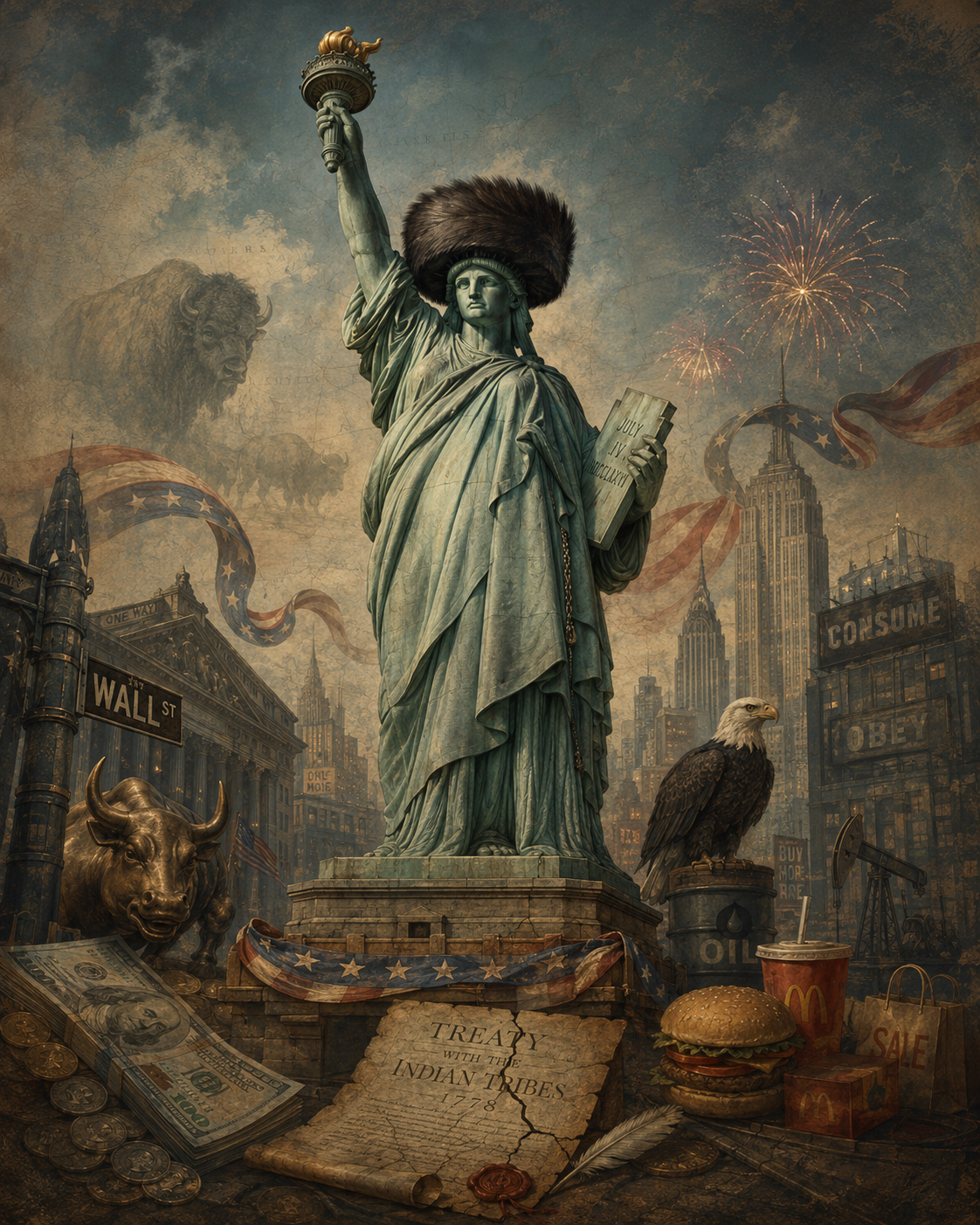
We Love America. How Convenient.
We love America, of course. It is rich, cinematic, generous when it wants to be, brutal when it has to be, and always capable of explaining the brutality afterward in a language polished enough to pass for moral seriousness. At 250, America asks to be admired again: not examined too closely, not interrupted by the inconvenient dead, not slowed down by those who did not survive the anthem, but admired with gratitude, ceremony, flags, and that familiar solemn prose which turns conquest into difficulty, slavery into contradiction, and dispossession into the complicated childhood of freedom.
The ceremony is well rehearsed. First, the land becomes empty. Then brave people arrive. They suffer, build, pray, legislate, fight, expand, correct themselves, welcome immigrants, defeat tyrants, defend democracy, and become indispensable to civilization. Mistakes were made, naturally. They always are, especially by those who inherit the profits. Then comes the happy ending, except for those who did not live happily ever after: Native peoples, enslaved Africans, children taken into assimilation schools, languages forbidden in children’s mouths, peoples whose worlds depended on the buffalo, Vietnamese villagers under napalm, dissenters hunted by political panic, workers consumed by capital, and communities poisoned by extraction. Such figures rarely receive proper invitations to the birthday party. They ruin the acoustics.
The most useful word in this performance is “complexity.” Complexity has excellent manners. It arrives wearing academic clothing and never denies the corpse outright; it merely asks that we consider the broader context in which the corpse became historically understandable. Complexity provides background for the settler, the missionary, the governor, the investor, the general, the judge, the patriot, the theologian, and eventually the university department that will arrange the matter into a balanced panel discussion. The victim, by contrast, receives less context. A child taken from a mother is embarrassingly direct. A broken treaty lacks sophistication. A people removed from its land has the vulgarity of being obvious.
So the vocabulary must improve. Theft becomes conquest; conquest becomes settlement; settlement becomes expansion; expansion becomes destiny; destiny becomes history; history becomes heritage; and heritage becomes a museum, where visitors are gently asked not to touch the glass. Theft, if it survives long enough, begins to sound like inheritance. A man who steals a house is a criminal; a state that steals a continent becomes a subject of constitutional admiration. Give the act enough time, flags, courts, schoolchildren, portraits, and anniversaries, and the original violence acquires the delicate fragrance of inevitability.
The academy then arrives to protect us from excessive clarity. We must not be anachronistic, it says. We must not impose our categories on the past. This is a noble warning when used honestly, but it is often used less as a method than as a disinfectant. No one needed the twenty-first century to know that a child cries when taken from its mother, that hunger weakens a body, that exile destroys a world, that broken oaths are betrayals, or that a language beaten out of a child’s mouth is not education. Earlier centuries possessed sin, oath, mercy, property, conscience, tyranny, justice, the soul, the person, and God. They did not lack moral vocabulary. They rationed it.
That rationing is the real scandal. For one’s own people, a child was a child; for others, the child became material for assimilation. For one’s own people, land was home; for others, land became frontier. For one’s own people, suffering was tragedy; for others, suffering was the cost of civilization. This is not anachronism. It is selective humanity, a fine old tradition still in excellent condition.
We should also be suspicious of the accusation of emotionality. When dispossession is named too plainly, someone will always say that the tone is excessive. The critic is angry, frustrated, moralistic, insufficiently balanced. This is another civilized device: move the problem from the world into the psyche of the person who notices it. Native dispossession is not an emotion. Slavery is not an emotion. Forced assimilation is not an emotion. Napalm is not an emotion. Broken treaties are not emotions. The emotion comes afterward, assuming the observer has not yet been completely educated out of perception. To call that response “frustration” is not analysis. It is containment.
To be fair, America does have virtues, and some of them are great. It gave refuge to many. It built institutions of astonishing durability. It produced constitutional language, civic energy, technical brilliance, artistic force, scientific achievement, and at moments real generosity. It helped defeat Nazism. It has protected allies. It offered immigrants a future unavailable elsewhere. No serious criticism needs the childish simplification that America is only violence. The problem is not that America has no beauty. The problem is that America asks beauty to do too much work.
“America the Beautiful” is a lovely song. It is less lovely when sung over an unmarked grave. Beauty becomes obscene when it functions as a curtain. Freedom becomes theatrical when it forgets the land beneath the stage. Gratitude becomes servility when it requires silence from those who paid first. This is especially dangerous for Jews, but not only for Jews. Jewish gratitude toward America is understandable: many Jews found shelter there, and Israel has depended on American power. But gratitude is not a sacrament. It does not cleanse the object of gratitude. A useful empire does not become righteous because it is useful. Dependency is not friendship. Protection is not innocence. Strategy is not love.
If America is an ally, say ally. If America is necessary, say necessary. If America is powerful, say powerful. But do not say innocent. The temptation is obvious: we prefer benefactors without graves under their foundations, allies without crimes, freedom without excluded populations, Madison without removal, Moses without bodies near the promise, constitutional architecture without the ground on which it stands. That is why every polished anniversary needs one impolite question: who had to disappear for this freedom to have space?
This is not a metaphorical question. It is literal. Who lost land, language, children, animals, rivers, graves, names, and political worlds? Who became scenery so another people could become destiny? The answer is not hidden. It is merely inconvenient. There is no need to make America uniquely demonic; that would be too generous to the rest of humanity. America is not the exception to the human story. It is one of its clearest laboratories: the transformation of survival into expansion, expansion into law, law into innocence, and innocence into celebration.
The animal kills to live. It does not write a constitution over the carcass, rename hunger as providence, or open a foundation for the study of its own nobility. Human beings are more advanced. They can kill, inherit, legalize, aestheticize, archive, commemorate, and then accuse the witness of lacking nuance. So let us keep the nuance: America gave refuge and America dispossessed; America proclaimed liberty and America enslaved; America built constitutional order and America broke treaties; America educated and America assimilated by force; America defended democracy and America burned villages; America welcomed many and America erased many. All of this can be true at once. Complexity should not be an alibi. It should be the discipline that prevents celebration from becoming stupid.
At 250, America does not need another hymn. It has enough. It needs a colder form of love, if love is still the word: a love that refuses cosmetic memory, patriotic anesthesia, and the charming little lie that the dead can be honored later, after the speeches. The dead have already waited long enough. So yes, we love America. How convenient. But if that love cannot name Native dispossession, slavery, forced assimilation, broken treaties, burned villages, poisoned lands, political persecution, and the long manufacture of innocence, then it is not love. It is good manners at a crime scene.
Yochanan Schimmelpfennig