


We must distinguish between civilians and combatants
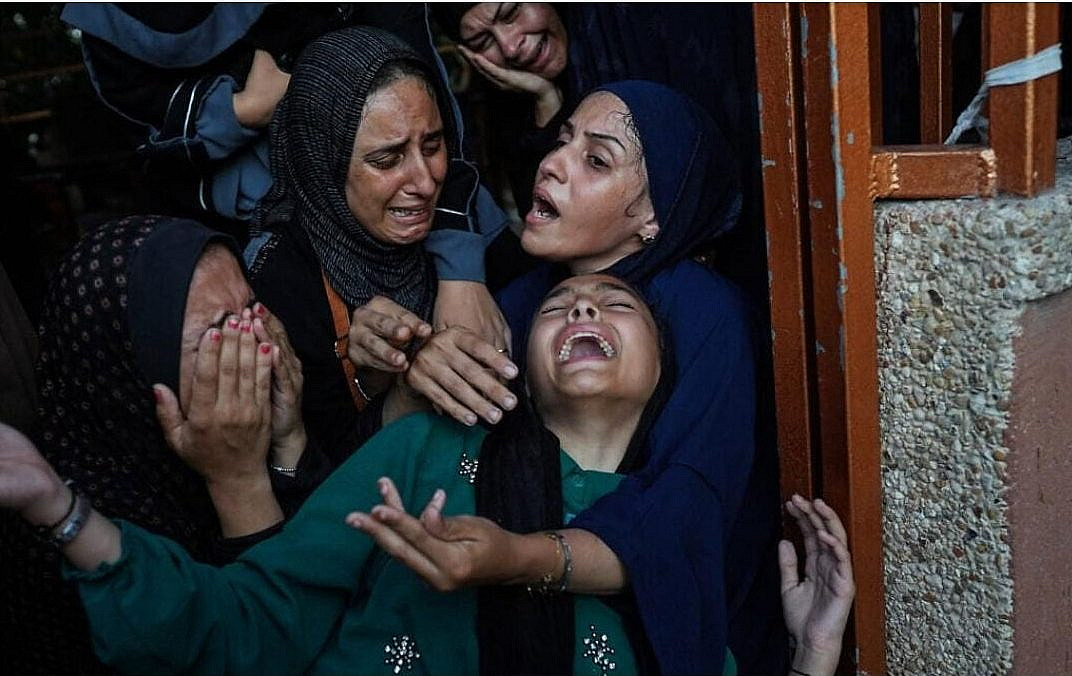
Say this loud and clear: Civilians are not legitimate targets
The ceasefire in the war with Iran provides us with an opportunity to draw lessons both for that conflict and beyond it.
The Israeli public has recently learned a great deal about Iran. Firstly, most of us now realize that the majority of Iranians share our revulsion of the Ayatollah regime. This is a principal factor uniting the secular Persian majority and the large non-Persian minorities – Azeris, Turkmens, Baluchis, Kurds, Ahwaz Arabs, and more.
It is also one of the reasons why Defense Minister Katz was forced to retract his appalling and damaging statement that the residents of Tehran “will soon pay the price” (of the Iranian attacks). A few days after an Israeli strike which focused on military targets, military leaders, and the heads of the Iranian nuclear program, Katz shifted to the outrageous position of declaring war on Iranian civilians, exposing yet again his own distorted moral compass and that of too many members of the current government. Katz is not alone, and indeed, many in Israel struggle to make the strategic and moral distinction between civilians and combatants and between leadership and people.
In the same vein, too many Israelis do not distinguish between Hamas and the residents of Gaza. According to a survey by the Accord Center, 64% of the Israeli public strongly agree with the shocking statement that there are no innocent people in Gaza. This battle cry has become the national alibi for justifying the extensive immoral harm to civilians in Gaza. Only too often have I heard the disgraceful statement that children who are killed in Gaza were anyway about to become future terrorists. It was precisely this “justification” that some Hamas supporters have used for killing young Israelis on October 7, saying that “they were anyway about to enlist in the IDF.” Too many people want to believe that children, women, the elderly, and indeed everyone in Gaza are Hamas. It may help them assuage their consciences, but it has no basis whatsoever in reality.
Nobody articulates this concept more clearly than retired general and emerging politician Giora Eiland. He argues that just as in his mind there can be no distinction between Hezbollah and Lebanon or between the Houthis and the population of Yemen, it would be a major error to distinguish between Hamas and Gaza. This is a convenient argument for Eiland since it frees him from the inconvenience of such “burdensome” concepts as international law, moral responsibility, or Jewish values.
But most of the world refuses to entertain this approach, and neither would we want them to. Very few of us want to be held accountable for the actions and decisions of Netanyahu and his extremist ministers, and indeed, this is one of our major lines of reasoning against the BDS movement. Britain’s recent imposition of sanctions on Ben Gvir and Smotrich, together with Canada, Australia, New Zealand, and Norway, serves as a clear example of the distinction that must be made between extremist ministers who support Jewish supremacy and the overwhelming majority of the country’s citizens who are opposed to it.
It was exactly those Western leaders who stood and cheered for the Israeli democratic spirit in early 2023 and for the Israelis who took to the streets to fight for their democracy. Two and a half years later, the horrors of the Gaza war have made them justifiably angry, but they still know how to distinguish between the citizens and their government. We must act that way, too.
Immediately after the announcement of the wholly justified and targeted sanctions against Ben Gvir and Smotrich, the usual protestations from the boycotted and their coalition partners surfaced. Benny Gantz joined in, claiming that their imposition was a “deep moral failure.” No, Benny. Quite the opposite is true. The deep moral confusion is with you, and it is precisely these personal sanctions that are moral, right, and the most pro-Israeli act that our friends around the world can do for us.
Instead of condemning, we should be behaving identically to those countries and directing our struggle against terrorists, armies, and hostile regimes, not against civilians. In Gaza we have failed to do so, and we must not fall once again into the same trap with Iran, Lebanon, Syria and Yemen. The current Israeli government approach has not only led to the deaths of tens of thousands of children, women, elderly, and uninvolved Gazans but has also pushed the State of Israel, and especially its government, further into isolation and has fueled the resentment and anger that propels the anti-Israel extremists around the world.
Even when Iran attacks Israeli population centers, as it has done on so many occasions, we must resist the temptation to emulate our enemies.
The time has come to understand that the distinction between right and wrong is not an option but an utmost necessity. This is what allows for both moral clarity and strategic decision-making at home and abroad, and it applies to us in exactly the same way as it applies to our neighbors.