
We Need a New Word: Israphobia
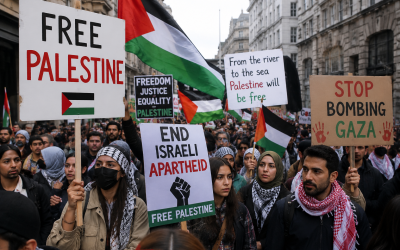
In the aftermath of the 7 October 2023 attacks and the subsequent wars in Gaza,Lebanon and Iran, incidents targeting Jewish communities and individuals have risen sharply in many parts of the world. Such incidents are routinely condemned as antisemitism, and rightly so. Political leaders, community organisations and civil society groups frequently reiterate that antisemitism has no place in modern society.
Yet a growing debate has emerged over how to describe hostility directed not at Jews as Jews, but at Israel, Zionism and those who identify as Zionists. While some view anti-Zionism as inseparable from antisemitism, others insist that opposition to Israel or Zionist ideology can exist independently of prejudice against Jews.
This distinction has become increasingly significant in public discourse. Most Jews worldwide identify, to some degree, with Israel and support its continued existence as a Jewish state. At the same time, critics argue that criticism of Israel, even severe criticism, should not automatically be categorised as antisemitic.
The result is a conceptual, political, legal and linguistic challenge. If hatred is directed primarily toward Israel, Israelis or Zionists rather than Jews as an ethnic or religious group, is “antisemitism” always the most accurate term?
This distinction has legal implications. Whereas antisemitism is recognised by anti-hate legislation in most democratic countries, hatred directed towards Israel is not recognised as illegal – and in it is practiced openly and even protected by free-speech laws.
Historically, anti-Zionism and antisemitism have often overlapped. The International Holocaust Remembrance Alliance (IHRA) Working Definition of Antisemitism, for example, includes examples relating to the targeting of Israel when it is treated as a collective expression of Jewish identity. Many advocates argue that attacks on Israel frequently serve as a proxy for hostility toward Jews.
However, the relationship is not always straightforward. There are Jews who identify as anti-Zionists. Some participate in anti-Israel activism, while certain Jewish religious communities reject Zionism on theological grounds. Conversely, many of the world’s strongest supporters of Israel are not Jewish. Large numbers of Evangelical Christians, particularly in the United States and elsewhere, strongly identify with the Zionist project and advocate for Israel’s security and legitimacy.
These realities complicate attempts to classify all anti-Zionist sentiment as antisemitic. They suggest that a separate concept may be needed to describe prejudicial hostility directed specifically at Israel, Israelis and Zionists.
I propose the term Israphobia.
Israphobia may be defined as the irrational fear, hatred, prejudice or discriminatory treatment of Israel, Israelis or Zionists. Like other forms of prejudice, it would not encompass legitimate criticism of policies, governments or political decisions. Rather, it would describe hostility that crosses the line from criticism into demonisation, dehumanisation or collective condemnation.
Under this framework, Israphobia could manifest in several ways.
Cultural and Social Prejudice
This may include portraying Israelis or Zionists as a monolithic group, attributing collective guilt to them, or presenting Israel as uniquely incompatible with democratic or international norms while applying different standards to other states.
Institutional Discrimination
Israphobia may appear in institutional settings where Israel, Israeli individuals or openly Zionist organisations are subjected to treatment that is not applied equally to comparable groups or nations.
Violence and Intimidation
Acts of violence against Israelis, Jewish institutions targeted because of their association with Israel, or attacks on individuals perceived to be Zionists may represent manifestations of Israphobia where the motivation is hostility toward Israel rather than toward Jewish identity itself.
Collective Threat Narratives
Another feature may be the portrayal of Israel as a uniquely malevolent or existential threat, extending moral responsibility for alleged government actions to Israelis or Zionists collectively.
Historical Analogies
One of the most contentious areas of modern discourse concerns comparisons between Israel and historical systems such as apartheid South Africa, Nazi Germany or Colonial Empires. Supporters of Israel often argue that such comparisons have no historical validity but are solely intended to delegitimise Israel’s existence and moral legitimacy. Critics, by contrast, view these comparisons as legitimate political analysis. The debate itself illustrates the difficulty of distinguishing criticism from prejudice.
Where the allegation or comparison to abhorrent regimes in history, without balanced objective basis, such as a comparison of collateral damage and unintended civilian causalities in the Hamas/Israel war in Gaza, to Nazi extermination camps in the Holocaust – this can be reasonably defined as a manifestation of Israphobia.
Delegitimisation
Perhaps the clearest manifestation of Israphobia would be the denial of Israel’s right to exist as a sovereign state while accepting that right for other nations. Under this definition, reasoned opposition to particular governments or policies would remain legitimate, whereas rejection of Israel’s existence as such would constitute a distinct form of prejudice.
A New Term for a New Debate
The purpose of introducing a term such as Israphobia is not to replace the term “antisemitism”. Antisemitism remains a well-defined and historically significant form of hatred directed against Jews.
Rather, the proposed term seeks to address a category of hostility that many believe is not adequately captured by existing language. In an era when debates over Israel and Zionism dominate political discourse, precision in language matters.
Whether Israphobia ultimately gains acceptance is a matter for scholars, policymakers and the broader public. Nevertheless, the discussion highlights an important challenge: how to distinguish legitimate political criticism from prejudice, and how to describe hostility directed at Israel, Israelis and Zionists without conflating every instance with antisemitism.
As public debate continues, the search for clearer and more accurate terminology is likely to remain both relevant and controversial.