

‘We would not be who we are without the graduates of the Yemin Orde Mechina’
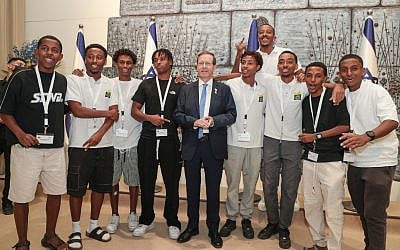
“On behalf of the State of Israel, I would like to honor you today—your contribution to the country’s security, its social resilience, its economy, education, spirit, and culture—to every field and domain. We would not be who we are without the graduates of (the) Yemin Orde (mechina), and we are grateful and blessed for that,” said President Isaac Herzog last Thursday (November 13th), at a festive ceremony marking a quarter-century of the Yemin Orde Young Men’s Leadership Program in Hatzor HaGlilit—the first leadership mechina in Israel for youth from the country’s social and geographic peripheries.
25 years; 1,200 graduates – nearly all of whom went on to do combat service, many in command and officer roles; and 15 President’s Award recipients, whom the president mentioned in his speech. These numbers tell the story of the Mechina that transformed the life trajectory of so many of its participants: teens from Israel’s geographic and social periphery, from the Ethiopian-Israeli community, and others.
“With us, they learn to dream and to reach their dreams,” said Eyal Eldar, the head of the Mechina since it opened. “Our participants gain experience in community leadership, public speaking, learning Jewish heritage, getting to know the land of Israel on foot, encountering our society in all of its diversity, engaging regularly in volunteer service, navigating, and preparing mentally and physically for meaningful military service.”
The Mechina continues to support its graduates actively even after their army service, helping them gain acceptance into higher education and to succeed in their studies. “There is immense value in the family you have created together over a quarter-century of activity,” President Herzog added, “a family of proud and united graduates, excelling in the army, academia, and the workforce—who continue to return to this powerful social and educational framework at key moments in their lives. And how meaningful this moment is—the opportunity to celebrate this extraordinary societal enterprise and host you here, at the President’s Residence, the home of the nation—whose people look to you with inspiration and pride.”
Dr. Chaim Peri, himself a recipient of the President’s Medal (2022), said in his speech: “The Mechina’s uniqueness lies in the direct, unmediated closeness it creates between educators and participants. A closeness not only for the moment—for the formative experience this year provides—but for an entire lifetime. None of this would be possible without the sense of mission, dedication, and distinctiveness of the Mechina’s staff throughout the years.”
With characteristic grace, Dr. Peri also mentioned the late Haim Rubovitch, the first CEO of Village Way Educational Initiatives and a former senior Shin Bet official: “My partner on this path, who—upon completing his security service—chose to devote himself fully to education. His steadfast values and wisdom continue to guide the educational work of Village Way across the full spectrum of Israeli society.”
Mechina Director Eldar spoke at the ceremony about the early, challenging years: “When we started, the prevailing belief was that mechinot were for the ‘champions,’ not the masses. Many raised an eyebrow and struggled to understand the need or the potential. When a representative from the Ministry of Absorption came during the first year and asked the participants why they hadn’t chosen other mechinot, Shlomo Alma—who is sitting here today—answered him: ‘In other mechinot they wouldn’t have accepted us; here I can express myself, grow, and lead.’
“Today, with a bit of ‘seniority’ and many graduates, people understand how right Shlomo was—how worthwhile the investment in our ‘champions’ is, and how much the state can gain and achieve with youth who have overcome hardships, learned to lead themselves and their surroundings, and strive to improve the place their parents dreamed of. Even now, many of our graduates are on the front lines, shaping our future with their bodies and spirit. May they return safely.”
The ceremony was emceed by Mechina graduate and educator Mkonet Gadamu, and included a panel discussion with four graduates. “The Mechina is made of people with enormous hearts who believe in people,” said Eliyahu Stolin, a graduate of the third cohort who immigrated from Russia as a teen, continued after the Mechina to serve in the Paratroopers Brigade, and has for many years been a clinical social worker treating, among others, trauma survivors.
“As a child who grew up in a non-religious, non-Zionist home, the Mechina helped me clarify my identity and my willingness to defend this land. For 25 years now, the Mechina has been connecting people, first and foremost, to themselves. My encounters with my Ethiopian-Israeli friends showed me that despite the differences, we are all one people.”