
Our People helping our people
We’ve Been Selling Aliyah Wrong for 78 Years
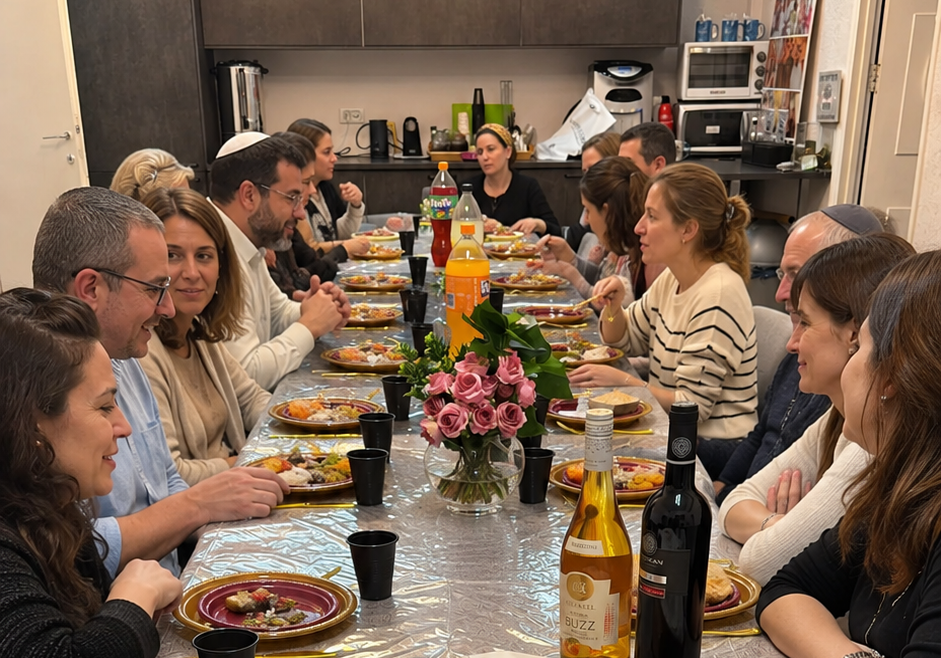
Our People community event
Three times a week, my phone rings with the same call.
A social entrepreneur. Smart, Zionist, usually a recent oleh. They have an idea for the aliyah space. An app. A portal. A WhatsApp bot that explains local Social Security. They want my feedback.
I run Our People, a Jerusalem nonprofit that helps olim long after they land, so they assume I know where the gaps are. I give them all the same answer. I’m putting it here because it will save us all a phone call.
The problem with aliyah isn’t a shortage of information. Much of what potential olim think they know is wrong, and much of what they need to know, they don’t even know to ask.
And we’re telling the story all wrong.
According to Nefesh B’Nefesh, 4,150 North Americans made aliyah in 2025, the highest number in four years. Aliyah files opened through NBN rose from 8,943 in 2022 to 13,389 in 2025. This year, they welcomed their 100,000th oleh.
But there are nearly 7 million Jews in North America. Even in a strong year, that’s about one oleh for every 2,000 Jews.
Something has shifted since October 7. In thousands of conversations with relatives, volunteers, donors, and friends, I’ve watched people move one step along a continuum. Those who used to talk about aliyah are making it. Those who used to think about it are talking. Those who barely knew the word are learning how to spell it.
From San Francisco to Winnipeg, people tell me about their exit plans. For some, it’s a German passport. For others, it’s a friendly neighbor with a farm who will hide them if push comes to shove. In mainstream Jewish Facebook groups, people are discussing what Argentina is like in case they have to leave the US.
Argentina. Not Israel.
Why are Jews who care about Israel considering Argentina?
There’s a useful answer in marketing theory.
Everett Rogers’ adoption curve divides people into groups according to how readily they embrace something new. Think of the first iPhone.
The innovators (2.5%) camped outside Apple stores in June 2007 to buy a phone with no App Store and no 3G. The early adopters (13.5%) saw its potential and were willing to put up with the bugs.
The early majority (34%) waited until the guy at the next desk had one and it clearly worked. The late majority (34%) switched when everyone else already had, and their kids set it up for them. The last group (16%) is still holding a flip phone. They’re fine, thank you.
Geoffrey Moore identified the gap between the early adopters and the early majority. He called it the chasm. It’s the difference in why and how people adopt a product on an idea. And if an idea can’t cross the chasm from the visionary to the ordinary it is doomed.
Early adopters buy the vision. The early majority buys proof. Show me it works, show me someone like me who uses it, tell me who to call when it breaks.
Now listen to how we talk about aliyah.
Coming home. Fulfilling the dream. Being part of history. And since October 7, solidarity.
We’ve become very good at speaking to people on one side of that chasm.
I know. I was one of them. I left Riverdale at 17, and nobody had to sell me anything. I was exactly the kind of person our aliyah institutions know how to reach, which makes me exactly the wrong person to ask how to reach everyone else.
According to Nefesh B’Nefesh data reported in 2025, about 65% of American families making aliyah identify as Orthodox. Meanwhile, research based on Pew’s 2020 survey found that six in ten American Jews who weren’t raised Orthodox had never even visited Israel.
These are fundamentally different audiences. Why would we expect the same message to work for both?
Recently, an official at the Ministry of Aliyah and Integration told me that, to better understand aliyah, they interview olim.
That’s essential if you want to understand absorption. But if you want to understand why Jews aren’t making aliyah, here’s a better list to call: the people who opened an aliyah file and never boarded the plane.
They got far enough to fill out government forms. Something stopped them. I doubt it was a shortage of Zionism.
The accountant in Omaha, Nebraska, with three kids and a mortgage isn’t waiting for a better speech about Jewish destiny. She’s trying to answer a much smaller question.
Will my life be okay?
And she’s often answering it based on information that is outdated or flat-out wrong.
“You can’t make a living as a teacher in Israel.” Everyone knows that. Except that ahead of this school year, the Ministry of Education had 8,000 teaching vacancies, there are opportunities to start teaching English before obtaining an Israeli teaching license at a salary of NIS 15,000 a month, and Nefesh B’Nefesh has developed a national program with government ministries to bring immigrant educators into Israeli classrooms.
Or take a single-parent family struggling financially in America. Has anyone helped them figure out whether they could qualify for public housing in a regular Israeli apartment building, along with other benefits and assistance?
Some of it isn’t about benefits at all. It’s about understanding how life works here. A family with four cars in suburban Florida won’t live the same way in Ra’anana. But when your kids can get themselves to school and visit their friends independently, having fewer cars isn’t necessarily a downgrade.
To understand these things, you need more than a government website.
Nefesh B’Nefesh has made the paperwork survivable, and anyone who made aliyah before it existed knows that’s no small thing. It does important work after landing, too.
But a form is not a life.
What the family in Omaha needs is to meet another family like theirs, who made aliyah five years ago. What was harder than they expected? What was easier? What did they get wrong? How are the kids doing? What do they do for a living now?
And where do they go on Friday night?
Not the heroic oleh who moved to the Negev with nothing but a backpack and a dream. The ordinary one who has built an ordinary, reasonably happy life in Israel.
Which brings me to the real problem: we measure the wrong thing.
We celebrate arrivals. We photograph the charter flight. Then the olim walk out of Ben Gurion and the cameras go home.
The hard part, often in the second or third year, when the novelty is gone and the system still doesn’t make sense, happens offscreen.
But their relatives and friends abroad are watching. They hear about the job search, the children’s difficulties at school, the loneliness. They also hear when someone finds a good job, when the kids start thriving, when the family finally feels at home.
Every oleh is quietly shaping someone else’s decision about aliyah.
We treat aliyah promotion and immigrant absorption as two separate fields. One gets people here; the other helps them stay. But the success of the second determines much of the success of the first.
Absorption isn’t the cost of aliyah. It’s the marketing.
Our People started in 2022 with emergency assistance in the first days of the war in Ukraine. Most of the olim we serve speak Russian or Ukrainian, but plenty of Anglos reach out too.
Over four years, I’ve noticed a pattern. People first call our helpline about a bureaucratic problem. What keeps them connected is knowing that next time something goes wrong, someone who understands them will pick up.
At our weekly Shabbat meals in Jerusalem, Russian-speaking olim sit next to English-speaking olim, Israelis and tourists. What I particularly love is the story of the people running these meals. They’re relatively recent olim who came here to escape persecution. They had no family in Israel and had left behind a community they loved. They originally came to our weekly seuda shlishit, the third Shabbat meal, as guests.
Then they turned around and decided that downtown Jerusalem needed a family-style Friday night table where olim could step outside their own bubbles, meet one another, and feel at home. Today, they’re the ones welcoming newcomers.
None of it makes a particularly impressive aliyah flight photo. All of it is what the next family needs to see.
I’d love to see a campaign celebrating the families who landed five years ago. I’d love to see prospective olim matched with veteran olim who share their professional backgrounds, family circumstances and concerns.
Not heroes. Neighbors.
So, to the three social entrepreneurs who will call me next week: before you build another portal, talk to the people who almost made aliyah and didn’t. Talk to the people considering Argentina. Then talk to the people who came five years ago and find out what made it possible for them to stay.
Nobody makes aliyah because they found the right PDF. Plenty don’t because they believed the wrong Facebook comment.
For the first time in a long time, we’re getting the attention of Jews who never seriously considered living in Israel. Let’s not waste it by giving them the same pitch we’ve been giving the people who were already coming.
We’ve spent 78 years telling Jews why they should come home.
Now let’s show them what home looks like in year three.
Related Topics