Urban Sociologist and Global Affairs Commentator
What AI Cannot Teach Us About Knowing
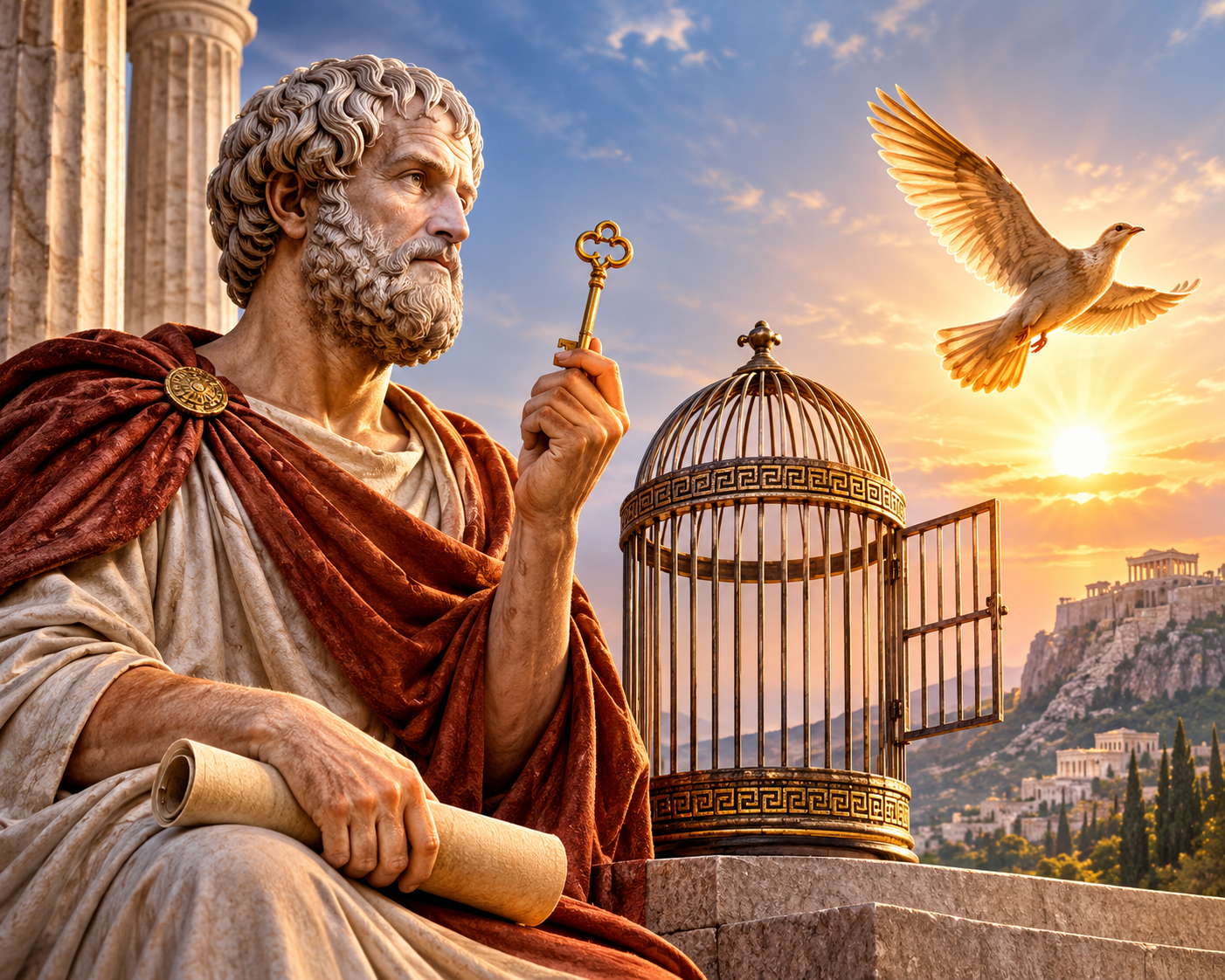
Master the structure, Earn the freedom: Aristotle's Phronesis represents practical wisdom. An AI Illustration.
The Wisdom of Approximately: Precision tells us what is true; Judgement tells us what to do about it.
A pilot bringing a plane down in a crosswind does not solve equations. She feels the drift in her hands, reads the sink rate in the seat of her pants, and trims by instinct a thousand times finer than she could explain. Yet an hour earlier, on the ground, she measured her fuel to the litre and refused to take off on “about enough.”
The same person is exact in one moment and intuitive in the next, and both are expressions of one skill. It is the skill of knowing how much precision a moment deserves. I will argue that this skill is the deepest form of human intelligence, that it is most visible in our bodies and our safety, and that it rests on a foundation of hard knowledge that no machine can pour on our behalf.
The map and the territory
Precision is humanity’s great achievement. It gave us vaccines, bridges and orbiting satellites. But every precise measurement is a map, and maps are useful precisely because they leave things out.
Two men have identical cholesterol results. One is thirty, sleeps well, and walks everywhere. The other is sixty-five, grieving, and sleeping four hours a night. The number is exact, and its meaning is not. A reading can sit inside the normal range while a person quietly declines, and another can sit just outside it on a person who is perfectly well.
The engineer Lotfi Zadeh built a whole branch of mathematics, fuzzy logic, on the observation that most useful concepts have no sharp edges. When does a hill become a mountain, or a stranger become a friend? Reality is graded, and intelligence must be graded to match it. Fuzziness here is not a flaw in thinking. It is thinking that matches the real resolution of the world.
The body, or why the plate is not the bloodstream
Health shows this most clearly, and protein is a fine teacher. The tidy rule says to eat a certain number of grams per kilogram. Useful, but it hides three fuzzier questions.
Which protein? Eggs, dairy, fish and meat are digested efficiently and carry all the essential amino acids in good proportion. Many plant proteins are less digestible and run short of one amino acid: grains tend to lack lysine, legumes lack methionine. But the shortfalls are complementary, which is why rice and beans have fed half the planet. Cooking also deactivates compounds in legumes that hinder digestion. Neither the carnivore nor the vegan has a monopoly on wisdom. The honest answer is “it depends on everything else you eat.”
How? The body seems to build muscle better from moderate doses spread across the day than from one heroic dinner, a difference that grows with age as muscle becomes less responsive to protein. Whole foods also arrive with fibre, fats and micronutrients that a powder leaves behind.
And then: does it arrive? This is the question the numbers cannot see. Eating protein is not using protein. Coeliac disease flattens the intestinal surface where absorption happens. Pancreatic insufficiency leaves food undigested for want of enzymes. Low stomach acid, common in older age and with long-term acid-suppressing medication, blunts the first step of protein digestion and impairs absorption of iron and vitamin B12, which also requires a gastric protein called intrinsic factor. Gut surgery, bacterial overgrowth and chronic infection can each do similar damage. A person can eat impeccably and still be running on empty.
Now watch intelligence at work. A friend is tired, losing muscle, and reports eating “plenty of protein.” The merely precise response audits the grams, finds them adequate, and shrugs. The wise response suspects the question itself. Is something failing between the fork and the bloodstream? Is the fatigue travelling with bloating, altered stools, hair loss, pallor? Is this a bad fortnight or a six-month slope? It holds several truths at once: fatigue is usually ordinary, persistent fatigue with company is not, and a reassuring number can rest on top of a developing problem.
No table contains that. It is a sense of proportion, and it can only be built from real knowledge. It also generalises: a healthy life is a pattern rather than a checklist, a single abnormal result rarely proves disease, and small persistent changes often outweigh dramatic transient ones.
Security: the arithmetic of acting early
Security is the same faculty with shorter fuses. We rarely get proof of danger. We get a smell from the chicken, a road with fast traffic and no crossing, a stranger whose behaviour does not fit the setting. Waiting for certainty is often the one luxury unavailable. The sensible response to doubtful chicken is the bin, not a laboratory.
Notice the hidden logic: calibration depends on the cost of being wrong. A smoke alarm is deliberately oversensitive, because a false alarm costs a nuisance and a missed fire costs a life. Intelligent caution tunes itself to that asymmetry. We are relaxed about the thing that would cost little to be wrong about, and vigilant where error would be irreversible.
But this is also where fuzzy judgement is most easily counterfeited. From the inside, prejudice feels exactly like intuition. An unfamiliar accent, garment or face is not evidence of anything. Trustworthy judgement runs on observable signals: behaviour that does not fit its context, conditions that have changed, a situation with no easy exit. And it requires a realistic map of how harm actually happens. Most of us fear the dramatic and neglect the mundane, such as roads, fires, scams and food, which do far more damage than the villains of our imagination.
The goal is calibrated caution, neither complacency nor paranoia. Calibration is learned from knowledge. The person who understands how fires spread and how fraud works can be calm and alert at once, because their alarm is wired to something real.
The same engine everywhere
Look closely and the pattern repeats.
Relationships. We never see intentions, only patterns. Maturity is telling a mistake from a habit, and an explanation from an excuse, with no rulebook to consult.
Parenting. Developmental milestones are real, yet no child has read the schedule. Good parents hold the norm and the particular child in view together.
Leadership and money. Decisions arrive before the data does. The wiser plan is rarely the “optimal” one that works only if a single forecast comes true. It is the reasonably good one that survives several possible futures.
Ethics. Honesty and loyalty collide; compassion and fairness pull apart. Rules without judgement turn cruel, and judgement without principle turns arbitrary. Aristotle called the capacity to weigh the particular case phronesis, practical wisdom, and thought no rulebook could replace it.
Two kinds of “probably”
Here is the distinction on which everything turns. Intelligent imprecision and uninformed vagueness sound identical.
Ask a physician and a bystander about a symptom. Both may say, “Probably nothing, but keep an eye on it.” The physician’s sentence is the compressed residue of thousands of cases, known failure modes, and a precise sense of which signs would change her mind. The bystander’s sentence is a shrug dressed as caution.
So fuzzy knowledge is not the rival of scientific knowledge. It is downstream of it. Science supplies the reference points: what is established, what is probable, what is false. Common sense carries those points into the traffic of daily life. Remove the first and intuition decays into superstition. Remove the second and facts pile up unused. And common sense must stay correctable, for it also carries inherited myths.
Think of a jazz soloist. The wild, free-sounding improvisation is possible only because scales and harmony have sunk below conscious thought. Freedom is the reward for mastering structure, never a substitute for it.
The machine that answers
Artificial intelligence is a marvel: a tireless colleague that can summarise literature, decode a lab report, and offer angles we had not imagined. Used well, it widens us. But three limits survive all its brilliance.
It answers the question you asked, not the one you needed to ask. Ask how much protein you need and you will receive a sound number. It will not know your real problem is malabsorption unless you mention the bloating, and you will only mention it if you know it might matter. Michael Polanyi observed that we know more than we can tell. Much of what bears on a decision lives in the body, unspoken, and the better your foundations, the better your questions, and so the better your answers.
It cannot stand where you stand. The person crossing a dim car park is the one who sees the shadows and hears the footsteps. Judgement in the moment belongs to whoever is in the moment, and what a statistic means for this body and this history lives mostly in your own head.
You cannot audit what you do not understand. AI is fluent, usually right, and occasionally fluently wrong. Spotting the difference demands enough background to feel that an answer is overconfident, mismatched, or merely implausible. A calculator never abolished the need for number sense. Type 40 × 100 by mistake and it will display 4,000 with perfect composure; only someone who knows the answer should be near 400 will notice. AI works the same way: it delivers every answer in the same confident voice, and only a person with a sense of the expected shape of the truth can hear when one is off. So AI does not level the field. It rewards those who already have a base and exposes those who do not.
There is a quieter danger too. Proportion, patience with uncertainty, and the nerve to say “I’m not sure, so let’s be careful” are habits, and habits that go unused fade. Anyone who has watched navigation apps erode a sense of direction knows how this goes. The healthy partnership is one where AI sharpens reasoning by testing assumptions and widening options, while the final weighing stays human.
The paradox, then, is clean: the more powerful our instruments, the more valuable the skilled hand.
Calibration
So what should we cultivate? Not precision, and not flexibility, but calibration: the sense of how much certainty a moment deserves.
Some moments demand exactness, such as drug doses, load tolerances and emergency procedures. There, approximation is negligence. Some demand flexibility, such as sensing that a friend is unwell, deciding whether to trust, reading a room. There, false precision is a form of blindness. And the richest moments demand both: the doctor who reads the lab values through the patient in front of her, the engineer who calculates exactly and then adds a margin for what she cannot foresee.
Precision without context is mechanical. Imprecision without knowledge is guesswork. Wisdom is the two held in one hand.
Information tells us what is known. Science tells us why we believe it. Fuzzy knowledge tells us what to do when knowledge runs out. Wisdom is sensing which of the three the moment needs.
In an age when answers are becoming nearly free, the scarce thing is not the retrieval of facts. It is the ability to live well among the things we know, the things we half-know, and the things we will never know for certain, and to tell, each time, which is which.
Related Topics
Related Posts