


What Are Whales Actually Saying?
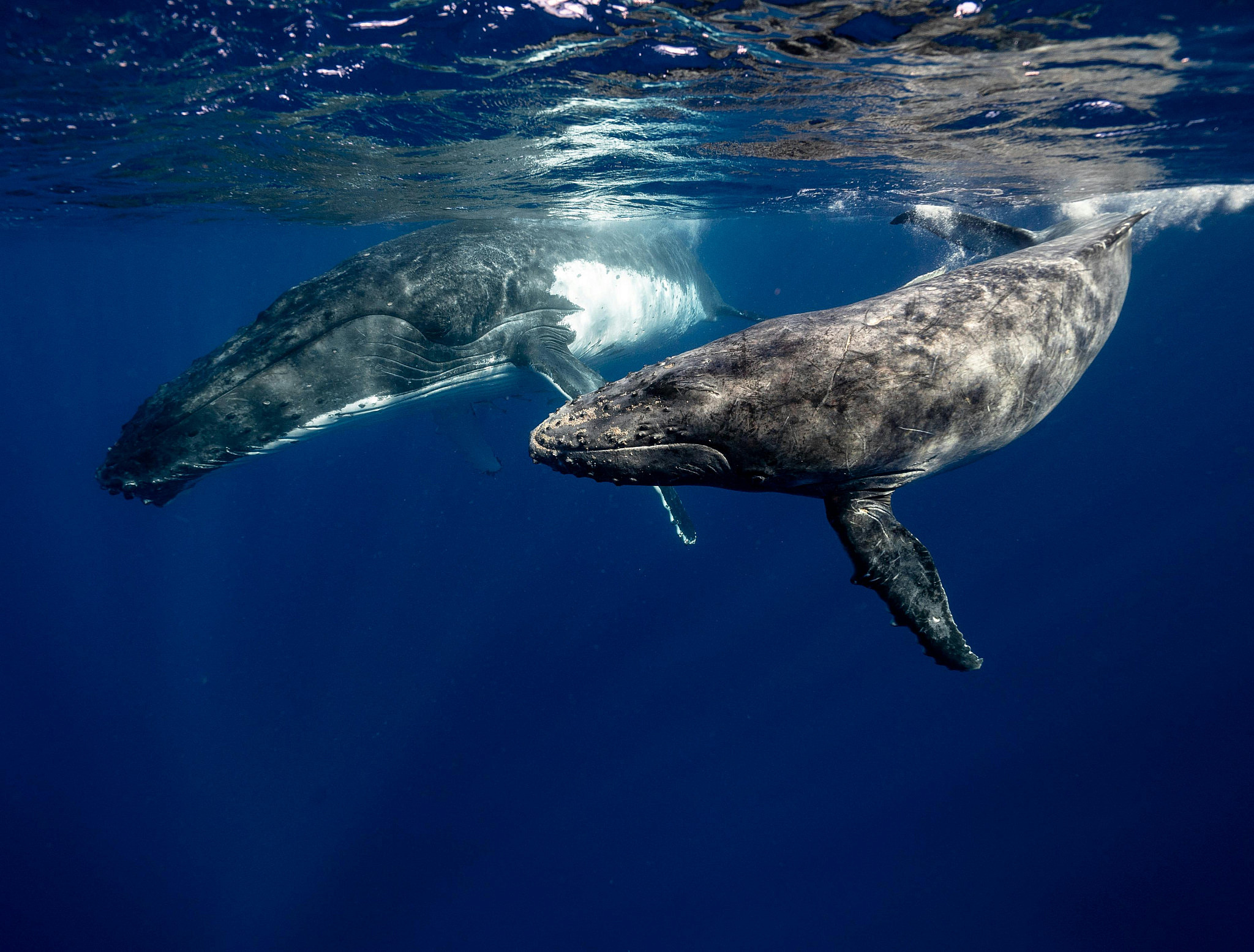
While some researchers count words in whale songs, others are trying to figure out what those words mean
Imagine this: you’re listening to a conversation in an unfamiliar language. You can count the sounds. Notice that short words pop up more often. Even record it all and play it back — your conversation partner will definitely react.
But will you understand a single word?
That’s exactly where whale communication science stands today. A recent study from Hebrew University in Jerusalem showed that humpback whale songs follow the same statistical patterns as human speech. Other scientists even tried “talking” to whales — played recordings of their own songs back to them. The whales responded!
Sounds cool. Except nobody knows what they played to the whales or what the whales answered back.
From Statistics to Meaning
What’s the problem? Most modern methods work like accountants, not translators. They count patterns. Classify sounds. Find statistical regularities.
But they can’t tell form from content.
It’s like trying to understand music by only measuring note frequencies and pause lengths. Sure, you’ll get numbers. But will you catch the emotion? Understand why the composer sped up here, added a tremor there?
Unlikely.
A new approach, developed by an independent signal processing researcher, offers a radically different path. Instead of turning whale “codas” (structured sequences of clicks) into frozen snapshots, the method keeps them alive — with all their variations, time stretches, and subtle nuances, like a musical performance.
Music That Stretches
The main problem with existing methods — they don’t know what to do with natural variability. Whales aren’t robots. The same sequence can sound faster or slower, with “ornaments” or without, with rhythmic variations (musicians call this rubato).
What do traditional algorithms do? Either treat it all as noise and throw it out. Or try to “stretch” signals after the fact — take two recordings of the same song (one fast, one slow) and mechanically speed one up to match the other.
Does it work? Yes. But crudely. Like a jerry-rigged fix.
The new approach is more elegant. It can automatically understand that two sequences at different tempos can mean the same thing — like two recordings of the same melody, played fast and slow.
Think of it this way: you recognize a song regardless of tempo, instrument, performer. The melody stays the same — only the packaging changes.
Hierarchy: From Clicks to Dialogues
But it’s not just about tempo. Whale communication is layered, like a matryoshka doll:
- Clicks form codas (sounds → words)
- Codas combine into phrases
- Phrases form dialogues
Standard methods take a recording and chop it into thousands of pieces. Analyze each separately. The big picture? Lost.
It’s like reading a book one word at a time, forgetting the previous one. Try understanding “Lord of the Rings” that way.
The new method works differently: sees the whole structure at once. Individual clicks, word-codas, phrases, and the entire conversation — simultaneously.
The computer learns at all levels at once. Like a child learning language: first sounds, then words, then — boom! — realizes words form sentences, and sentences form stories.
Resonance with Context
And here’s where it gets really interesting.
The method can link sounds to behavior: are the whales hunting, caring for calves, coordinating in groups?
The idea is simple: find stable correspondences. Structures that remain unchanged under any conditions, across different clans. If a certain sequence always appears during hunting — that’s no coincidence. If another sounds only during social interaction — also a clue.
This is the key to meaning. To what signals actually signify.
Not just “whales are making sounds.” But “whales are saying something specific.”
From Whales to Dolphins — and Back
The method was developed for sperm whales. But it works easily with dolphins too — and that opens completely different horizons.
Dolphins use multi-layered communication:
- Ultrasonic packets (echolocation) — acoustic “pictures,” or even “videos” of objects
- Clicks and pulses for social signaling
- Whistle signals as individual “names”
The same approach works for all types of dolphin signals. Maybe we’ll see how dolphins coordinate ultrasonic images with whistles. Are they transmitting not just “hey, fish over there!” — but structured pictures: where the school is, what shape, which direction it’s moving?
The Mediterranean Sea off Israel’s coast is full of dolphins. The Red Sea too.
Maybe soon we’ll be able to not just listen to their clicks, but understand their conversations about fish, dangers, evening plans.
What Does This Give Us?
Practical implications? Huge.
Protecting whales and dolphins. If we understand how noise from ships, sonars, and drilling platforms destroys their communication, we can develop real protective measures. Not abstract “reduce noise,” but specific: what times, at what frequencies, in which areas.
Studying culture. Whales have dialects — each clan speaks differently. The method lets us compare them. Track how traditions pass from generation to generation. This is cultural evolution in its pure form!
Interspecies understanding. Long-term — the possibility of understanding the meaning of their messages. Not recording, but understanding.
Will we ever talk with whales? Maybe not.
But learning to listen — really listen — we can do right now.
Conclusion: Listening Isn’t the Same as Hearing
Whale communication research is often compared to deciphering ancient languages. Or searching for alien signals.
But there’s an important difference: whales are here. Next to us. Their messages sound every day.
While some scientists count words, others try to understand sentences. The new approach suggests moving to the next level — hearing not sounds, not patterns, but meaning.
Maybe in a few years we’ll be able to not just play whales their songs, but understand what those songs are about.
And that’s a completely different story.
Note: The research is published on the Zenodo platform and available to other scientific groups. The software is designed so any part can be used separately — making the method accessible to labs worldwide. Zenodo DOI: 10.5281/zenodo.16969927