


What Changes When the Audience Is Jewish
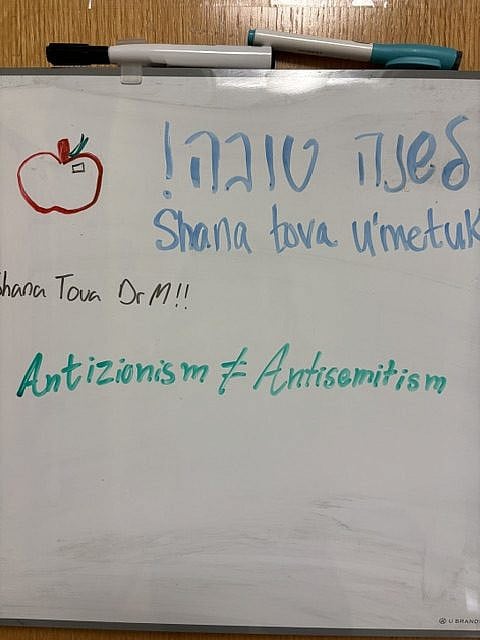
The day after Yom Kippur, a colleague sent me a photograph of the whiteboard hanging on my office door. Among the warm High Holiday messages, someone had written: “antizionism ≠ antisemitism.” I looked at the photograph for a long time. What stayed with me was not simply the sentence itself, but the choice of where it was written. This message was not the first unsettling note left on my office door, although this one did not alarm me in the way some previous messages had. Still, although I didn’t feel physically threatened, the message left me feeling ill at ease.
My office is the space on our university campus that houses Jewish Studies and Hillel. Jewish, Israeli, and Zionist students gather there. Moreover, I am also publicly a Zionist. Whoever wrote the message could have made the same argument in a classroom, at a protest, in an article, in a campus forum, or even in an email to me. Instead, someone chose the only Jewish communal space on our campus and wrote it anonymously on the door of a Jewish professor.
Days later, the message was gone, and the High Holiday greetings around it remained. I do not know who erased it or why, but the visual distinction struck me. In some ways, its disappearance made the question that had been bothering me even clearer. What had made the message significant was never simply the words. It was the decision to put those words on the door of a Jewish communal space.
This incident is an example of why context matters. Words do not exist independently of where they are spoken, who is expected to hear them, or why that particular audience has been chosen. We understand this principle intuitively in many other settings. “All Lives Matter” is a charged political statement wherever it appears, but deliberately placing it on the door of an African American Studies program adds another layer of meaning and feels targeted. A statement that marriage should exist only between a man and a woman might be argued as a religious or political proposition; writing it on the door of an LGBTQ center is something different. The words have not changed, nor has the stance of the writer, but the location has turned an abstract proposition into a directed message.
“Free Palestine” offers an illustrative example. At a demonstration for Palestinian rights, the phrase is readily understood as a political demand, though people may disagree sharply over what political outcome it implies. But when “Free Palestine” is shouted at Jews entering a synagogue, directed at visibly Jewish strangers, or written on a Jewish institution, the social function of the phrase changes. The relevant question is no longer simply what the speaker means by “Free Palestine,” but why a Jew entering a synagogue has been made the audience for that demand. When Jews are singled out for political messages about Israel simply because they are Jewish, the problem is not only the content of the message, but the assumption that Jewish identity itself makes someone an appropriate recipient for political confrontation.
That distinction is central to how I understand anti-Zionism and antisemitism. I believe anti-Zionism is antisemitic at its core because Zionism, in its most basic sense, is the historic and contemporary movement for Jewish collective self-determination in our ancestral homeland. To reject Zionism is therefore not merely to criticize an Israeli government, oppose a war, condemn settlements, or object to a particular policy–positions that many Zionists themselves hold. Those are political positions, and they can be argued vigorously without being antisemitic. Anti-Zionism goes further: it rejects the legitimacy of Jewish nationhood itself and of Jewish collective self-determination. That exceptionalism is antisemitic. It treats Jewish peoplehood as somehow less authentic, Jewish historical connection as less meaningful, and Jewish claims to collective political existence as uniquely suspect.
The problem is not that every anti-Zionist consciously hates Jews; indeed, prejudice does not require conscious hatred to operate. The problem is that anti-Zionism denies Jews a form of collective legitimacy we recognize as intelligible in other national and ethnic contexts. That is the distinction that matters to me: criticism asks what a Jewish state does; anti-Zionism asks whether Jews were ever entitled to one at all.
What concerns me, then, is the increasing tendency to treat the assertion “anti-Zionism is not antisemitism” as though it ends the conversation rather than begins one. Framed as a clarification, the phrase can also function as a litmus test that Jews are expected to undergo before any discussion of our own experiences can take place. It becomes a way of telling Jews in advance which forms of hostility toward us we are permitted to recognize as antisemitic.
These actions are especially complicated because anti-Zionism does not remain confined to political theory; it appears in encounters with actual Jews. Jewish students are treated as representatives of Israeli policy; Jewish organizations are asked to account for positions on Israel; Zionists are cast as morally suspect before anyone has asked what we mean by the term; and Jewish communal spaces become sites for political messages even when no political discussion is occurring there.
That question is sometimes evaded by insisting that Zionism is merely a political ideology and therefore fair game wherever it appears. Of course, Zionism can be debated in appropriate contexts; in fact, that is part of our own Jewish tradition of inquiry. But for many Jews, Zionism is not experienced solely as a position on a policy platform. It is bound up with Jewish peoplehood, historical memory, connection to Israel, and the idea that we, as Jews, possess a collective future as a people. Identifying as a Zionist is also plainly distinct from support for the policies of any particular Israeli government. That is why directing political messages about Israel toward Jewish spaces or individual Jews deserves scrutiny; it assumes that Jewish identity itself makes someone an appropriate recipient for that confrontation.
There is an irony here for universities, which should be unusually good at contextual analysis. We teach students to ask who is speaking, to whom, in what setting, with what history, and within what structures of power. We teach that meaning is not reducible to the dictionary definition of individual words. Yet when political messages are directed toward Jews or Jewish spaces, that contextual analysis can become strikingly literal–we look only at the sentence while ignoring the act of where it was put.
Academic freedom makes this distinction more important, not less. Universities should be places where we are willing to have difficult conversations, including conversations that make us uncomfortable and encourage us to articulate what we believe. If the relationship between Zionism and antisemitism is disputed, then we should be willing to teach that dispute, grapple with it, and listen seriously to people who reach different educated conclusions. I believe that kind of intellectual courage is essential to university life. But an anonymous message written on the door of a Jewish communal space is not intellectual engagement. Whatever the writer intended, that choice made me uncomfortable in a place where I work every day. Not because I encountered an opposing idea, but because that idea was anonymously directed at a Jewish space instead of being raised in direct engagement with the people inside it.
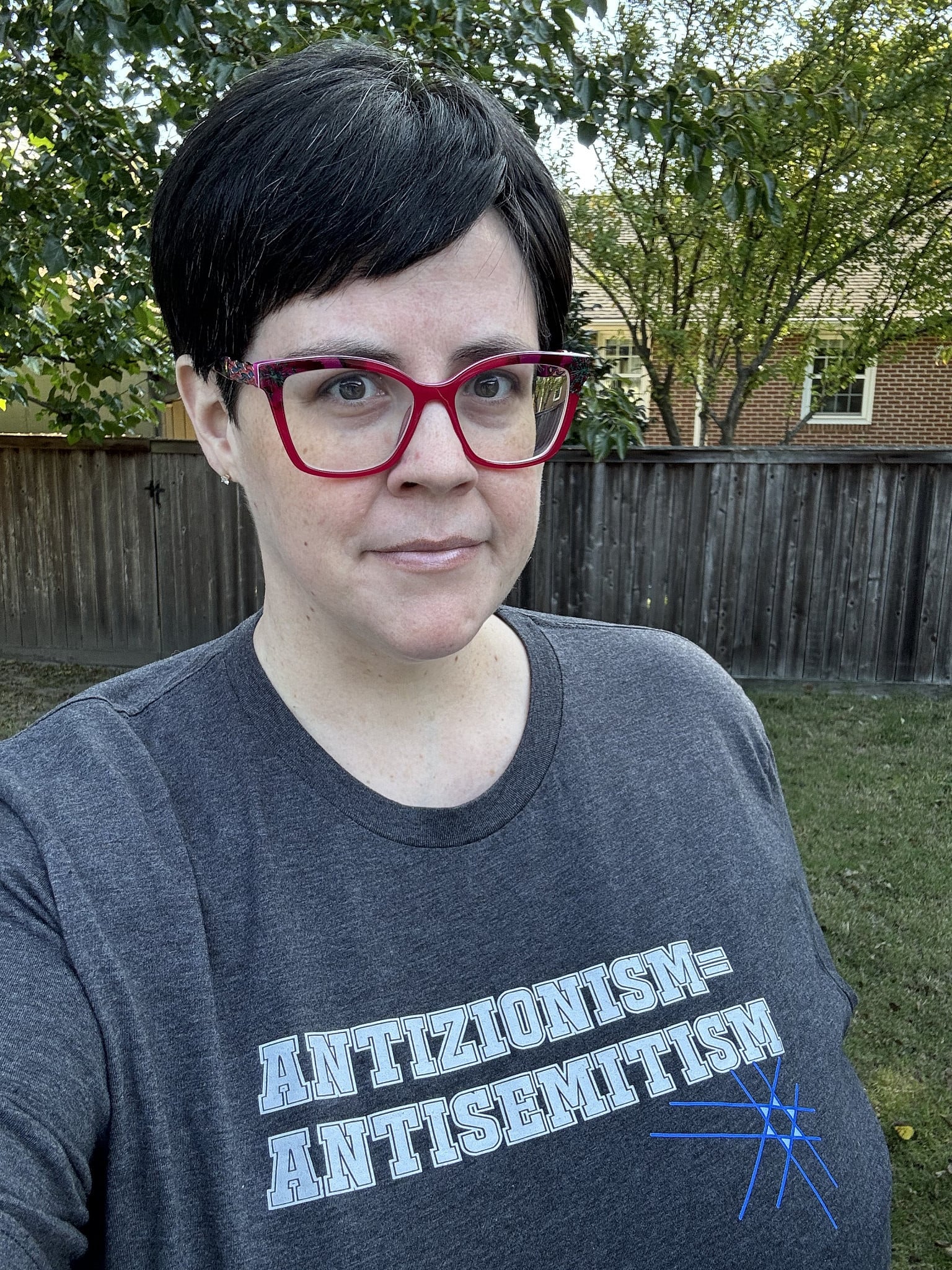
I still do not know who wrote the original message. When I came back to campus, the message had been erased by someone else, and the High Holiday greetings remained. That day, I wore a t-shirt that stated my own position plainly: “antizionism = antisemitism.” I have a clear position in this conversation, and I do not expect everyone to agree with me; but I am willing to attach my name and my face to that position, explain what I mean by it, and have the difficult conversation that follows. Whoever wrote on my door has never asked what I believe or had that conversation with me. Instead, I returned to the office behind that door—the place where I teach, meet with students, and spend my professional life—and found that someone had made it part of an argument without ever speaking to the person inside.
We should demand more of ourselves and of our institutions. Intellectual courage is not simply the willingness to hold difficult positions; it is the willingness to bring those positions into serious conversation with people who disagree. Difficult conversations require the courage to have them with one another, not to leave them anonymously on a door.