Rabbi, Economist and Community Builder
What Connects Abraham and Iran?
What Connects Abraham and Iran?
Rabbi Saadia Gaon’s Arabic translation of the Torah helps us not only uncover deeper meanings in the text, but also identify geographical locations that, to most of us, sound remote and unfamiliar.
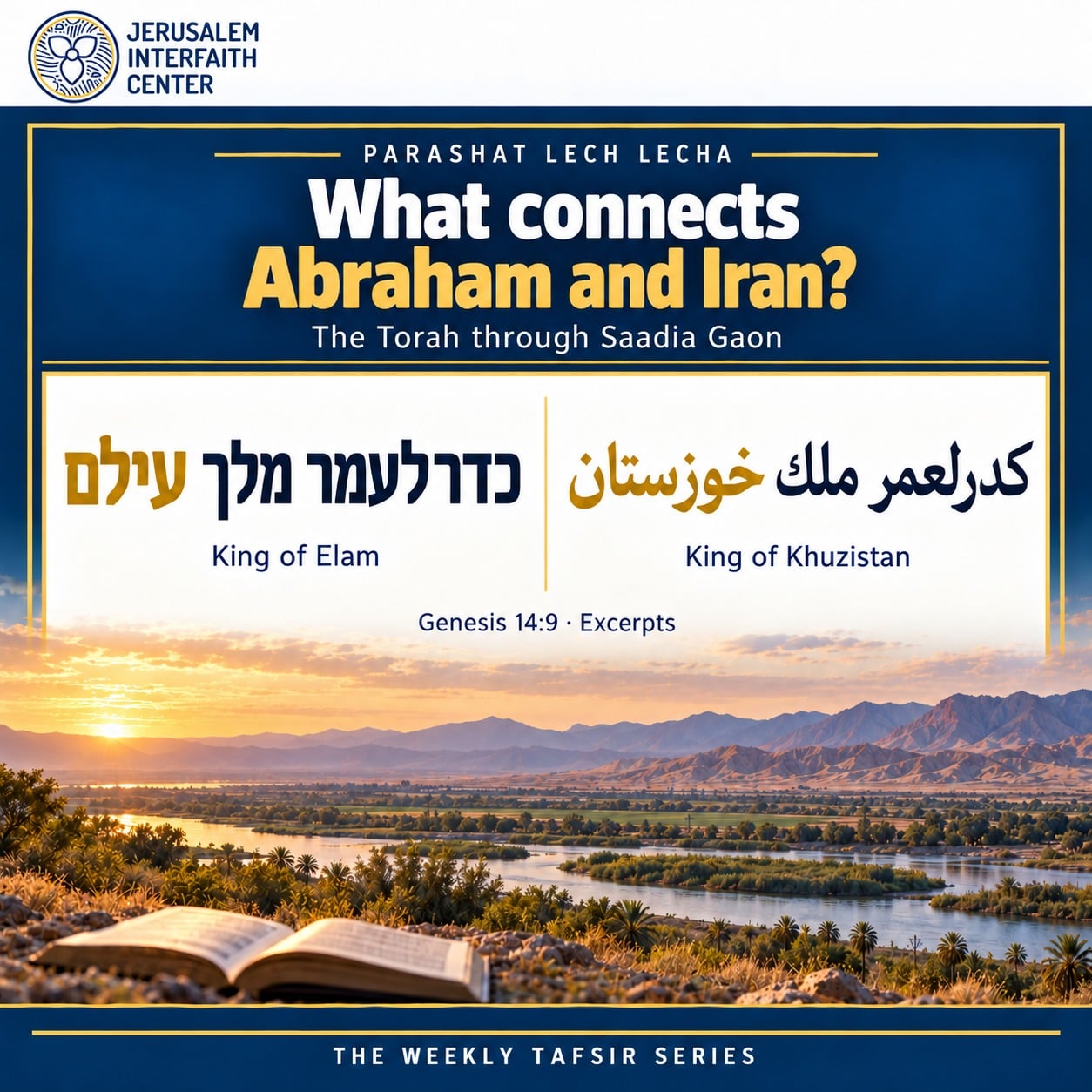
For example, this week’s Torah portion describes the war of the four kings against the five – what we might be termed as the Bible’s “First World War.” Chedorlaomer led the campaign, described as “Chedorlaomer, king of Elam” (Genesis 14:9).
Saadia translates this as: “Chedorlaomer, king of Khuzistan” (Kidurlaʿumir malik Khuzistan – كِدُرْلَعُمِرَ مَلِكَ خُوزِسْتَان).
Ancient Elam lay east of the lower Tigris, in what is today southwestern Iran. One of its most important centers was the city of Susa, which later also became a Persian capital – the very Shushan familiar to us from the story of Mordechai and Esther. The site lies in modern-day Khuzistan, Iran. The Book of Daniel similarly locates Shushan in Elam: “I was in Shushan the citadel, which is in the province of Elam” (Daniel 8:2).
As we have noted, more than a thousand years ago, Rabbi Saadia Gaon produced his monumental Arabic translation of the Torah, known as the Tafsir (تفسير) – an Arabic word meaning “interpretation” or “commentary,” derived from a root related to the Hebrew word pesher (“interpretation”). Saadia’s choice of words often reveals how he himself understood the deeper meaning of the biblical text. Each week, we select one verse from the weekly Torah portion and try to uncover a new insight that emerges from his translation.
Saadia systematically identifies Elam with Khuzistan elsewhere in his translation as well. He does something similar with other biblical locations, for example identifying Assyria with Mosul, a city in present-day Iraq. In other words, he replaces ancient biblical place names with geographical names that would have been familiar to his tenth-century readers – and which, in some cases, are actually more familiar to us as twenty-first-century readers as well.
The identification of Elam with Khuzistan was not invented by Saadia. It appears in geographical traditions that predate him, although modern scholarship understands ancient Elam as a larger and more complex geographical and political entity than Khuzistan alone.
The bottom line is that Saadia does not merely translate language; he also translates geography. Instead of leaving his readers with an ancient, obscure place name, he gives them a name they can locate on the map of the world they knew. With a single word, Saadia bridges a gap of thousands of years and brings the biblical world closer to the world of his readers.
Here too, a single Arabic word chosen by Rabbi Saadia Gaon helps us see another dimension of the biblical verse more clearly. And this is precisely one of the reasons why Saadia’s Tafsir is one of the great treasures of Jewish writing in Arabic. For centuries, it shaped the way Arabic-speaking Jews read and understood the Bible, and its influence extended far beyond translation alone.
In a divided and polarized world, differences of language can easily become yet another wall separating people.
In this weekly series, we are trying to demonstrate precisely the opposite: how the similarities and differences between Hebrew and Arabic can become a source of connection – and how the two languages can illuminate, through one another, profound ideas that neither language reveals in quite the same way on its own.
We owe a deep debt of gratitude to Rabbi Yom Tov Gindi of Kfar Chabad, who several years ago published Saadia Gaon’s Tafsir in a modern edition using Arabic script, making it accessible to all of us. We could not have embarked on this journey without his work, and we invite you to join us.
Shabbat Shalom, and see you next week!
Related Topics
Related Posts