
What does Ben Franklin have to do with Yom Kippur?
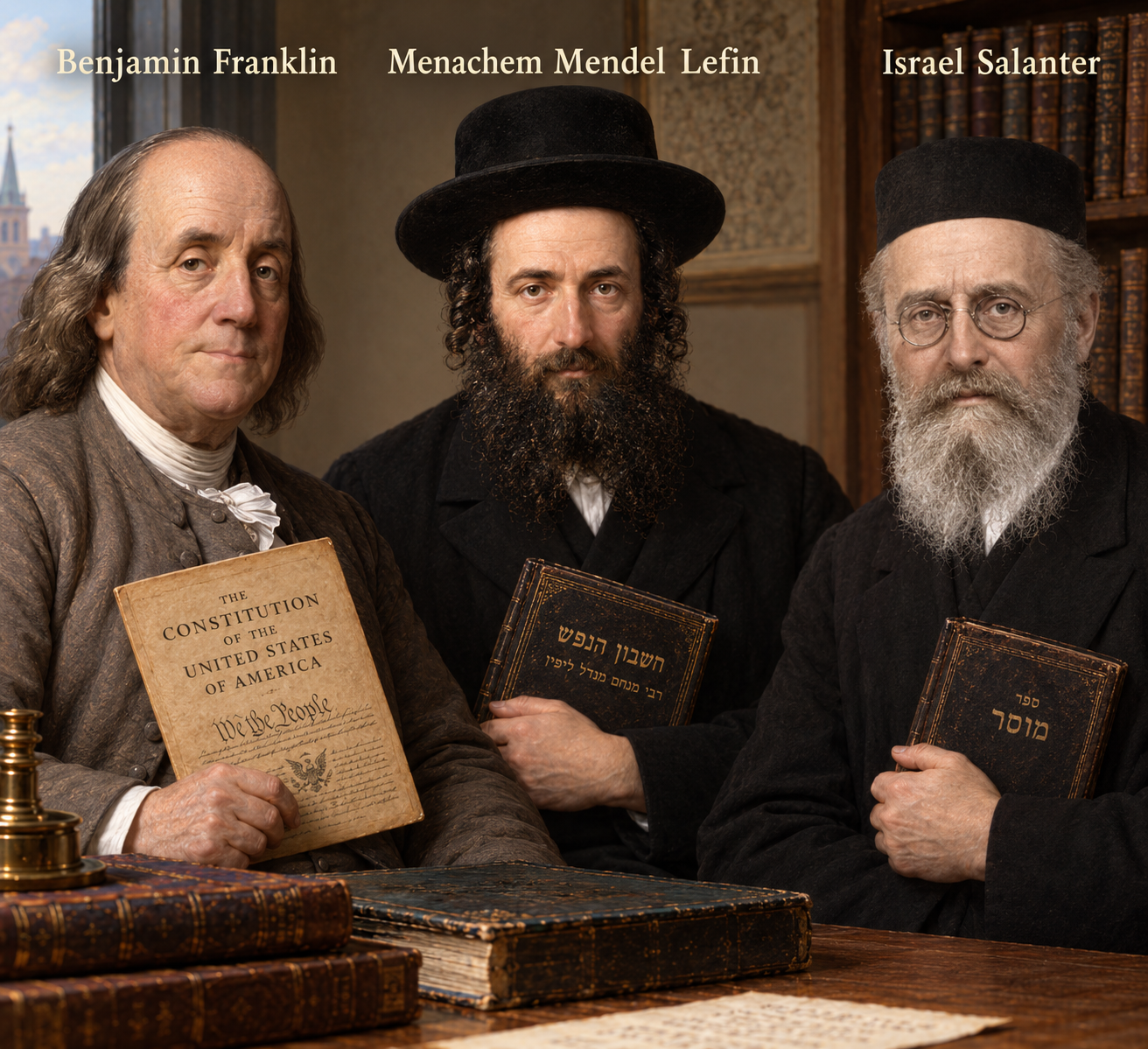
What does Benjamin Franklin have to do with Yom Kippur? A few years ago, I would have answered “nothing,” and I would have been confidently, completely wrong (I am, it turns out, wrong more often than I like to admit, a trait that will turn out to matter here).
Consider the calendar this year. Constitution Day, September 17, the anniversary of the day the delegates in Philadelphia signed their great and unfinished document in 1787, falls this year squarely inside the Aseret Yemei Teshuvah, the Ten Days of Repentance between Rosh Hashanah and Yom Kippur, just three days before Kol Nidre. Two peoples, an American one and a Jewish one, sitting down in the very same week to take an honest accounting of themselves. And it turns out that is not only an accident of the calendar. The two reckonings are quietly, historically, almost unbelievably linked, and the link runs straight through Benjamin Franklin.
Start with Franklin himself, because he is the hinge of the whole story. Printer, scientist, diplomat, the oldest man at the Constitutional Convention, and, less famously, a lifelong tinkerer with his own character. As a young man, he set himself what he called, in his autobiography and without a trace of modesty, “the bold and arduous project of arriving at moral perfection.” He drew up a list of thirteen virtues, temperance, silence, order, resolution, frugality, industry, sincerity, justice, moderation, cleanliness, tranquility, chastity, and humility, and he built himself a little book with a grid: the thirteen virtues down the side, the seven days of the week across the top. He would work on one virtue a week, thirteen weeks to a cycle, four cycles a year, marking a small black dot in the box each time he slipped. A scorecard for the soul centuries before anyone strapped on a fitness tracker or a SmartWatch.
Franklin was, to his great credit, honest about the results. Order defeated him for a lifetime. Humility he added to the list only because a friend told him he was insufferably proud, and he admitted he never truly acquired it, only the appearance of it; even if he ever conquered his pride, he wrote, he would probably end up “proud of my humility.” I find the great Franklin’s failures more instructive than his triumphs.
Now the turn that makes this a Jewish story. Franklin’s autobiography, thirteen-virtue chart and all, crossed the ocean and reached Rabbi Menachem Mendel Lefin of Satanów, an early figure of the Haskalah, the Jewish Enlightenment. Around 1808, Lefin published a slim and striking book of mussar, the Jewish discipline of character refinement, and called it Cheshbon Hanefesh, “an accounting of the soul.” Its method, the weekly virtue, the daily self-examination, the ledger of marks, was Franklin’s, very nearly line for line. What Lefin added was its Jewish soul: he rooted each trait in Torah and classical sources, turning a Philadelphia deist’s self-help experiment into a manual for refining the middot, the character traits (middot literally means “measures”).
And it did not stay a curiosity. Rabbi Israel Salanter, the founder of the modern Mussar movement, encouraged the book’s reprinting and made its method a central tool of his mussar houses; from there it traveled into the great Lithuanian yeshivot, into Slabodka and Mir and Novardok, where students bent over Franklin’s grid as an instrument of teshuvah, of return.
Sit with that image for a moment: a self-improvement chart drawn up by a man who would sign both the Declaration of Independence and the Constitution, studied by rabbis as a ladder toward holiness. Salanter, who had little love for the Enlightenment, almost certainly knew the source and taught the method anyway; wisdom, apparently, is kosher wherever you find it.
Franklin, for his part, was a good neighbor to living Jews and not only to their bookshelves. In 1788, when Philadelphia’s Congregation Mikveh Israel was buried in debt from building its synagogue, the congregation appealed in print to their “worthy fellow Citizens of every religious Denomination.” Franklin was among the first to answer, giving five pounds, a lot of money in those days; he had also signed the public subscription for their earlier building. He was no scholar of Judaism, but when the city’s oldest synagogue needed a hand, his was on the list.
A word on Maimonides, because I suspected a connection and want to be honest about what I found. When we say, “Maimonides’ Thirteen Principles,” we usually mean his Thirteen Principles of Faith, the articles of belief we echo in the Yigdal hymn and in the “Ani Ma’amin” (I Believe) declaration. Those are a creed, not a program of virtues, and the shared number thirteen is a beautiful resonance rather than a real line of descent. I could also throw in that originally we had thirteen colonies, but I don’t want to reach.
The genuine Maimonidean thread runs through his ethics. Lefin built Cheshbon Hanefesh on the Rambam’s Hilchot De’ot, the Laws of Character, and its teaching of the “middle path,” the golden mean between extremes. And Hilchot De’ot asks a bold question: what does it actually mean to fulfill the commandment to “walk in His ways”? The Rambam answers by quoting the Sages: “just as He is called gracious, so you be gracious; just as He is called merciful, so you be merciful.” In other words, we become good by imitating God’s own traits.
Now look at which traits he names first. Gracious. Merciful. Chanun and rachum. Those are not random examples; they are lifted straight from the Thirteen Attributes of Mercy, the Shalosh Esrei Middot, that we chant on Selichot and on Yom Kippur until the words wear smooth. The Torah gives them to us in the rawest possible moment, in Exodus 34, right after the golden calf, when God passes before Moses and proclaims Himself “compassionate and gracious, slow to anger, abounding in kindness and truth.” The Talmud pictures God at that moment wrapping Himself like a prayer leader, a chazzan at the amud, showing Moses the order of the words and making a promise: whenever Israel performs this order, I will forgive them. It is the closest thing our tradition has to a covenant of second chances, and it is the spine of the whole Day of Atonement; at Ne’ilah, as the sun goes down and the gates begin to close, we call the thirteen out over and over, seven times, as if we cannot bear to let them go.
Here is why that matters for a piece that began with Benjamin Franklin. We call those thirteen the Thirteen Middot, the thirteen measures, the very same word, middot, that names the character traits Lefin set out to refine and that a mussar student tracks in the margins of a little book. On Yom Kippur we praise thirteen middot in God. The rest of the year we are asked to build thirteen middot in ourselves. And the quiet claim underneath Franklin’s chart, Lefin’s ledger, and the Rambam’s law is one and the same: the attributes we sing are meant to become the habits we live. Thirteen, the age we call a child into responsibility for exactly that work; thirteen, the numerical value of echad, “one.”
Which brings us back today, and to those two reckonings sharing a single week. Look closely at what the framers built in Philadelphia. They did not claim to have written something perfect. They wrote a document designed to be amended, a national confession, in effect, that the people who signed it would get things wrong and would need a way to correct themselves. The Constitution is a kind of national cheshbon hanefesh: a covenant that takes its own imperfection for granted and builds in the machinery of return.
No one on that floor understood this better than Franklin. On September 17, 1787, he was eighty-one, frail, worn down by gout and a kidney stone, too weak even to read his own remarks, so he handed them to his fellow Pennsylvanian James Wilson to read aloud. The speech, preserved in James Madison’s notes of that final day, is a small masterpiece, and it could double as a drasha, a sermon, or a blog post for the Days of Awe. “I confess,” it begins, “that there are several parts of this Constitution which I do not at present approve, but I am not sure I shall never approve them.” It goes on: “the older I grow, the more apt I am to doubt my own judgment, and to pay more respect to the judgment of others.” And then the plea that convinced a divided, exhausted room into signing: a wish that every member “who may still have objections to it, would with me, on this occasion doubt a little of his own infallibility.”
Doubt a little of his own infallibility. I know of no better one-line summary of Yom Kippur. The entire day is an argument against our own certainty, a structured insistence that we may be wrong, that we ought to look again, that the person we were is not the person we are sentenced to remain. The Thirteen Attributes we chant are God’s half of that argument, the standing promise that mercy is available; Franklin’s chart, and Lefin’s after it, are our half, the daily discipline of actually changing. Attributes above, dots in a little book below, and teshuvah is the current that runs between them.
There is one more Franklin moment from that day, and it belongs to this season more than any other. As the last delegates came forward to sign, Franklin looked at the sun painted on the back of Washington’s chair and remarked that painters have always struggled to tell a rising sun from a setting one; he had stared at it through all the long weeks of argument, he said, unable to know which it was, “but now at length I have the happiness to know that it is a rising and not a setting sun.”
Think of where we meet that same sun in our own liturgy. At Ne’ilah the gates swing shut precisely as the sun goes down, and still, standing in the failing light, we insist on beginning again. That is the whole audacity of teshuvah: to sit in the dusk and stake everything on a sunrise.
So here is what I will be holding this week, as the two calendars agree. You do not have to be a founding father or a head of school to keep the ledger; you need only a quiet page, an honest look, and the nerve to mark the dot where you fell short and resolve to do better next week. Franklin kept his account in a little book. Lefin taught our great-great-grandparents to keep theirs. We keep ours in the machzor, the High Holiday prayer book, in the day’s whispered confessions, in the resolutions we make when no one is watching. A nation renews itself by amendment; a soul renews itself by teshuvah; a people renews itself one honest accounting at a time. Franklin, the story goes, was asked as he left the hall what kind of government the delegates had given us, and answered, “A republic, if you can keep it.” A republic, if you can keep it. A soul, a covenant, a people, if you can keep them. This year the American calendar and the Jewish one hand us the same assignment. May all of us, on both accounts, be sealed for good.
A Note on Sources
Franklin’s thirteen virtues and his rueful “proud of my humility” are from his Autobiography. His words on the Convention’s final day, the wish that each delegate “doubt a little of his own infallibility” and the remark about “a rising and not a setting sun,” are preserved in James Madison’s notes for September 17, 1787; too frail to speak, Franklin had the speech read aloud by James Wilson. “A republic, if you can keep it” comes to us secondhand, through the diary of James McHenry. Franklin’s 1788 gift to Congregation Mikveh Israel is recorded in the congregation’s own appeal. On the Jewish side, Maimonides on imitating God’s ways is in the Mishneh Torah, Hilchot De’ot 1:6; the divine attributes are proclaimed in Exodus 34:6, and the image of God teaching Moses their order appears in the Talmud, Rosh Hashanah 17b. On Lefin’s debt to Franklin, see Nancy Sinkoff, “Benjamin Franklin in Jewish Eastern Europe: Cultural Appropriation in the Age of the Enlightenment,” Journal of the History of Ideas 61 (2000): 133-152, and her entry on Lefin in the YIVO Encyclopedia of Jews of Eastern Europe.