
What Does Shemittah Have to Do with Smartphones? – B’har-B’hukkotai 5786
So this past week, I was in a supermarket, and I went to the front desk because I could not find the Cape Cod chips in the 100-calorie bag. I am trying to eat healthily. 😉
The woman behind the customer service desk and I had an interaction that went like this:

https://www.flickr.com/photos/jeepersmedia/49325404916
“Hi!”
She was looking down at her phone.
“How can I help you?” she murmured.
I explained what I was looking for.
No reply. She kept texting.
“Um… do you know where these chips are?”
Still looking down, she said, “Aisle 12B, right side, one-third of the way down, bottom shelf.”
“Thanks…”
And the amazing thing is, she was totally helpful. She knew exactly where the item was.
But in the entire interaction, she never looked at me.
Not once.
But, it’s not just her; I know I do this too. I can be on my phone and lose the sense that I am on my phone. I can be connecting lightly with people somewhere else, while not really connecting with the person right in front of me.
And when that happens, I am not only missing the other person.
I am missing the world around me.
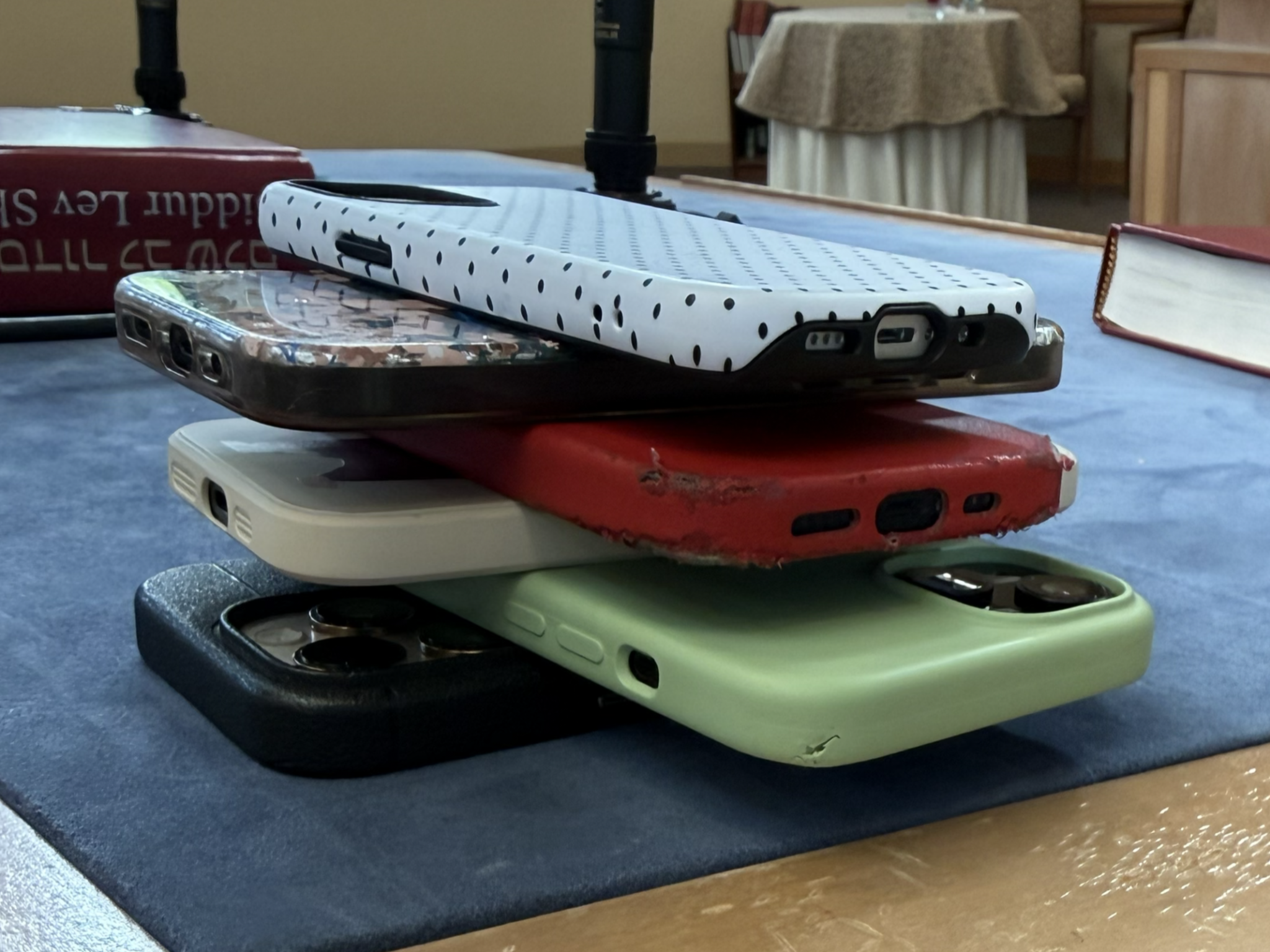
That is why the first thing I do in my classes, as I did this past Wednesday night with our teens, is ask everyone to take out their phones, mine included, and put them face down in the middle of the room. We make a kind of Jenga tower of phones.
It’s a kind of ritual.
For this hour, we are with each other.
***
Jonathan Haidt, the social psychologist at NYU Stern and author of The Anxious Generation, has helped shift our attention to the damage that phones and social media are doing to children and teens.
Seth Kaplan, a lecturer at Johns Hopkins and author of Fragile Neighborhoods, adds another important piece. He writes that phones “did not simply replace something good”; they “filled a void created by the earlier loss of community and the decline of the play-based childhood.”
In other words, it is not enough to take away the phones. We have to give our children, and ourselves, something richer in their place.
Kaplan calls us to rebuild “the social architecture that makes off-screen life rich and compelling.”
Robert Putnam, the Harvard political scientist and author of Bowling Alone and Lexington resident, documented how much our civic and communal lives have weakened over time.
Just this week, I read a piece in Vox by Sara Radin about “neighborism,” a renewed interest in getting to know the people around us. As she puts it, “proximity is a resource.” And Eric Klinenberg, the NYU sociologist and author of Palaces for the People, calls places like libraries, playgrounds, parks, sports facilities, and green spaces part of our “social infrastructure.”
And I would add shuls/synagogues and other religious centers.

These are the places that make local ties possible.
The park, the sidewalk, the playground, the shul, the classroom, the supermarket counter, these are places where life happens.
********
Now, surprisingly, neither of this morning’s Torah portions, B’har or B’hukkotai, discusses cell phones.
But the Torah speaks very clearly to this moment.
Our parashah opens:
וַיְדַבֵּר יְיָ אֶל־מֹשֶׁה בְּהַר סִינַי לֵאמֹר… וְשָׁבְתָה הָאָרֶץ שַׁבָּת לַייָ
“Adonai spoke to Moses on Mount Sinai, saying… the land shall observe a Sabbath of Adonai.”
The Torah then teaches the mitzvah of shemittah. For six years, the land is worked. In the seventh year, the land rests. That’s shemittah.
Rashi, our great 11th century French commentator, basing himself on the earlier rabbinic midrash in the Sifra, famously asks:
מַה עִנְיַן שְׁמִטָּה אֵצֶל הַר סִינַי
“What does shemittah have to do with Mount Sinai?”
And then he adds:
וַהֲלֹא כָּל הַמִּצְוֹת נֶאֶמְרוּ מִסִּינַי
“Weren’t all the commandments spoken from Sinai?”
Why does the Torah mention Sinai here, specifically with shemittah?!
The Sifra’s answer, which Rashi brings, is that just as shemittah was given at Sinai with its broad principles and all its details, so too all the mitzvot were given at Sinai with their broad principles and all their details.
The Talmud deepens this teaching: plant for six years and rest in the seventh, so that you will know that the land belongs to God.
That is a radical idea.
We work the land.
We harvest from it.
We build upon it.
We may even own it legally.
But every seventh year, we are invited to stop and remember: this is not ultimately ours.
The earth does not belong to us.
We belong to it, and all of it belongs to God.
Rabbi Art Green broadens this teaching by citing the Mishnah in Pirkei Avot, which states that the world was created with ten divine utterances. God says, “Let there be,” and the world comes into being.
Those ten utterances from Sinai are not gone.
They are still here, still pulsing through creation, still present in the earth, the trees, the sky, the animals, and the people around us.
At Sinai, those ten utterances of creation become the Ten Commandments, the Aseret Hadibrot. Creation and revelation are connected. The mitzvot are the path that helps us notice the divine presence that was already woven into the world from the beginning.
And shemittah takes the idea of Shabbat and applies it not only to people, but to the land itself.
The land gets to rest.
The earth is alive with holiness.

The Sefat Emet, Rabbi Yehudah Aryeh Leib Alter of Ger, my favorite mystical commentator, reads Rashi’s question not just as a technical question about where a mitzvah was given, but as a spiritual question: what does Sinai have to do with stopping, releasing, resting, and becoming free?
For the Sefat Emet, shemittah is connected to Sinai because both teach us how to interrupt a habit.
We get caught in the endless cycle of producing, consuming, checking, responding, working, and striving.
Shemittah says: stop.
Stop long enough to notice the land.
Stop long enough to notice the person in front of you.
Stop long enough to hear the call of Sinai again, which is always there, inviting us to listen.
Sinai is the discipline of stopping long enough to see the holiness that is already here.
In the land.
In our neighborhoods.
In our children.
In the person standing in front of us.
In the natural world that we so often walk through without really seeing.
And maybe this is why the teaching speaks so strongly to our moment.
We live in a majestic world filled with grandeur and beauty. We live in a world of trees and sky, soil and animals, neighbors and strangers, children and elders, all of them can be seen as inviting us into connection, into relationship.
And our phones, useful as they are, pull us away from that presence.
So I want to try a small step, and I am saying it publicly so you can help hold me to it.
I am going to try not merely to silence my phone, not merely to put it on vibrate, but actually to turn it off, even if only for a few minutes, and go for a walk outside.
Rashi did not ask what shemittah had to do with smartphones.
But the deeper question is the same: can we stop long enough to remember whose world this is, who is standing before us, and what it means to truly be present?
The woman in the supermarket helped me find the chips.
But our tradition is asking us to find something more.
To find each other.
To find the land.
To find the holiness that has been here since creation, waiting for us to look up.