What Flydubai Reveals About the Nobel Prize
Had the attempted Flydubai hijacking succeeded, would we have accepted the UN explaining that the murder of hundreds of innocent people “did not happen in a vacuum”? And would we have awarded someone who supported those words the Nobel Peace Prize?
Had the Omani co-pilot succeeded in his alleged plan to crash Flydubai Flight FZ1073 into Ben Gurion Airport, more than 170 people on board could have been murdered, alongside potentially many more on the ground. Thankfully, the attack failed. The injured captain and those who intervened prevented what could have become one of the worst acts of aviation terrorism since September 11.
But imagine the alternative. Imagine the funerals, grieving families and shockwaves across Israel and beyond. Then imagine prominent international figures responding by stressing the historical grievances, political frustrations and perceived injustices that may have contributed to the attack.
Would that have felt appropriate? Would we have welcomed hearing that such an atrocity “did not happen in a vacuum”? I doubt it.
Most people instinctively understand that when innocent civilians are deliberately targeted, moral condemnation comes first. Historical analysis can follow. That distinction lies at the heart of a troubling question raised by the Nobel Peace Prize awarded this week to Navi Pillay.
On October 24, 2023, just seventeen days after Hamas terrorists murdered approximately 1,200 people, committed acts of sexual violence and kidnapped 251 hostages, UN Secretary-General António Guterres told the Security Council that the attacks “did not happen in a vacuum.”
To be clear, Guterres also stated that Palestinian grievances could not justify the massacre. He condemned Hamas unequivocally. Nevertheless, the phrase provoked outrage across Israel because many felt it shifted attention, however unintentionally, from the perpetrators to the circumstances surrounding their actions.
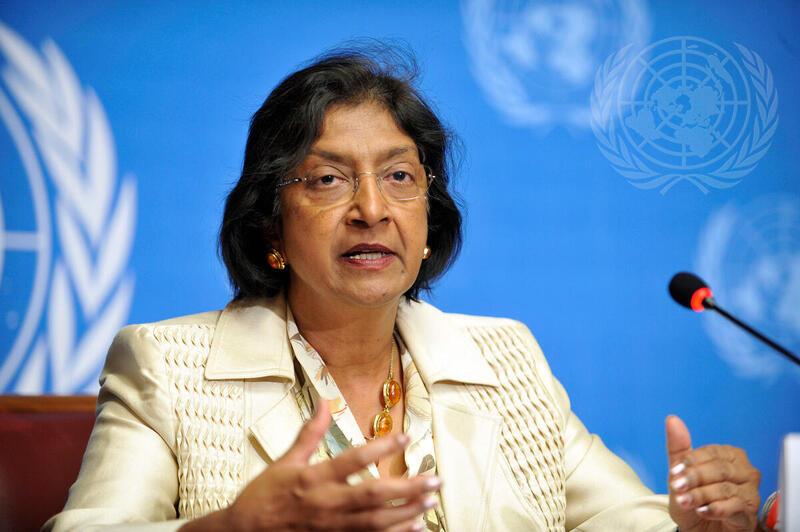
The following day, October 25, Navi Pillay, chairing the UN Commission of Inquiry into the conflict, explicitly supported Guterres. At a UN press briefing, she reportedly stated: “The Secretary-General, in my view, made a correct statement.”
Pillay argued that the attack was not isolated and had to be understood in its wider context, referring to Palestinian desperation and oppression. This was just eighteen days after October 7, while hostages remained in captivity and communities were still reeling from the attack.
Eight months later, in June 2024, Pillay returned to the same argument while presenting her Commission’s findings:
“The 7 October attack in Israel and Israel’s subsequent military operation in Gaza have not occurred in a vacuum.”
She also explicitly stated that unlawful actions by one party cannot justify unlawful actions by another. I acknowledge that distinction. My concern is not that she expressly excused Hamas, but that she repeatedly chose to frame October 7 through the historical grievances surrounding the conflict.
Of course, terrorism has a context. September 11 did. The July 7 London bombings did. October 7 did. The attempted Flydubai massacre did. Virtually every terrorist believes he is responding to some grievance, real or imagined.
Words matter. Language signals priorities and establishes emphasis. When civilians are murdered, raped and kidnapped, condemnation should occupy centre stage, not historical contextualisation.
This is why the Nobel Committee’s decision deserves scrutiny.
Navi Pillay has unquestionably had a distinguished career. Her opposition to apartheid, contributions to international law and decades of human rights work are significant achievements that deserve recognition.
The Nobel Peace Prize, however, is more than a lifetime achievement award. It is one of the world’s highest moral honours. Recipients become symbols not merely of accomplishment but of the judgement and values the Committee wishes to celebrate.
In awarding Pillay the Nobel Peace Prize, the Committee has recognised her distinguished career. But it cannot ignore the fact that the Middle East has become one of the world’s most politically charged issues, used by governments, international organisations and activists to advance competing agendas. Pillay’s leadership of the UN Commission of Inquiry into October 7 and the subsequent war in Gaza was among her most prominent and controversial recent public roles.
I cannot know what weight the Nobel Committee gave to her statements, but I believe they should have mattered enormously. This is not about expecting her to support Israel or dismiss Palestinian suffering. It is about the moral judgement we should demand from someone receiving the world’s most prestigious peace award.
For those of us living in Israel, October 7 was not an abstract political event. It was the murder of people we knew, the destruction of communities and the kidnapping of innocent civilians. That reality must never become secondary to political narratives, whatever their source.
Had the Flydubai attack succeeded, I would have expected unequivocal condemnation before discussion of the attacker’s grievances. October 7 deserved exactly the same.
Terrorism may have a context. It never has an excuse.
I believe the Nobel Committee has failed to give that distinction the weight it deserves.