


What happens if WhatsApp goes dark on Election Day?
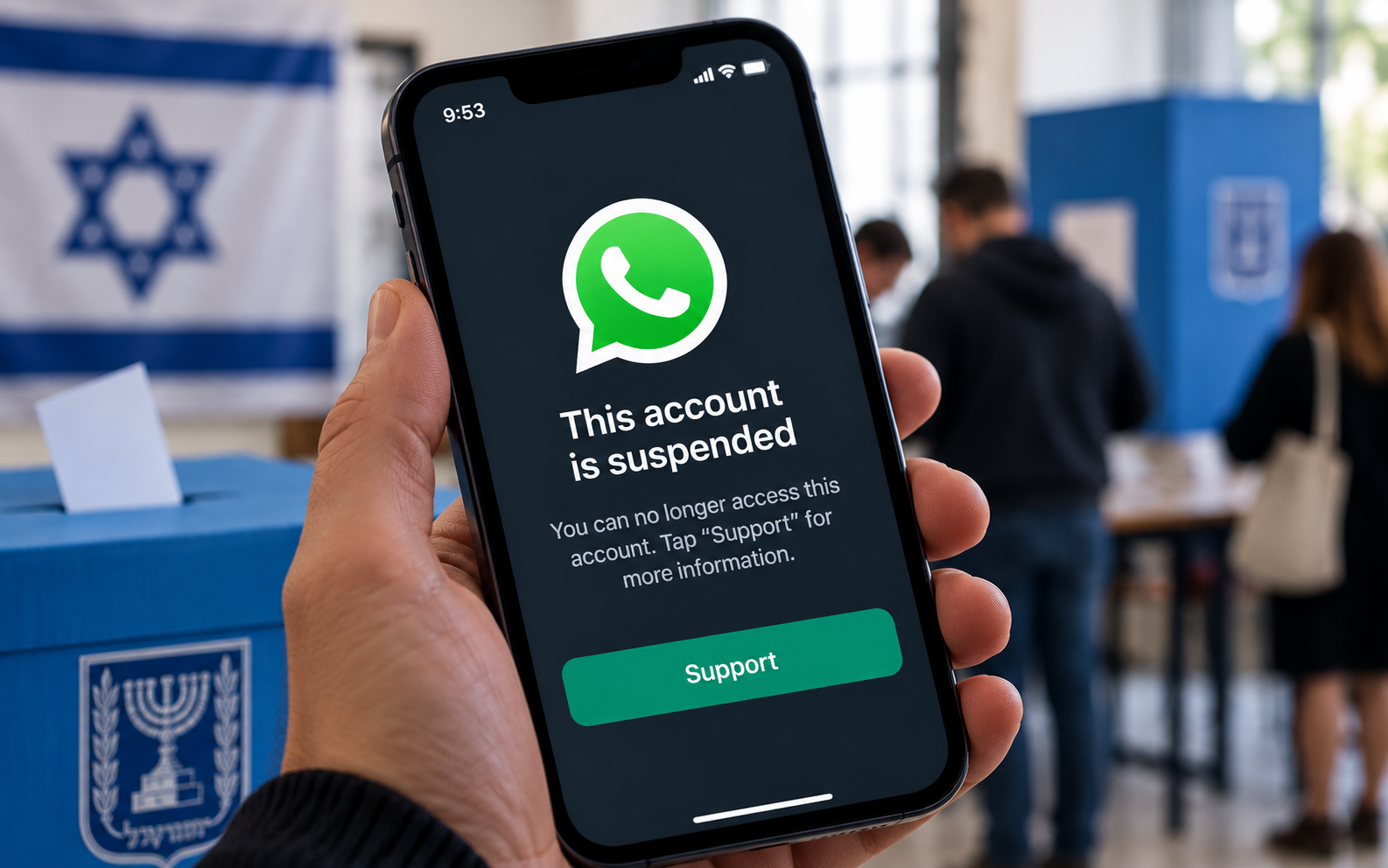
It’s Tuesday morning, October 27. A WhatsApp group connecting the Central Elections Committee to hundreds of polling station secretaries is suddenly suspended. Elsewhere, a campaign manager discovers that her account has been banned, cutting her off from the activists she coordinates. A political party loses access to groups it has spent months building, just as its get-out-the-vote operation reaches its most critical hours. Activists await instructions, transportation arrangements need adjusting, and polling station observers need information. By the time the accounts are restored, the election may be over.
None of this requires a cyberattack or sophisticated foreign interference. WhatsApp, owned by Meta, relies on automated systems to identify spam, fraud and other violations. These systems examine activity patterns, including message frequency, group creation and new participants. On Election Day, previously quiet accounts may suddenly become extremely active. Campaign workers send hundreds of messages, create groups and contact unfamiliar numbers. To a campaign manager, this is Election Day. To an automated system, it may look suspicious.
There is another possibility. Because WhatsApp messages are end-to-end encrypted, the company cannot ordinarily read private conversations. It therefore relies partly on user reports to identify prohibited activity. Reported messages and related information may become available for review. But this safety mechanism can be exploited: coordinated false reports alleging serious violations may be used to trigger enforcement against political opponents.
And here is the uncomfortable question: Who would anyone call?
Israel has quietly moved much of its organizational infrastructure onto WhatsApp. Beyond family conversations and neighborhood groups, it supports the daily coordination of public institutions, political organizations, emergency services, businesses and civil society. Approximately 99 percent of Israeli adults use WhatsApp, according to the Israel Internet Association. During elections, parties coordinate campaign headquarters, activists, observers and transportation through it. Civil society organizations organize volunteers. Even the Central Elections Committee communicates with polling station secretaries on WhatsApp.
There is a fundamental mismatch between what WhatsApp was designed to be and what it has become. Its architecture and enforcement systems were built primarily for personal communication. In Israel, however, it functions as organizational infrastructure. Activity that may look abnormal through the lens of a personal messaging service can be perfectly legitimate — and essential — for a political campaign or public institution. Enforcement systems must reflect the actual social and institutional roles of the services they govern.
Yet WhatsApp belongs to a private company whose enforcement decisions are made through systems largely outside Israel, without a clearly established local address for resolving urgent suspensions. Blocking a central account or large group can disrupt hundreds or thousands of people. A few failures at critical points could paralyze much larger operations.
There is reason to take this seriously. In 2023, reports emerged in Israel of attempts to target protest activists through malicious reporting. Later that year, WhatsApp simultaneously blocked the accounts of approximately ten Yesh Atid members of Knesset. Authorities examined suspicions of coordinated malicious activity, although the cause was never conclusively established.
During the summer of 2026, Israeli users reported waves of unexplained WhatsApp suspensions. Some were blocked after connecting through their computers; others were blocked again shortly after reinstatement. A request to certify a class action was filed, alleging inadequate explanations and ineffective appeals. Similar incidents occurred in India and Indonesia, where a WhatsApp representative acknowledged an enforcement-system error that had caused mistaken suspensions globally.
We cannot predict how many accounts might be mistakenly blocked during Israel’s elections. Much of the information needed to assess the risk remains with Meta. But documented errors, opportunities for malicious reporting and the intensity of Election Day activity demand preparation.
WhatsApp users whose accounts are blocked may, when the option is available, request a review. According to the company, reviews are generally conducted within 24 hours. That may sound reasonable for customer service. On Election Day, it is almost meaningless. A voter who missed transportation to a polling station cannot be driven there tomorrow. An observer who missed a critical shift cannot return after the polls close.
What is missing is a clear emergency procedure for disruptions to essential electoral activity. Does a campaign manager contact customer support? Does a polling station secretary turn to the Central Elections Committee? Who at Meta can distinguish an ordinary enforcement decision from an attempt to disrupt an election? Who can request immediate human review, and how quickly?
Israel’s Central Elections Committee says it has a direct communication channel with Meta. Meta regularly describes its preparations to protect elections worldwide. Yet a statement issued this week by Meta’s independent Oversight Board offers a sobering reminder of the gap between assurances and reality. The Board warned of recurring enforcement failures, citing mistaken removal of political activist accounts in the United States and restrictions affecting the advertising accounts of Brazil’s President Luiz Inácio Lula da Silva. It questioned why Meta’s mistake-prevention and human-review mechanisms had failed, and criticized the absence of meaningful public measures of its election-protection efforts. These incidents did not involve WhatsApp specifically, but they show why dedicated teams and communication channels cannot guarantee timely correction of serious errors.
Election protection has traditionally concentrated on disinformation, deepfakes, foreign interference and harmful content. These threats matter. But mistaken enforcement can also undermine democratic participation when a messaging service has become essential to organizing it.
Before the elections, Meta must assess and stress-test its WhatsApp enforcement systems against the expected surge in legitimate activity. It should monitor unusual spikes in suspensions, identify systemic errors in real time and ensure sufficient human reviewers for urgent cases. Afterward, it should disclose how many accounts were blocked, how many decisions were reversed and how long reviews took.
The Central Elections Committee and Meta must also ensure their existing communication channel covers WhatsApp suspensions, not just harmful content on Facebook and Instagram. They need designated contacts, criteria for identifying urgent cases and a timeframe for expedited human review. “We have forwarded the matter to our team in Ireland” is no answer while polling stations are open.
This would not empower the Committee to order reinstatements or exempt political parties from WhatsApp’s rules. It would establish a way to address enforcement mistakes whose consequences extend far beyond individual users. Israeli election authorities must also prepare alternative arrangements for essential communications that should not depend entirely on one commercial service.
A democracy should not depend on whether an automated system at a technology company gets it right on Election Day. And certainly not on whether someone at that company answers an appeal before the polls close.