What I brought from Baku to Capitol Hill
When I traveled from Baku to Washington, I did not come merely to speak about religious tolerance. I came to describe a reality that I live every day, one that too many people outside Azerbaijan still find surprising.
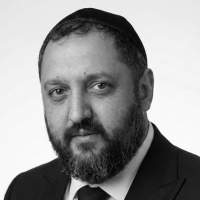
I am a rabbi in a Muslim-majority country.
I lead the Sephardi Jewish community of Baku, where our synagogue, Jewish school, kindergarten, mikveh, kosher services and rabbinical court operate openly and freely. Our children study Hebrew, Torah, Jewish history and Jewish tradition while receiving a modern education and growing up as proud citizens of Azerbaijan.
For us, these two identities are not in conflict. We are fully Jewish and fully Azerbaijani. That was the message I carried with me to Capitol Hill.
I participated in a religious freedom forum organized by the IRF Secretariat alongside Pastor Rasim Khalilov, chairman of the Azerbaijan Bible Society and a leader of Azerbaijan’s Protestant community. Religious leaders and delegates from around the world gathered with US officials, senators and political figures to discuss freedom of faith and the treatment of religious minorities.
The sight of a rabbi and a Protestant pastor speaking on behalf of a predominantly Muslim country may have challenged some expectations. But in Azerbaijan, our appearance together was not unusual. It reflected the country we know.
There is an old mosque across from the synagogue where I pray in Baku. Sometimes, when I meet its imam, I greet him in Arabic: “Assalamu alaikum.” He answers me in Hebrew: “Boker tov.”
It is a small exchange, but it expresses something important.
Coexistence is not meaningful when it exists only in conference declarations, government documents or carefully worded speeches. It becomes meaningful when it can be seen in the ordinary encounters of daily life: outside a synagogue, in a classroom, between neighbors and among citizens who follow different faiths but share the same country.
Identity without suspicion
During my visit, I spoke about a question that affects religious minorities in many countries: Must a person choose between devotion to faith and loyalty to the state?
My answer is no.
A Muslim does not become less Muslim by respecting a synagogue. A Christian should not have to conceal his faith to demonstrate his patriotism. A Jew does not become less Jewish by loving and serving his country.
Yet Jews in many parts of the world continue to encounter suspicions of “dual loyalty.” They are sometimes expected to prove that their connection to the Jewish people or to Israel does not diminish their commitment to the countries in which they live.
In Azerbaijan, I do not experience my Jewish and Azerbaijani identities as rival loyalties. The state does not ask our community to become less Jewish in order to belong. Our Jewish institutions are visible, our religious life is active and our children are taught to value both their heritage and their citizenship.
This does not mean that any society is perfect or that its model can simply be copied elsewhere. It does mean that Azerbaijan offers an experience worth examining at a time when Jewish communities in parts of Europe and elsewhere are confronting growing insecurity and antisemitism.
Religious freedom should not be measured only by what a constitution promises. It should be measured by whether a Jewish child can walk into a Jewish school without feeling that his identity must be hidden, whether a community can maintain its institutions and whether religious minorities are treated as permanent and equal members of the nation rather than as temporary guests.
By that measure, Jewish life in Azerbaijan has something important to teach.
More than a diplomatic alliance
Azerbaijan’s relationship with Israel is often discussed in strategic terms. Those considerations are real and important. Azerbaijan is a Muslim-majority country that has developed a close partnership with the Jewish state, and its geographic position gives it particular significance in a complicated region.
But the relationship is not built only on energy, security or geopolitics.
It is also rooted in the human connection between Azerbaijan and its Jewish citizens, as well as in the respect many Azerbaijanis have for the Jewish people and for Israel.
For generations, Jewish communities in Azerbaijan have been able to live openly and maintain their traditions. During the Holocaust, more than 55,000 Jews fleeing Nazi-occupied territories found refuge in Azerbaijan, where local families offered them shelter and shared what little they had. Today, Azerbaijani students learn about the Holocaust and the dangers of antisemitism.
Before the Capitol Hill forum, Pastor Khalilov and I met with Eric Trump. We discussed the importance of stronger relations between Washington and Baku. He described Azerbaijan as a friend of the United States and as a strategic partner of Israel.
That friendship deserves greater attention in Washington.
Azerbaijan sits at the meeting point of Europe, Asia and the Middle East. As the regional order changes, the United States has an opportunity to deepen its engagement with a country that has demonstrated both strategic reliability and an ability to maintain religious diversity within a Muslim-majority society.
The planned Trump Route for International Peace and Prosperity, or TRIPP, illustrates the broader possibilities. The proposed corridor through Armenia would connect Azerbaijan with its Nakhchivan exclave and Turkey, while strengthening wider transportation links between Central Asia and Europe.
Such projects are not only about roads and commerce. They can create connections between peoples and offer the South Caucasus an alternative to permanent isolation and conflict.
This is also why the future of Section 907 of the US Freedom Support Act deserves serious reconsideration. The provision restricts certain forms of direct American assistance to the Azerbaijani government, subject to presidential waiver.
In my view, it has constrained deeper American engagement with Azerbaijan at a time when Washington is seeking a stronger role in a region historically influenced by Russia and Iran.
A law adopted more than three decades ago should not prevent the United States from responding to the realities and opportunities of today.
The message I carried home
My journey to Washington reinforced my belief that religious leaders have a responsibility beyond their own communities. We must protect our traditions, but we must also build bridges between people who may know one another only through stereotypes.
I did not travel to the United States to claim that Azerbaijan has solved every challenge of coexistence. I traveled to share the experience of a Jewish community that is able to live openly, educate its children, maintain its religious institutions and participate fully in the life of a Muslim-majority nation.
The world often speaks about dialogue between Muslims, Jews and Christians as an aspiration. In Azerbaijan, I see it in the imam who answers my Arabic greeting in Hebrew. I see it when Jewish children study Torah while growing up proud of the country they call home. I saw it again when Pastor Khalilov and I stood together on Capitol Hill to represent the same nation.
Azerbaijan’s model deserves to be better known, not because it should be presented as a perfect formula, but because it demonstrates a principle the world urgently needs to remember.
A strong religious identity does not weaken national unity. When it is respected, it can strengthen it.