


What If a U.S. President Pulled a de Gaulle?
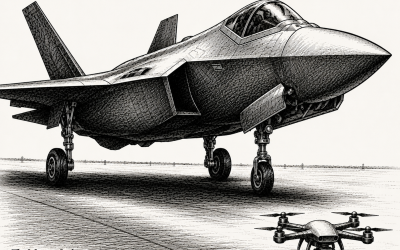
“You don’t need a weatherman to know which way the wind blows.”
— Bob Dylan
In June 1967, only days after Israel’s stunning victory in the Six-Day War, French President Charles de Gaulle imposed an arms embargo on Israel. Overnight, the nation that had become Israel’s principal supplier of advanced fighter aircraft closed the door.
For most countries, such a decision would have created a strategic crisis.
For Israel, it became a strategic lesson.
Rather than simply searching for another supplier, Israel transformed itself. It modified existing aircraft, developed indigenous avionics, built world-class electronic warfare capabilities, and eventually created aircraft such as the Nesher and the Kfir. More importantly, it learned that long-term military superiority depends less on the nationality of an aircraft than on a nation’s ability to innovate faster than its adversaries.
History is valuable not because it tells us what happened.
History is valuable because it teaches us what to do when something similar happens again.
Today, as geopolitical alliances become less predictable and American foreign policy becomes increasingly debated across the political spectrum, Israel should ask a strategic—not political—question.
What if another great power one day “pulled a de Gaulle”?
The answer should not begin with panic.
It should begin with history.
Israel’s greatest strategic advantage has never been the aircraft it purchased. It has been the doctrine it developed around those aircraft. From the Mirage III to the Phantom, from the F-15 to the F-35, Israel consistently transformed imported platforms into uniquely Israeli combat systems through superior training, intelligence, electronic warfare, software, and operational innovation.
The lesson of the past sixty years is clear: military superiority has never depended exclusively on possessing the newest fighter. It has depended on integrating technology, doctrine, intelligence, and operational creativity into a coherent system.
If American military ties were someday to become less exclusive, Israel would almost certainly pursue several parallel strategies. It would expand cooperation with other advanced aerospace partners, seek participation in next-generation fighter programs, extend the operational life of existing aircraft through indigenous upgrades, accelerate autonomous combat systems, strengthen cyber and electronic warfare capabilities, and continue producing world-class precision-guided weapons and missile defense systems.
None of those responses would represent a departure from Israeli history.
They would represent its continuation.
Yet another lesson has emerged from the battlefields of Ukraine.
For decades, military planners assumed that increasingly sophisticated fighter aircraft would remain the undisputed centerpiece of offensive air power. Ukraine has challenged that assumption. Relatively inexpensive drones, loitering munitions, electronic warfare, and precision-guided weapons have repeatedly demonstrated an ability to threaten or destroy military systems worth tens or even hundreds of millions of dollars. The traditional relationship between cost and combat effectiveness is being rewritten.
History periodically overturns accepted military doctrine.
The tank challenged the cavalry.
The aircraft carrier displaced the battleship.
Precision-guided munitions transformed strategic bombing.
Today, autonomous systems may be forcing military planners to reconsider the very nature of offensive air power.
For Israel, this should not be viewed as a strategic disadvantage.
It may be its next strategic opportunity.
Israel has repeatedly demonstrated that it performs best during periods of military transformation. Rather than asking how to replace one foreign-built fighter with another, the more important question may be whether the very concept of air offense is evolving. The future may belong not to a handful of extraordinarily expensive aircraft operating independently, but to an integrated combat system combining manned fighters, autonomous drone wingmen, artificial intelligence, cyber capabilities, electronic warfare, and precision weapons.
If that proves to be the direction of modern warfare, Israel enters this new era with many of the necessary ingredients already in place.
Its historical advantage has never been the nationality of its aircraft.
It has been its ability to recognize strategic change earlier than its adversaries and adapt faster than anyone else.
The lesson of 1967 was not simply that Israel needed another supplier.
The lesson was that national security can never depend on a single supplier, a single platform, or a single generation of technology.
It happened before.
Israel learned from it.
The question is not whether history will repeat itself.
The question is whether Israel will recognize the next turning point before everyone else does.