
An Aging Jewish Feminist
What If: Power, Punishment, and Moral Responsibility in Behar–Beḥukotai
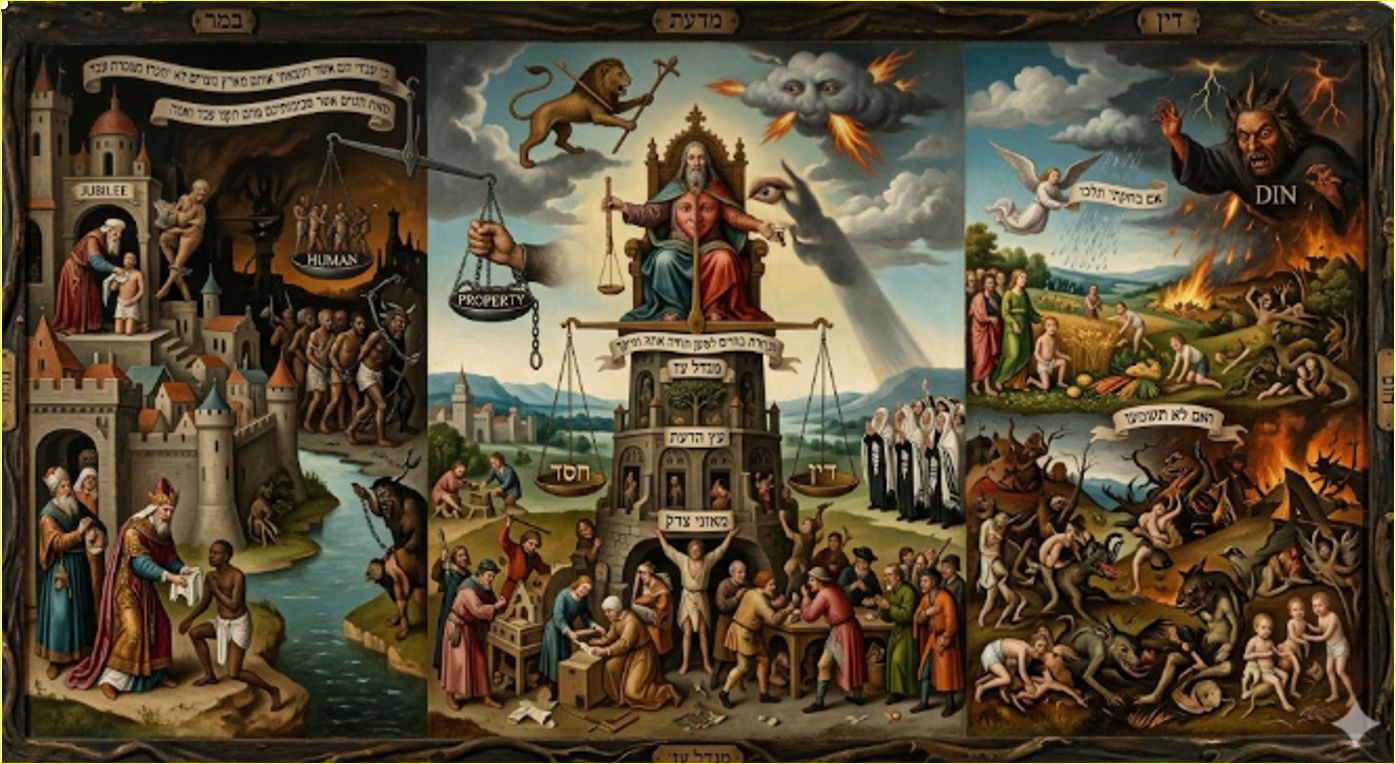
The closing parshiyot of Sefer Vayikra confront us with two deeply unsettling themes: human power over others and divine power over us. In Behar, we are forced to grapple with the Torah’s sanctioning of slavery. In Becḥukotai, we face a theology of reward and punishment that can feel overwhelming in its severity. Together, these texts challenge not only how we read Torah, but how we understand morality, responsibility, and God.
Behar: Power Over the Other
Parshat Behar presents a striking contrast. On the one hand, Israelite servants must be treated with dignity and released in the Jubilee year. They are God’s servants, redeemed from Egypt, and cannot be permanently enslaved (Leviticus 25:39–43). On the other hand, the Torah permits the enslavement of non-Israelites in perpetuity. Foreign slaves may be acquired, owned as property, and passed down through generations (Leviticus 25:44–46). Unlike Israelite servants, they are never freed.
This tension is difficult to ignore. The Torah insists on compassion within the Israelite community while allowing permanent domination over outsiders. These verses are often minimized or explained away—perhaps because of their use in justifying later systems of slavery.
A candid acknowledgment of this tension appears in The Torah: A Women’s Commentary, which notes that these laws sharply contradict other biblical principles that call for a single standard for both citizen and stranger. Later rabbinic interpretations attempt to soften the text by suggesting that “for all time” actually means “until the Jubilee year,” but this reading strains against the plain meaning.
What if this second passage did not exist? Would history have unfolded differently? It’s hard to say. Slavery predates the Torah and appears across ancient civilizations. From the Code of Hammurabi to Egypt, Greece, and Rome, slave systems were deeply embedded in economic and social structures. The rise of agriculture and surplus made such hierarchies possible.
Still, acknowledging the ubiquity of slavery does not resolve the discomfort of seeing it codified in sacred text. The question remains: how do we live with this? Do we contextualize it, reinterpret it—or confront it directly?
Attempts to mitigate the harshness of these laws are common. Even modern tools like ChatGPT tend to frame the issue in softer terms, emphasizing protections against extreme abuse while downplaying the permanence of the institution. For example, citing laws that require freeing an injured slave may offer some moral relief—but they do not challenge the underlying system.
Similarly, Maimonides, in his Mishneh Torah, permits owning non-Israelite slaves while advocating compassion and restraint. Yet he, too, accepts the system as a given. Slavery is not questioned—only moderated. Maimonides places slaves within the same broader category as dependents and property, reinforcing the hierarchy rather than dismantling it.
The moral discomfort remains. What do we do with a sacred text that both limits and legitimizes inequality? What if this passage had not existed—would history have been different? Perhaps not, since slavery predates the Torah and appears across ancient civilizations. But its presence in our tradition still demands confrontation, not avoidance.
If Behar forces us to examine how humans wield power over one another, Becḥukotai turns the lens upward—to how divine power is exercised over us. The shift is jarring. Having wrestled with the ethics of domination, we now confront a theology in which our own fate hangs entirely on obedience.
Becḥukotai: Living Under Blessing and Curse
We are well aware that life in the land is conditional. Every day, in the Shema, we recite the promise: if we follow God’s commandments, the rains will come, the land will yield its produce, and we will live securely. If we turn away, the heavens will close, and we risk losing everything.
This theme runs throughout the Tanakh—but in Parshat Becḥukotai, it is intensified to an almost unbearable degree. It begins with blessings we recognize: rain in its season, abundant harvests, peace in the land, and victory over enemies (Leviticus 26:3–13). But after these promises comes a long, relentless series of curses for disobedience. The tone shifts dramatically, and the text becomes hard to hear, let alone read aloud. The fear is so deep that even a rustling leaf inspires panic.
The tradition itself reflects discomfort. The Mishnah (megillah) instructs that these curses should be read by a single person, perhaps to contain their emotional weight. As a Torah reader, one must decide: read them softly, as some congregations do, or proclaim them fully as a warning. The land is laid waste, the people scattered, and survivors left with despair and guilt.
In the shadow of events like the October 7 attacks, it is hard not to hear echoes of these ancient warnings. And yet, attributing suffering to divine punishment risks falling into the trap of blaming victims—something that feels morally reprehensible, especially when innocents suffer on all sides.
This tension appears elsewhere in our tradition. The Talmud (BT Yevamot 62b) recounts that 24,000 students of Rabbi Akiva died because they did not treat one another with respect. Another tradition links their fate to their treatment of his wife, Rachel. Some seek historical or medical explanations—but others, myself included, are willing to confront the theological implication: sometimes suffering is attributed directly to God. Examples of these voices are in Psalm 22, the Book of Lamentations, and the Book of Job, all of which openly challenge divine justice.
God, in our sources, embodies both compassion (rachamim) and strict justice (din). At times—especially now—it feels as though din overwhelms rachamim. When we talk about what is happening in today’s world, we often ask what kind of world are we leaving for our grandchildren. We have wasted natural resources; we have engaged in endless wars. We are acting out the curse in this week’s Torah portion: When nothing is left, “you will eat the flesh of your sons and daughters” (Leviticus 26:29).
Choosing How to Use Power
Taken together, Behar and Becḥukotai force us to confront power in two directions: the power we hold over others, and the power God holds over us. In Behar, the danger is that we justify domination. In Becḥukotai, the danger is that we interpret suffering as deserved. Both can lead to moral blindness. The language of curse is not unique to this parsha. From Cain to Canaan, from the cursed ground to the long litany in Deuteronomy 28, the Bible repeatedly invokes the word ארור–“cursed be…” There, the curses are even more explicit and all-encompassing—touching every aspect of life.
Maimonides notes that these passages are read liturgically before Shavuot and Rosh Hashanah, perhaps to prompt reflection and repentance. One cannot help but wonder: if we truly internalized these warnings, could catastrophe be averted?
But our tradition also offers another path. Nachman of Breslov warned against ריב ומחלוקת—endless internal conflict. And in moments of crisis, we have seen extraordinary acts of chesed, compassion, responsibility, and solidarity.
If God contains both justice and compassion, then so do we. The question is not only how God acts—but how we choose to act.
We can read these parshiyot as warnings, or as calls to moral growth.
We are not condemned to perpetuate injustice, nor to live in fear of punishment. Even within difficult texts—and difficult times—we retain the ability to choose empathy over domination, humility over certainty, and goodness over despair.
That choice, ultimately, is ours.
Related Topics
Related Posts