A millennial, Zionist, reform Rabbi
What If We Let Ourselves Hope?
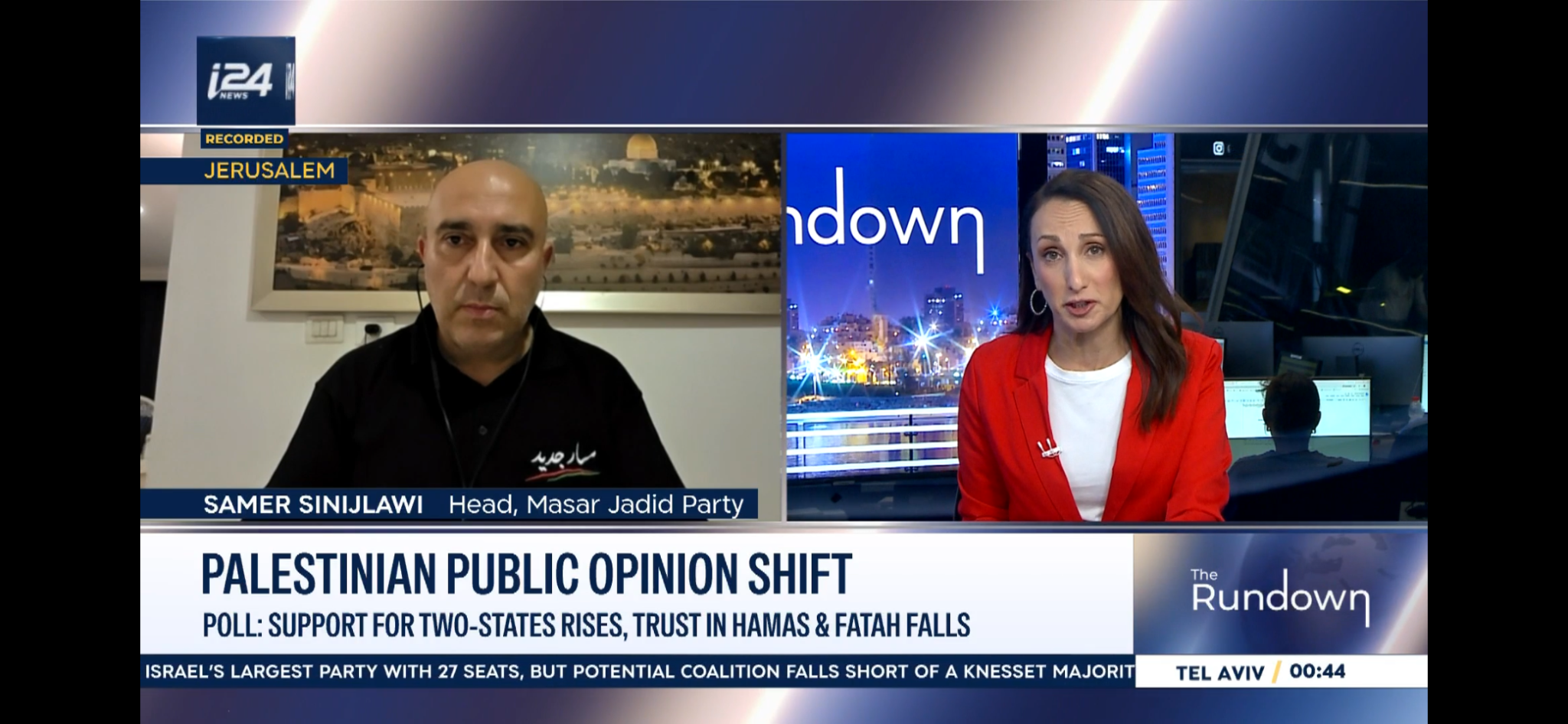
Screenshot while watching i24 News
I wasn’t expecting to feel hopeful.
Honestly, I think I have forgotten what hope about Israeli-Palestinian negotiations feels like. I’ve given up on the childish notion of peace, because I live in this world that repeatedly turns its back on my people. I’m approaching this new year with as much pain and fear as ever.
Like so many Jews, I have spent the years since October 7 watching one horror follow another. I have watched Hamas’s brutality, the hostages, the war, the suffering, the antisemitism exploding around the world. I have watched stories about Hamas rebuilding and weapons being smuggled and wondered how anyone can still speak confidently about “peace” without also speaking honestly about what Israelis have every reason to fear.
And then, for a few minutes tonight, I felt something I haven’t felt in a long time.
Hope.
It was small. I questioned it immediately. I didn’t trust it at all.
But it was there.
I was watching an i24NEWS interview with Samer Sinijlawi, a Palestinian political leader and head of the new Masar Jadid — New Path — party.
And I found myself leaning closer to the screen.
Here was a Palestinian nationalist speaking openly about two states. About recognizing the Jewish people’s historical connection to this land. About Palestinian responsibility. About the failure of violence. About the need for Palestinians to understand that Israeli security isn’t an obstacle to Palestinian freedom — it is necessary for achieving it.
I kept waiting for the caveat.
And then the segment ended, and the news moved on to more reminders of exactly why I have learned not to get my hopes up.
But the hope didn’t entirely disappear.
So I started reading.
And I discovered something else.
According to the latest Palestinian Center for Policy and Survey Research poll, Palestinian public opinion may actually be shifting. Forty-four percent now identify negotiations as the most effective path toward Palestinian statehood, compared with 27% who choose armed struggle. Support for negotiations is at its highest level in four years; support for armed struggle is at its lowest. Even more strikingly, 55% of Palestinians surveyed in Gaza chose negotiations.
No, this does not mean Palestinians suddenly embrace Israel.
It does not mean Hamas has disappeared. It does not mean Palestinian extremism has vanished. And it certainly does not mean Israelis should forget October 7 for even a second, lower their defenses, or gamble their children’s lives on wishful thinking.
I won’t.
But perhaps being clear-eyed does not require being hopeless.
Palestinians are approaching elections. Sinijlawi’s new party is attempting to offer something Palestinians have rarely been given the opportunity to choose at the ballot box: a political path that insists Palestinian national aspirations and Israeli permanence do not have to be mutually exclusive.
Maybe they will reject it.
Maybe extremists will intimidate those who might support it. Maybe the elections will fail to be genuinely free. Maybe Masar Jadid will receive almost no support at all.
Those possibilities matter. The results will matter.
Because for years, many of us have heard that ordinary Palestinians want peace but have been failed by their leaders. If Palestinians are finally offered leaders explicitly advocating negotiation, coexistence and two states, what they do with that choice will tell us something important.
But we aren’t there yet.
Today, all I know is that I watched a Palestinian leader say things I have desperately wanted to hear a Palestinian leader say.
And instead of immediately explaining to myself why it couldn’t possibly matter, I decided to let myself sit with another possibility.
What if it does?
What if the devastation of these past years has changed something?
What if there are Palestinians looking at Gaza and concluding that armed struggle has brought them devastation rather than liberation? What if there are Israelis who could eventually look across the divide and discover someone genuinely willing to recognize that Jewish safety, sovereignty and belonging are not negotiable — while asking us to recognize Palestinian dignity and national aspirations in return?
What if, somewhere underneath all this grief, something new really is beginning?
I don’t know.
I am not naïve enough to call this a potential path to eventual peace.
But maybe — just maybe — I am willing to call it a glimmer of hope. Hope that, even if it takes generations, new choices may emerge.
And right now, that feels like something worth noticing.
Related Topics