What If We Were Never Meant to Go Back to October 6?
*Three years after October 7, an ancient Midrash on the first verses of the Torah made me rethink what Jewish resilience really means.*
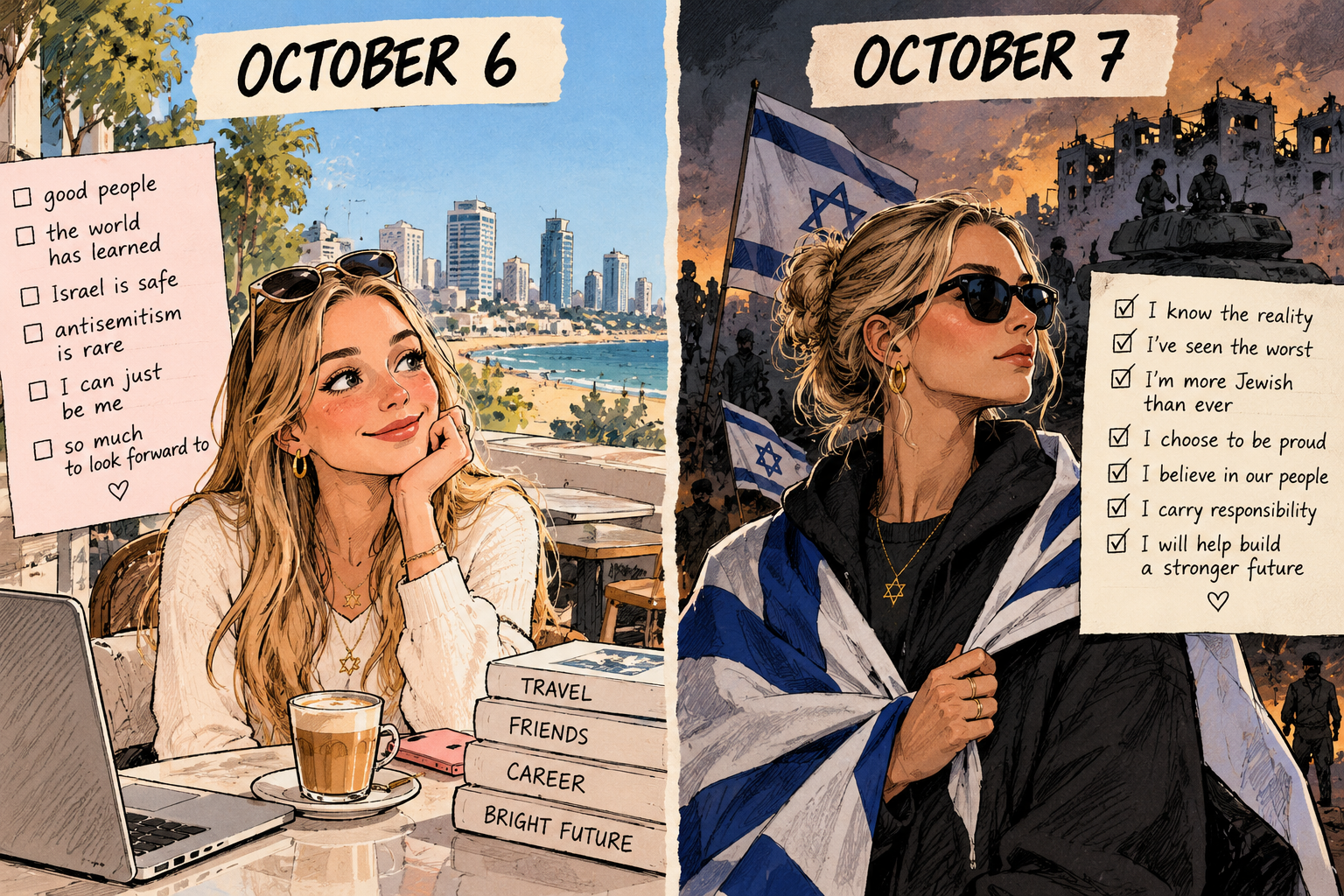
I sometimes wonder what I would tell the October 6 version of myself.
Would I warn her about what was coming? Would I tell her how much the world was about to change? How differently she would come to understand antisemitism, Jewish identity, Israel, and even the people around her?
Or would I let her have one more day of innocence?
Three years later, I’ve realised something.
I don’t think I want to be her again.
I would give anything for October 7 never to have happened. For every family to be whole, every life to have been spared, and for that Shabbat morning to have remained just another ordinary Shabbat.
But I don’t miss my naivety.
I don’t miss believing that the world had learned lessons it clearly hadn’t. I don’t miss taking certain freedoms for granted. And I don’t miss being unaware of just how fragile the world I thought I knew could be.
I wish I could have gained this awareness without the suffering that came with it.
And yet, here we are.
Three years later, we’re not the same Jewish people we were on October 6.
And this week, as we begin reading the Torah again, I came across two extraordinary Midrashim that made me question something.
**What if our greatest responsibility isn’t to return to the world we had before, but to build the Jewish world that comes next?**
## Why does the Torah begin with chaos?
We all know the opening words of the Torah.
*Bereishit bara Elokim et hashamayim ve’et ha’aretz.*
In the beginning, God created the heavens and the earth.
But the second verse is rather strange.
**וְהָאָרֶץ הָיְתָה תֹהוּ וָבֹהוּ וְחֹשֶׁךְ עַל־פְּנֵי תְהוֹם**
*And the earth was formless and empty, and darkness was upon the face of the deep.*
Tohu VaVohu.
Chaos. Emptiness. Darkness.
Why?
If God is all-powerful, why does the Torah introduce us to a world that is anything but perfect?
Why not begin with light, beauty and life?
And why does darkness feature so prominently in the very first description of creation?
In Bereishit Rabbah 2:4, an ancient collection of rabbinic teachings, Rabbi Shimon ben Lakish offers an extraordinary interpretation.
He suggests that the second verse of the Torah isn’t simply describing the physical state of the world before creation.
It’s describing Jewish history.
*Tohu* represents the Babylonian exile.
*Vavohu* represents the exile under Persia.
*Choshech*, darkness, represents the Greek exile.
And *tehom*, the deep, represents the exile associated with Edom and Rome.
Think about that for a moment.
Before we’ve even met Abraham, before the Jewish people have received the Torah, before the Temple in Jerusalem has been built, the Midrash is already describing our exiles.
Our suffering.
Our destruction.
But what fascinated me most wasn’t the darkness.
It was what came next.
**וְרוּחַ אֱלֹהִים מְרַחֶפֶת עַל־פְּנֵי הַמָּיִם**
*And the spirit of God hovered over the waters.*
The Midrash explains:
**זֶה רוּחוֹ שֶׁל מֶלֶךְ הַמָּשִׁיחַ**
*This is the spirit of the Messiah.*
I find that extraordinary.
Because the spirit of Mashiach, the promise of ultimate redemption, is already there.
Before the darkness has disappeared.
Before the exiles have ended.
Before God has even said *Yehi Or*, let there be light.
The possibility of redemption is already hovering over a world that is still in chaos.
And perhaps there’s something profound about that.
We tend to imagine redemption as something that begins when everything finally becomes okay. When the suffering ends. When the pain disappears. When life returns to normal.
But the Midrash offers a different perspective.
**Perhaps the possibility of redemption exists even when we cannot yet see the light.**
Not because the darkness isn’t real.
Not because suffering is necessary or justified.
But because darkness is never the entirety of the Jewish story.
## Built. Destroyed. Rebuilt.
Then I came across another Midrash, and I think this one is even more remarkable.
In Bereishit Rabbah 2:5, Rabbi Chiyya Rabbah teaches that from the very beginning of creation, God foresaw the Beit HaMikdash, the Temple in Jerusalem, built, destroyed and rebuilt.
**בָּנוּי וְחָרֵב וּבָנוּי**
Built. Destroyed. Rebuilt.
And he finds all three stages in the opening verses of the Torah.
*Bereishit bara Elokim.*
The Temple is built.
*Veha’aretz hayta tohu vavohu.*
The Temple is destroyed.
*Vayomer Elokim yehi or.*
The Temple is rebuilt.
But here’s the detail I can’t stop thinking about.
The Midrash doesn’t simply say that the Temple will be rebuilt.
It describes it as *banui u’meshuchlal*, rebuilt and perfected in the future.
And I found myself wondering why.
Why doesn’t the story simply end with the restoration of what was lost?
Why does the Midrash describe a future that is more complete than what existed before?
Of course, this doesn’t mean destruction was necessary. It doesn’t mean that the suffering of generations was somehow worth it.
But perhaps there’s a distinction between rebuilding what existed and creating what is still possible.
And I wonder whether that’s something we, as a Jewish people, need to think about right now.
## The danger of wanting to go back
For three years, we’ve spoken about the world before October 7 and the world after.
And I understand why.
Because something fundamental changed.
I grew up proudly Jewish. My identity was never something I questioned or felt ashamed of. Judaism shaped my education, my community, my values and the way I understood the world.
But I think I was naive about the world around me.
I assumed certain lessons from history had been learned.
I didn’t realise how quickly Jewish people could find themselves feeling afraid to identify openly as Jewish.
How suddenly conversations with friends could change.
How something as simple as wearing a Magen David could become a conscious decision rather than an ordinary expression of identity.
But I’ve also witnessed something extraordinary.
Jewish people choosing to become more connected to their identity at precisely the moment when being openly Jewish has felt more frightening.
People returning to synagogues.
People wanting to learn more about their history and traditions.
People choosing to wear their Jewish identity with pride rather than hide it.
And I find that deeply moving.
Not because we needed October 7 to remind us who we are.
I wish with everything in me that it had never happened.
But because, even after everything, there are people choosing to build Jewish life rather than retreat from it.
And perhaps that is what Jewish resilience actually looks like.
Not pretending we’re unbreakable.
Not insisting that everything happens for a reason we can understand.
And certainly not treating our suffering as a prerequisite for growth.
**But refusing to allow those who seek to destroy Jewish life to determine what our future will look like.**
## We don’t have to stop grieving to start building
I keep thinking about Kibbutz Be’eri.
About the families whose lives were shattered on October 7.
About the people who lost loved ones, homes, friends and entire communities.
And about the extraordinary determination of those who, in the aftermath of devastation, began the difficult work of rebuilding.
How do you build when you’re still grieving?
How do you imagine a future when so much of the past has been taken from you?
How do you create something new without feeling as though you’re leaving behind the people and the world you’ve lost?
I don’t have a simple answer.
But perhaps rebuilding doesn’t mean leaving our grief behind.
Perhaps we carry it with us.
Perhaps we build because we remember.
Because the lives that were taken mattered. Because the communities that were attacked mattered. Because the Jewish future matters.
*Banui, charev, u’banui.*
Built. Destroyed. Rebuilt.
Three words that describe so much of Jewish history.
And yet the story doesn’t end with *charev*.
Destroyed.
There is another word.
*Banui.*
Built.
## What kind of Jews do we want to become?
There’s something I’ve been thinking about a lot since October 7.
I don’t want Jewish identity to be defined only by what has been done to us.
I want it to be defined by what we choose to create.
I don’t want the next generation to know more about antisemitism than they know about Judaism.
I want Jewish children to know the beauty of Shabbat, the depth of Torah, the richness of Jewish history and the extraordinary privilege of belonging to a people whose story stretches back thousands of years.
I want them to understand what we’ve survived, but also what we’ve lived for.
Because there’s so much more to being Jewish than the people who hate us.
There’s family.
There’s community.
There’s learning, questioning, celebrating, tradition and responsibility for one another.
And I think that’s something we need to protect.
Because if our Jewish identity becomes entirely reactive, if we define ourselves only in opposition to antisemitism, we risk allowing those who hate us to shape our understanding of who we are.
And I refuse to give them that power.
Jewish resilience cannot simply mean surviving another tragedy.
It must also mean building Jewish lives that are meaningful, rich and worth passing on.
Not because we need to prove anything to the world.
But because Jewish life is valuable in its own right.
## Why doesn’t God eliminate the darkness?
There’s one more detail in Bereishit that I find fascinating.
After God creates light, the Torah tells us:
**וַיַּבְדֵּל אֱלֹהִים בֵּין הָאוֹר וּבֵין הַחֹשֶׁךְ**
*And God separated between the light and the darkness.*
Notice what God doesn’t do.
He doesn’t eliminate the darkness.
He separates it from the light.
And then He gives them both names.
Day and night.
Why does darkness remain part of creation?
I’ve been thinking about what that might teach us about *emunah*, faith.
Because I think sometimes we confuse faith with certainty.
We want to believe that if we have enough faith, everything will turn out the way we hope. That the people we love will be safe. That good will always triumph in ways we can immediately recognise.
But Jewish history has never offered us that kind of guarantee.
And perhaps that’s not what emunah is.
Perhaps faith isn’t the conviction that nothing terrible will ever happen.
**Perhaps faith is the decision not to surrender our responsibility to the future, even when terrible things do happen.**
And then there’s the final line of the first day of creation.
*Vayehi erev, vayehi boker, yom echad.*
And there was evening, and there was morning, one day.
The evening comes first.
But the morning belongs to the same day.
## What are we going to build now?
Every year, we finish the Torah and begin again.
We return to the same opening words.
*Bereishit bara Elokim.*
But we are never quite the same people reading them.
Another year has passed.
We’ve experienced joy and disappointment. We’ve gained things and lost things. We’ve had moments when life felt full of possibility and moments when it felt like tohu vavohu.
And I think there’s something deeply meaningful about beginning the Torah again with a world that is not yet complete.
Because so often, we wait for our lives to look a certain way before we feel ready to begin.
We wait for certainty.
For healing.
For the perfect circumstances.
For the world to make sense again.
But creation doesn’t begin with a finished world.
It begins with the possibility of making one.
And perhaps that’s the question Bereishit is asking us this year.
Not whether we can return to October 6.
Not whether we can erase everything that has happened since.
We can’t.
But what are we going to do with the responsibility of being here, of being Jewish, of carrying this history forward?
What kind of Jewish homes are we going to build?
What kind of communities?
How are we going to educate the next generation?
How do we preserve our unity without needing another tragedy to bring us together?
How do we make Jewish life so meaningful, so rich and so deeply rooted that our children inherit more than the memory of what we’ve suffered?
Because three years after October 7, I don’t want Jewish identity to be defined only by what has been done to us.
I want it to be defined by what we choose to create.
By the Torah we learn. The mitzvot we do. The families we raise. The communities we strengthen. The kindness we show one another.
By the lives we build.
And perhaps this is the most profound part of those opening verses.
Before the Torah tells us about light, the Midrash finds the spirit of Mashiach.
Before the Torah tells us about the creation of humanity, the Midrash already finds destruction and rebuilding in its opening verses.
The possibility of a future is there, even when the world is still tohu vavohu.
I don’t think we will ever be the Jewish people we were on October 6.
And I don’t think we need to pretend that the innocence we lost can simply be recovered.
But we can decide what we will pass on.
We can decide whether the next generation inherits only our fear, or also our faith, our courage, our traditions and our determination to create a Jewish future.
And maybe that’s what it means to begin again.
Not to forget what happened.
Not to stop grieving.
Not even to know exactly what comes next.
But to understand that the story is not finished.
**We cannot go back to October 6.**
**But we can decide what kind of Jewish world comes after October 7.**
And that might be the most important thing we build.
*Shabbat Shalom,*
*Chana*
–-
*Torah sources: Bereishit 1:1–5; Bereishit Rabbah 2:4–5.*