
What Indiana Jones teaches about anti-Zionism
In Raiders of the Lost Ark (1981), Indiana Jones faces off against a skilled swordsman in a crowded Shuk. When the Arab man performs an elaborate display—spinning, slashing, showing a true mastery of his weapon—the choreography signals an impending dramatic and honorable duel.
Indiana Jones watches for a moment, sighs, pulls out a gun, and shoots the man in a turban.
This scene, in many ways, has become cinematic shorthand for the strategic miscalculation; where no amount of technical excellence compensates for a fundamental mismatch between the rules the knife-wielder assumes govern the fight, and the rules that Jones operates by instead.
This, I want to suggest, is the position Jewish students increasingly find themselves in when confronting anti-Zionism on college campuses and in progressive educational spaces today.
For decades, Jewish educational and advocacy responses to antisemitism assumed that the conflict over narrative and legitimacy could be won through facts, historical accuracy, moral reasoning, and good faith dialogue. If Jews explained themselves clearly enough—if we contextualized Israel properly, demonstrated our deservingness of empathy, conceded complexity, and told our story well—we would eventually convince antisemites.
That assumption no longer holds.
Contemporary anti-Zionism does not operate primarily as a debate over facts or history. It operates as a struggle over epistemic authority: who has the right to define reality, suffering, and moral legitimacy in the first place. And within this struggle, Jewish memory itself is often treated as inadmissible.
This phenomenon, which I term “replacement memory,” is not simply disagreement between Zionist and Palestinian narratives, nor is it a denial of Palestinian suffering. It is the systematic overwriting of Jewish historical experience within activist–intellectual frameworks that imagine themselves as anti-racist, anti-colonial, and liberatory. Jewish trauma is not merely misunderstood; it is re-coded as evidence of power. Jewish testimony is not weighed; it is disqualified. Jewish survival is reframed as domination.
Under replacement memory, Palestinian suffering becomes the singular moral currency of belonging, while Jewish suffering must disappear for justice to function.
This helps explain why Israel advocacy efforts on campus have failed so forsakenly: not because Jewish students lack evidence, empathy, or ethical seriousness, but because they have been trained to bring swords to a gunfight.
I lived this dynamic firsthand as a doctoral student at Stanford, studying Jewish identity within ethnic studies–oriented education. I asked what seemed like a reasonable question: How can Jews be included authentically in conversations about race, power, and oppression?
The daily answer was: “You don’t belong here.”
After I led a classroom activity that had nothing to do with Israel or Gaza—an assessment exercise for educational programs—a classmate broke down in tears, saying it “reproduced settler colonial violence” against her ancestors. Another explained to me “the optics” of me, as a “white woman,” feeling unsafe around “six women of color wearing keffiyehs,” who were “actually oppressed.” When an American servicemember self-immolated outside the Israeli embassy in Washington while shouting “Free Palestine,” a peer called him “a martyr,” to snaps throughout the room.
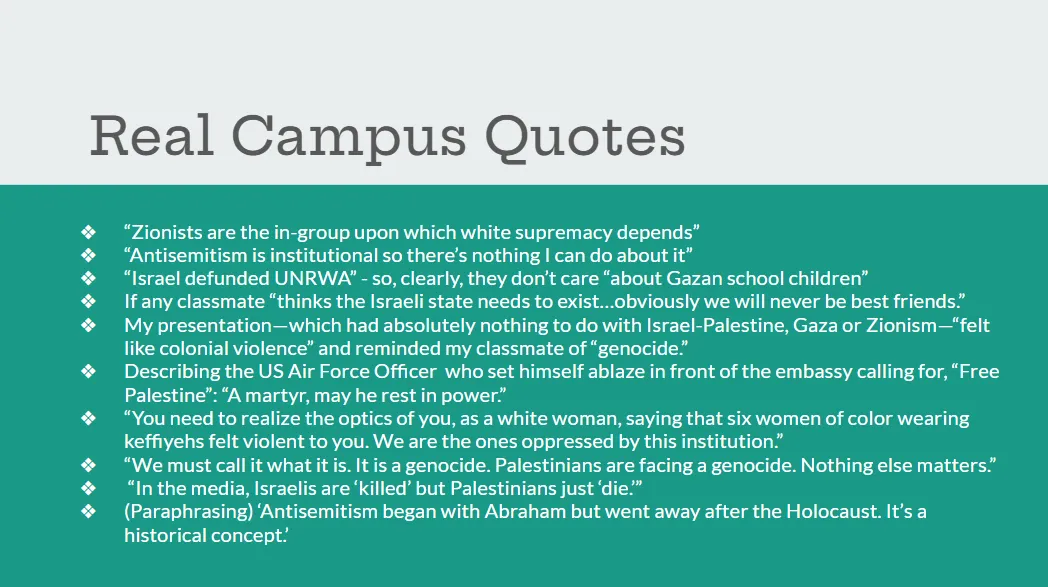 When I raised concerns, the institution later concluded that what I experienced only “felt like” antisemitism.
That distinction between harm that is and harm that merely “feels like” is the essence of replacement memory: Jewish experiences are filtered through external ideological frameworks that decide, in advance, whether Jews are allowed to be victims at all.
Ethnic studies and collective liberation frameworks emerged from real struggles against racism and exclusion. They center the knowledge of the marginalized and demand solidarity across movements. But when these frameworks encounter Jews, they falter.
Jews do not fit neatly into a binary of European oppressor and racialized, colonized oppressed. Jewish history precedes modern racial hierarchies, shaped by pre-modern Christian theology that cast Jews as the paradigmatic Other long before colonialism gave “barbarian” and “savage” racialized, rather than theological, meaning. Jewish identity is ethnically, racially, and geographically diverse. And Jewish nationalism in the form of modern Zionism emerged not as an extension of empire, but as a response to statelessness, persecution, and genocide enacted by those very ideologies that defended both colonial conquest and Jewish persecution.
Yet within contemporary liberation politics, Zionism is frequently positioned as the ultimate expression of global evil: settler colonialism, racial capitalism, and domination rolled into one. To belong, Jews are required to renounce our national movement, let other reinterpret our history and overrule our pain, and suspend Jewish grief for collective liberation.
This is not solidarity. It is ideological conformity.
One of the clearest articulations of this logic appears in the work of Edward Said. In a 2000 interview with Haaretz, Said declared himself “the last Jewish intellectual”…despite not being Jewish. He argued that Palestinians had inherited the ethical vocation once associated with Jewish exile, critique, and marginality.
Earlier, in his 1979 essay “Zionism from the Standpoint of Its Victims,” Said reframed Jewish history primarily as a story of Palestinian suffering. Zionism, he argued, was predicated on the systematic displacement of Palestinians, and Western discourse erred by privileging Jewish trauma while rendering Palestinian victimhood invisible. To speak of Zionism without centering Palestinian dispossession, he insisted, was to “ignore historical responsibility.”
Viewed through the lens of replacement memory, Said’s claim to be “the last Jewish intellectual” is not an act of solidarity but an epistemic substitution: Palestinian identity stands in for Jewish identity. Jewish persecution becomes merely a prelude to Palestinian suffering, and Jewish moral authority is not shared, but it is transferred.
The result is an ethical inversion: acknowledging Palestinian pain while erasing the possibility that Jewish vulnerability persists at all.
This logic is not confined to academic texts. It surfaces repeatedly in contemporary activism and media culture.
In October 2025, climate activist Greta Thunberg shared an image intended to highlight Israeli state violence against Palestinians. The photograph, however, depicted Israeli hostage Evyatar David. After public outcry, the image was deleted, framed as a miscalculation or mistake of innocence.
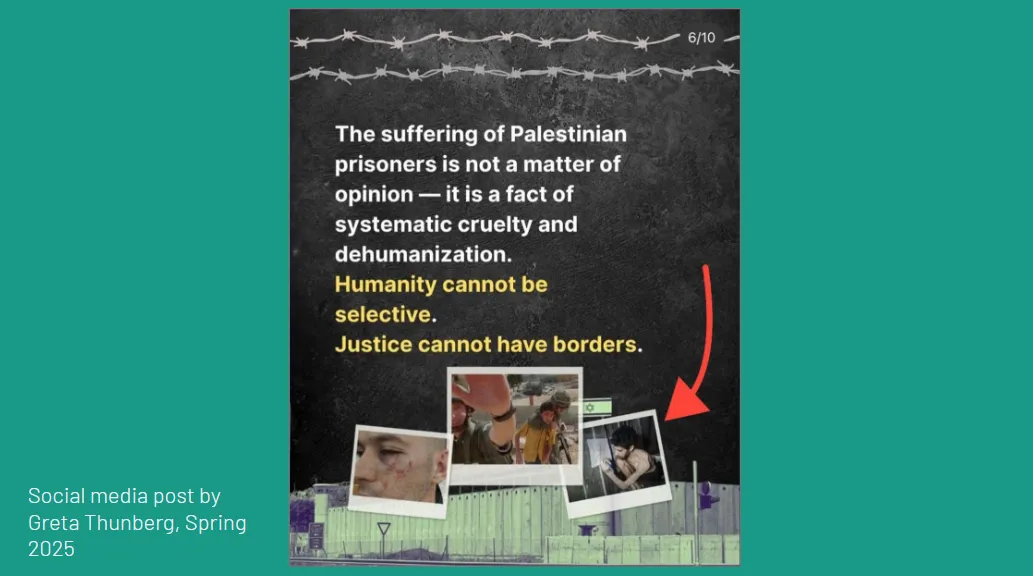 But the “error” revealed something deeper: an image of Jewish captivity was instinctively read and circulated as Palestinian suffering. Jewish trauma became interchangeable, fungible, detachable from Jewish subjects and repurposed to serve a dominant moral script.
The backlash was swift because the substitution was visible. But replacement memory usually operates less visibly, embedded in the circulation of symbols, narratives, and moral cues that dictate which suffering counts and which does not. Which becomes harder to identify, name and combat.
Under replacement memory, Jewish trauma is overwritten.
This helps explain why, in the aftermath of October 7, Jewish death, r*pe, and terror were not merely minimized in many academic and activist spaces but reframed as “resistance” and “justice.” Within replacement memory, a Jew with a military cannot feel pain because Jewish grief becomes un-tragic, and instead: suspect. Jewish testimony is no longer counter evidence; it is distilled exclusively to “propaganda.”
What, then, must change?
The issue is not that Jews have failed to explain ourselves. It is that we are being tried in moral tribunals where the verdict has already been rendered, and so many in our community do not understand the language.
We must name replacement memory explicitly. When Jewish history is ruled inadmissible, the appropriate response is not better storytelling, but epistemic refusal. Let Jews speak as Jews; and be heard.
Jewish advocacy must shift from narrative persuasion to epistemic defense: teaching students to recognize when a conversation is not a debate, to refuse premises that require Jewish erasure, and to insist that Jewish self-definition is non-negotiable.
This does not mean denying Palestinian suffering. It means rejecting a false moral economy that demands Jewish disappearance as the price of justice.
Indiana Jones does not survive the encounter in the marketplace by arguing about whose grievance is older or whose technique is purer. He survives by recognizing that the fight is not what it pretends to be. And the man facing him? He loses because he arrived at the wrong fight, with the wrong tools, and the wrong assumptions.
If we want Jewish students to survive intellectually, emotionally, and morally in contemporary educational spaces, we must stop training them for a duel with the wrong weapons. It is imperative we equip them to recognize that the rules themselves are rigged, and some leaders don’t understand just how so.
Put frankly, we must accept what we do not understand and listen to those in our community who have the knowledge, experience and wherewithal to say: This is what is happening. This is how we can keep our students safe. The old way isn’t working; let’s try a new one.
The tragedy is not that Jews are losing arguments on campus.
The tragedy is that we keep insisting on bringing swords to gunfights—and calling the outcome antisemitism, without the chutzpah to change our tactics.
Note: To learn more about the academic side of this work, you can watch my recent lecture at the ISCA Early Speaker Series, Session 6: “Weaponizing Holocaust & Antisemitism in the Ivory Tower.”
You can find the written text on my Substack, where I ponder Jewish history, ethnic studies, politics, and reflections on antisemitism in America: Rabbi’s Daughter Rebellion: And other featured stories | Zahava Feldstein | Substack