
Using science background to write rationally about Israel, Jews and Academia
What is wrong with Israel’s response to NAZA?
Haaretz recently published a headline that is difficult to dismiss: “I Saw ‘NAZA.’ In a Healthy Israel, It Would Be Shown on the Evening News.” I agree with the diagnosis, but not with its implied account of the disease. Israel is not healthy. Yet no competent physician would examine an immune system in overdrive without first asking what has been attacking the organism.
I have not seen NAZA, and the film itself is not my subject here. I cannot judge its evidence, its methods, or its fairness. My subject is the response described by Haaretz: the immediate closing of ranks in Israel and across much of the Jewish world. That response is unhealthy. It is also, in the most literal sense of the word, reactive. To understand it, we must begin not with the reaction but with the agent that provoked it.
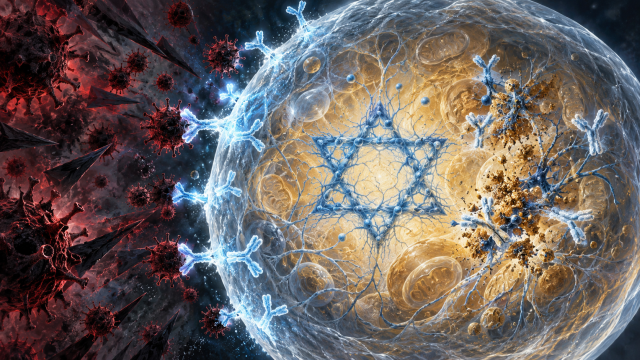
The medical metaphor is useful if we apply it carefully. An organism invaded by a virus mobilizes its defenses. The resulting inflammation is not initially a disease; it is an attempt to survive. But if the assault persists, the immune system may remain permanently activated. It can lose its capacity to distinguish an invading pathogen from the body’s own tissue. A protective response then becomes an autoimmune disorder, attacking the very organism it was meant to defend.
That, I believe, is the condition of Israel and much of the Jewish world today. The external virus is not Palestinians, Muslims, protesters, or critics of Israeli policy. It is a political and moral pathology: the ancient hatred of Jews refashioned as the conviction that Jewish fears are fraudulent, Jewish collective existence is illegitimate, and the Jewish state is uniquely beyond redemption. Legitimate criticism of Israel is not part of this virus. The transformation of every Israeli crime or failure into an argument against Israel’s right to exist is.
This virus did not appear in response to NAZA, nor did it begin with the devastation of Gaza. It revealed itself with particular clarity on and immediately after October 7, before Israel’s military campaign had even begun. Israelis and Jews watched people celebrate the massacre, rationalize it as resistance, or hurry to place its victims on trial. They watched the hostages disappear from demonstrations and from the moral vocabulary of the conflict. They saw murdered families treated as inconvenient context, while Jewish grief was received as propaganda designed to obstruct the world’s preferred narrative.
Since then, the infection has spread through parts of the political, academic, cultural, and media worlds. ‘Zionist’ is increasingly used not as the name of a broad and internally divided political tradition, but as a synonym for moral depravity. Calls for the abolition of Israel are presented as ordinary proposals for justice. Jews thousands of miles from Gaza are required to demonstrate their decency by denouncing a state whose decisions they do not control. Those who refuse may be excluded, harassed, or treated as presumptively complicit.
This is not an atmosphere in which accusations against Israel arrive as discrete claims to be considered on their merits. They arrive as exhibits in a trial whose verdict has already been announced. An Israeli allegation of wrongdoing is rarely allowed to remain an allegation against particular commanders, policies, or politicians. It is recruited into a much larger case against Zionism, against Jewish sovereignty, and increasingly against Jews who will not renounce either.
For diaspora Jews, this experience is especially revealing. Many who recoil from accusations against Israel are not admirers of Netanyahu. They may oppose the settlements, despise Ben-Gvir and Smotrich, grieve for Gaza, and have spent years defending the possibility of a liberal Israel. Yet they have learned that none of this necessarily earns them moral standing. Unless they cross the final line and repudiate Zionism itself, they remain defendants. Their defensiveness is therefore not simply loyalty to an Israeli government. It is the immune response of a community that senses the accusation passing through Israel and attaching itself to Jews everywhere.
The same process operates even more powerfully inside Israel. A society that has seen its dead mocked, its hostages forgotten, and its national existence treated as a crime will naturally become suspicious of condemnation from abroad. When every acknowledgment of wrongdoing is immediately used as proof that Israel is uniquely monstrous, Israelis learn to acknowledge nothing. When compassion for Palestinian children is accompanied by indifference to murdered Israeli families, Israelis eventually stop hearing the compassion and hear only the indifference.
This defensive response was initially protective. Solidarity after October 7 was not evidence of moral failure. Skepticism toward accusers who had shown contempt for Israeli lives was not irrational. Nor was it unreasonable for Jews to fear that genuine Palestinian suffering would be used to erase the massacre, absolve Hamas, and revive the demand that Jews once again entrust their safety entirely to the goodwill of others. The world cannot help generate this response and then disclaim all responsibility for it.
But an immune response kept at maximum intensity eventually becomes dangerous. It loses discrimination. Criticism is mistaken for infection; dissenters are treated as foreign bodies; journalists, courts, artists, and political opponents become targets of the defenses built to protect the nation. Compassion for Palestinian civilians is attacked as weakness. Doubt becomes disloyalty. The organism begins to damage its own healthy tissue.
This is where the Israeli right enters the pathology. Netanyahu and his extremist partners did not create the external virus, and it is a serious mistake to pretend that they did. But they have learned to keep the immune system permanently activated and to direct it against their domestic opponents. They collapse the distinctions between government, state, army, and people so that criticism of any action by any Israeli institution can be branded an attack on Israel itself. Fear becomes a political resource, and inflammation becomes a method of rule.
The reaction to NAZA belongs to this autoimmune stage. Much of the outrage preceded any serious engagement with the film. The question ceased to be whether its claims were true or false and became whether the filmmakers belonged inside or outside the national body. Threats, demands for punishment, and proposals to revoke citizenship are symptoms of an immune system that can no longer distinguish scrutiny from sabotage.
Israel is responsible for controlling this autoimmune reaction. External hatred cannot excuse intimidation, the suppression of facts, or the degradation of democratic institutions. An immune system that attacks the brain, heart, and nervous system of the body must be restrained, even if an infection helped provoke it. Explanation is not exoneration.
But it is equally mistaken to imagine that the disorder can be cured simply by demanding that Israelis and Jews lower their defenses while the virus remains active. One cannot expect lasting remission while reinfecting the patient every day. If every admission of Israeli wrongdoing is converted into another argument that Israel must disappear, self-examination will continue to feel like self-destruction. If Jews are required to choose between moral criticism and collective self-preservation, many will choose self-preservation – and the immune response will remain in overdrive.
The first condition of recovery is therefore to neutralize the external virus. That means drawing and enforcing a clear boundary between criticism of Israel and denial of Israel’s legitimacy; rejecting the use of ‘Zionist’ as a respectable substitute for ‘Jew’; treating October 7 and the hostages as morally real rather than as obstacles to solidarity with Palestinians; and refusing to make diaspora Jews answer for decisions of the Israeli government. It means creating a moral environment in which Israel can acknowledge crimes and failures without hearing that confession presented as proof that Jewish sovereignty itself was a crime.
Only then can the immune system begin to stand down. Israel must relearn how to distinguish an enemy from a critic, an accusation from an attack, and internal dissent from treason. It must confront the right-wing extremism that has converted legitimate fear into political power and national blindness. But those who demand this change from Israel must understand that they cannot simultaneously continue supplying the fear on which the extremists feed.
Haaretz is right that a healthier Israel would respond to a film such as NAZA with argument rather than panic. But a healthier Israel also requires a healthier world – one in which Jewish vulnerability is not mocked, Israel’s existence is not perpetually conditional, and Palestinian humanity can be defended without denying Jewish history or political legitimacy. Treating only the autoimmune disorder while ignoring the infection that sustains it is not a cure. It is malpractice.
Israel and the Jewish world must recover the ability to practice solidarity and self-criticism at the same time. The world, for its part, must stop making those two virtues appear mutually exclusive. Recovery begins when the virus is named, the external assault is resisted, and the immune system no longer needs to live as if every criticism were a mortal threat.
Related Topics