
What Israel Can Learn from El Salvador About Human Rights
Not long ago, El Salvador was terrorized by gang violence. As recently as 2019, only 3% of El Salvador murders resulted in prosecution. This is because gangs intimidated judges and witnesses, employed teenagers who were too young for the regular justice system, and thwarted the government’s efforts to collect the evidence necessary for trials.
But since then, President Nayib Bukele has turned the tables. He declared a state of emergency which enabled a policy of mass arrests and incarceration, and just recently his government announced that nearly 500 alleged gang members would be tried at once for having collectively committed nearly 49,000 crimes.
Unlike in an ordinary trial, the government will not be required to prove that each defendant committed a specific crime. Under the theory that a gang operates as a collective, simply showing that an individual is a gang member will be enough to hold them responsible for all of the gang’s crimes.
Israel recently passed a similar law to enable the prosecution of hundreds of Hamas members apprehended after the Oct. 7th attack. Under this new law, the government will not need to prove that each person individually committed an atrocity, which it likely cannot do. Instead, it will simply have to demonstrate that each defendant participated in the Oct. 7th invasion. Under the theory that all the Hamas members worked together, they will all then be liable for that day’s horrors.
Human rights groups have loudly protested in both these cases. Human Rights Watch criticized the El Salvador law, claiming that gang membership was defined so broadly that it could even include people who made statements supportive of gangs, which would violate freedom of expression. Gang membership might also be proven based on hearsay, and there could have been cases of forced recruitment. And it seems fundamentally unfair for a young, new gang recruit to receive the same punishment as a hardened, long time leader.
UN Human Rights Chief Volker Türk released a statement making similar criticisms of Israel, and calling for Israel to repeal its new law. He says that the law violates the accused Palestinians’ rights to due process, undermines their presumption of innocence, and may result harsh punishment for those who are truly innocent.
What is strikingly different, however, is the way Israeli and El Salvadoran leaders have reacted to this criticism. Israeli lawmakers, by and large, have strived to emphasize that the law makes only the minimal changes necessary to accommodate the circumstances of Oct. 7th, with fundamental legal guardrails still preserved. For example, Knesset member Yulia Malinovsky, one of the bill’s authors, was quoted emphasizing that the legislation still ensures a fair, lawful trial, and that sentences will be given by independent judges and not based on public opinion.
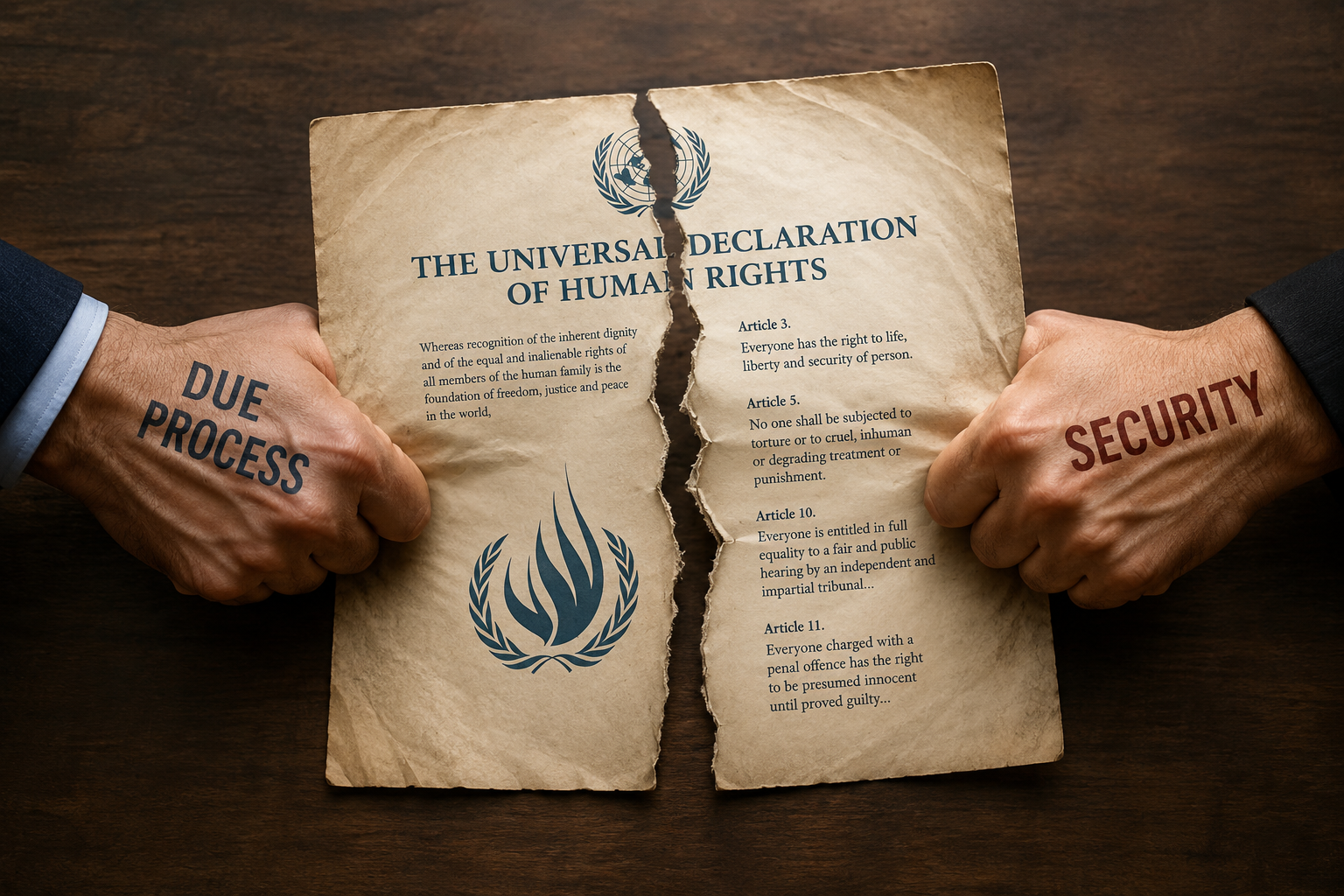
Bukele, on the other hand, readily acknowledges that his crackdown violates the rights of the accused. But he justifies this by pointing out that human rights always involve trade offs- in this case between the rights of the accused and the rights of the public at large. Requiring individual trials at which each defendant’s guilt must be proven would help protect the innocent and tailor punishments to the defendant’s specific crimes. But that would come at the cost of letting many heinous criminals go free due to lack of evidence, allowing the gangs to regroup and sow more terror over the population. All while investing vast quantities of scarce state resources in difficult prosecutions.
Bukele says that he is choosing to violate the fair trial rights of accused gang members, rather than risk letting those gang members go free and violate the right of the public to basic safety. And he demands to know why human rights groups are so up in arms to defend the rights of prisoners who may be falsely accused or denied due process, without giving serious weight to the rights of the public that have been trampled upon by gangs. He claims that if human rights are for everyone, they have to protect ordinary citizens who want to walk around at night without fear of shootouts, not just due process rights of the accused.
There’s a lesson here for Israel. Arguing that the new trial regime for the perpetrators of Oct. 7th doesn’t violate at least some of the defendants’ rights is unlikely to be persuasive. Trials of multiple defendants operating with relaxed rules of evidence will inevitably fall short of the normal, demanding standards of its criminal justice system.
But granting these people all the rights to which they would ordinarily be entitled would likely result in letting most, if not all, go free. The central question is what would be a greater violation of human rights- mistakenly punishing some individuals who were wrongly apprehended and truly did not play roles in the Oct. 7th attack, or letting many of the actual perpetrators escape accountability for their unspeakable crimes?
Of course some human rights advocates might take a principled stand to protect the innocent. But insisting that the rights of the accused must always override grave threats to public safety is an attempt to simply ignore the difficult tradeoffs these situations create. If Israel decides that in this case, the sum total of upholding rights for all, including Oct. 7th victims and the general public, requires lessening protections for the accused, it can look any human rights advocate right in the eyes and feel comfortable it’s on ground just as solid as theirs.