
What Jewish Education Looks Like from 90,000 Feet
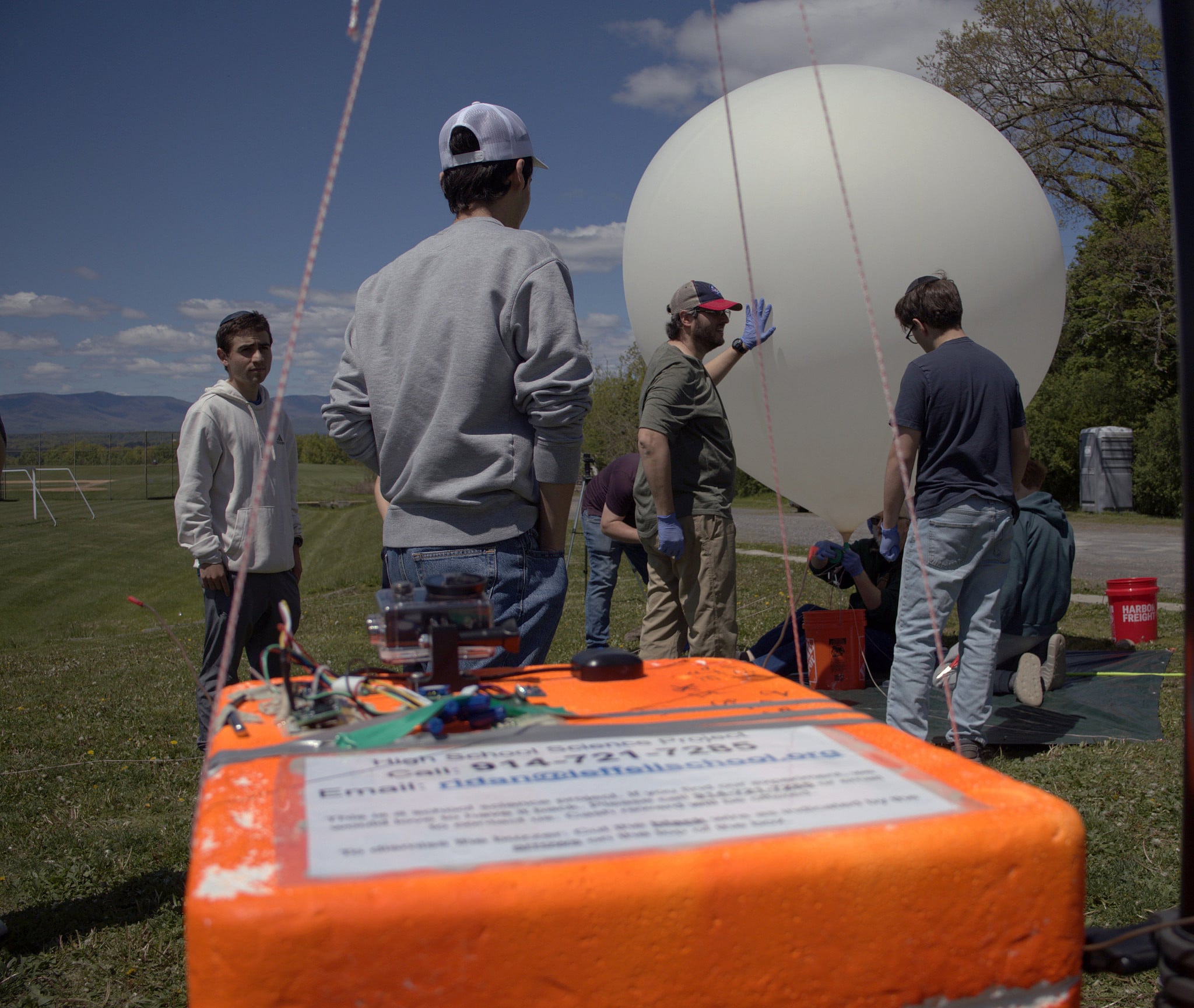
Eleven students in the Leffell Space Program climbed onto a school bus loaded with antennas, laptops, radios, tools, and tracking systems and headed off to launch and (hopefully) recover the program’s first high-altitude weather balloon and payload on the morning of May 11th.
This came after months of preparation and frustration as they learned that high-altitude balloon launches are extremely weather dependent. Over the past year, the students experienced multiple last-minute cancellations due to unfavorable conditions. In the days leading up to this launch, students ran predictive flight models and calculated projected ascent and descent paths in order to determine where they’d have the best chance of both a successful launch and a recoverable payload. Based on the data, Hudson, NY, 110 miles north of our school, became the target.
We called the administration of Hudson Senior High School, who graciously welcomed us onto their athletics fields to launch. Watching the students preparing for the launch with a backdrop of the Hudson Valley, it didn’t feel like a school activity anymore. It felt like mission operations.
Leffell Space Education Coordinator Raz Idan, who taught and guided the students throughout the year, helped them move from classroom preparation into real mission operations.
The payload itself was designed and assembled by students in the Leffell Space Program. It carried cameras, weather sensors, tracking systems, and student-built electronics intended to survive an ascent to the edge of space. Included in the payload box was artwork created by members of our school community specifically for the mission. Attached to the system was a radio beacon repeatedly transmitting a message throughout the flight: “Am Yisrael Chai.” The students chose those words deliberately. To broadcast that declaration, that we are alive and we persist, from tens of thousands of feet above the earth felt, to them, like exactly the right thing to say.
One of the beautiful things about ambitious STEM projects is that they attract people who genuinely love exploration and want young people to experience it too. A hobbyist ballooning expert drove down from Ithaca simply to help our students make the launch successful. He had no obligation to be there. He came because that’s what people who love this would do.
And then, almost immediately, things started going wrong.
Certain programs began crashing. One transmitter had been configured incorrectly. A small but important structural component failed during setup. Students immediately broke into subteams to begin troubleshooting, while others continued filling the balloon with helium. Nobody panicked. They simply started solving problems. Within an hour, they had worked through each issue. The balloon was ready.
Then, at 11:55 a.m., we had liftoff. The cheers were immediate. After months of cancelled launches and weather watches and last-minute disappointments, the balloon climbed faster than most of us expected. Within seconds it was clearing the treeline. Within minutes it was a speck. The students watched it go, craning their necks until there was nothing left to see.
After we lost sight of the balloon, the students jumped in the bus and headed for the predicted area of descent. For a while, everything worked exactly as planned. Students tracked the balloon in real-time as it climbed higher and higher through the atmosphere. Telemetry streamed continuously and the predictive models appeared accurate.
Though we hoped to reach as high as 100,000 feet, at 90,779 feet, the balloon burst as expected.
What followed, however, was far more complicated than the team had anticipated. During descent, the students encountered an unexpected systems issue that dramatically changed the recovery process and forced them to adapt in real-time. One tracker drifted eastward toward the Atlantic Ocean while another continued transmitting from the payload itself. Students recalculated routes, updated maps, monitored telemetry, and coordinated a rapidly changing recovery effort across multiple states.
Hours later, after following telemetry into Hartford, CT, we located the payload in the empty parking lot of a STEM magnet school after school hours. It easily could have landed on a roof, in water, or somewhere inaccessible, and we had even brought extension poles with hooks in case we needed to retrieve it from a tree. Instead, the payload box was sitting in the middle of a parking lot, waiting for us. One camera had broken during descent, while another camera and most of the sensor systems remained intact. Amazingly, the payload was fully recovered.
One of the students, Ari Messinger, later reflected that “the entire mission demanded tireless effort and taught skills far beyond how to wire a sensor, including lessons in collaboration and perseverance.”
Ari’s observation gets to the heart of why experiences like this matter. Too often, school unintentionally teaches students that learning is neat, controlled, and linear. Real engineering is none of those things. Real engineering involves uncertainty, unexpected failures, adaptation, teamwork, and the willingness to continue working the problem even when outcomes become unclear.
There is something deeply Jewish about teaching students that meaningful work often involves setbacks, delays, uncertainty, and repeated attempts, and that we are still obligated to continue the work anyway. Our students lived that in a single day. They watched their models work, watched parts of the mission fail unexpectedly, tracked one transmitter drifting toward the ocean, recovered a payload across state lines, and then immediately began discussing what they would improve for the next launch. The balloon transmitting “Am Yisrael Chai” from near the edge of space was not just a radio message. It reflected that same idea.
The students stopped seeing themselves as kids pretending. They began seeing themselves as capable of doing hard things that matter.
For me, the clearest sign that the mission succeeded is that on the bus home, the students were already planning the second launch. Not because the first one was perfect, but because they had ideas about how to make the next one better.