


CEO of Time to Stand Up for Israel
What Keeps Israel Standing?
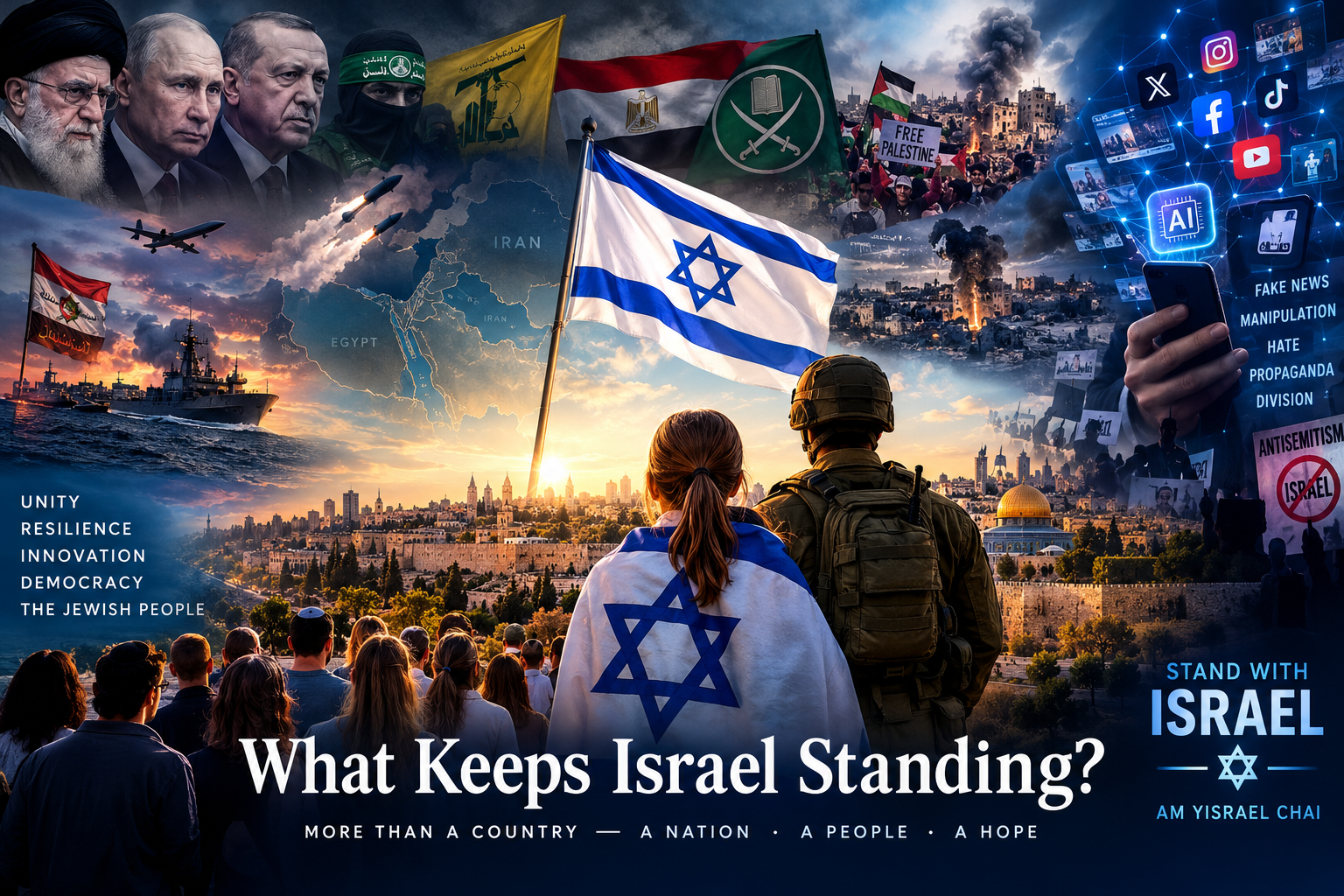
Photo Credits: Sabine Sterk (AI)
A nation under siege, a world in turmoil, and a new war for the truth
When I wrote about the threats facing Israel in 2018, the world was already a dangerous place. Authoritarian leaders were flexing their muscles, Iran was expanding its regional ambitions, terrorism remained a constant concern, and Israel was fighting to defend its legitimacy in a world that often judged it by a different standard than every other nation.
Yet the threats Israel faces today have grown more complex, more interconnected, and in many ways more dangerous. The massacre of October 7, 2023, changed Israel forever. It exposed the devastating consequences of underestimating an enemy, shattered the illusion that sophisticated intelligence and military technology could guarantee security, and plunged the country into a prolonged struggle on multiple fronts. It also unleashed a wave of hostility that has extended far beyond the battlefield.
So the question I asked in 2018 remains more urgent than ever. What keeps Israel standing?
Israel faces a regional environment in which Iran has spent decades building networks of armed proxies, developing missile capabilities, advancing its nuclear ambitions, and promoting the destruction of the Jewish state. Hamas demonstrated on October 7 how devastating that ideology can become when the world fails to take its promises seriously. Hezbollah has represented another major threat on Israel’s northern border, with its extensive arsenal and its willingness to endanger civilian populations. In Yemen, the Houthis have demonstrated that even a movement operating far from Israel can threaten international shipping, launch missiles and drones, and disrupt vital commercial routes. Their attacks have illustrated how modern warfare can extend across thousands of kilometres and affect the security of the entire international community.
These are not isolated dangers. They are part of a broader regional struggle in which Israel must continually assess the intentions, capabilities, and alliances of its adversaries. Even when one front becomes quieter, another can become more dangerous. Military victories can weaken hostile organisations, but they do not automatically eliminate the ideologies that sustain them.
Turkey under Recep Tayyip Erdoğan has also pursued a more assertive regional policy and has repeatedly adopted hostile rhetoric towards Israel. Its political relationship with Hamas and its criticism of Israeli military operations raise serious strategic concerns. At the same time, Egypt occupies a particularly important position in Israel’s security calculations. The peace treaty between Israel and Egypt remains a cornerstone of regional stability, and it would be wrong to equate Egypt automatically with Israel’s enemies. Nevertheless, developments in the Sinai Peninsula, military deployments, regional alignments, and the political climate surrounding Israel require continued attention. Peace must be preserved through diplomacy, mutual restraint, and vigilance, rather than taken for granted.
The Muslim Brotherhood and movements inspired by its ideology present another dimension of the challenge. Their political influence, ideological networks, and differing relationships with violent Islamist organisations must be assessed carefully, country by country. Not every movement or supporter can be placed in the same category. However, where political or religious ideologies deny the legitimacy of Israel as the homeland of the Jewish people, they contribute to an environment in which hostility towards Israel can become normalised and even celebrated.
Meanwhile, the war in Ukraine has reminded the world that conventional warfare between states has not disappeared. Russia’s invasion has demonstrated the devastating consequences of territorial aggression, the importance of military preparedness, and the danger of assuming that international condemnation alone will stop an aggressor. It has also placed enormous pressure on Western resources, alliances, defence industries, and political attention. Israel cannot afford to assume that the international community will always have the capacity or the willingness to respond to every threat simultaneously.
The world is increasingly unstable, and the consequences reach far beyond the immediate battlefields. Rivalries between major powers, regional conflicts, nuclear proliferation, energy insecurity, and political polarisation create an international environment in which Israel must constantly defend its interests. In such a world, a small country cannot rely exclusively on declarations of solidarity or promises of international protection. It must be capable of defending itself.
But the most profound lesson of October 7 is that even a technologically advanced nation can be vulnerable when its assumptions prove wrong. Israel possesses remarkable intelligence capabilities, advanced air defence systems, a powerful military, a sophisticated technology sector, and an extraordinary capacity for innovation. Yet no system is infallible. No intelligence service can guarantee that every warning will be understood correctly, and no border can be considered invulnerable simply because it has advanced sensors and surveillance equipment.
October 7 was a human tragedy on an unimaginable scale. Israelis were murdered, tortured, sexually assaulted, and abducted. Families were destroyed, communities were devastated, and hostages were dragged into Gaza. The massacre exposed not only the brutality of Hamas but also the terrible price of strategic complacency. The subsequent war, the suffering of Israeli civilians, the trauma of hostage families, and the immense destruction and humanitarian suffering in Gaza have left wounds that will take generations to heal.
Israel must draw the necessary lessons from this catastrophe. Accountability is essential. Intelligence failures must be investigated, political decisions must be scrutinised, and security institutions must learn from their mistakes. Patriotism cannot mean refusing to acknowledge failure. On the contrary, genuine patriotism demands the courage to confront uncomfortable truths and make the changes necessary to protect the country.
Yet accountability must not become an excuse to weaken the nation from within. There is a fundamental difference between legitimate political criticism and conduct that knowingly undermines national security. Israelis have every right to disagree with their government, demonstrate peacefully, demand elections, and hold their leaders responsible. These freedoms are part of Israel’s democratic strength. But deliberately assisting an enemy, revealing sensitive military information, or knowingly spreading information intended to endanger soldiers and civilians is an entirely different matter. A democracy must protect dissent while taking genuine security breaches seriously.
This distinction has never been more important. Israel’s enemies understand that a divided society is easier to intimidate, exhaust, and defeat. They do not need to destroy every tank or intercept every aircraft if they can persuade Israelis that their fellow citizens are their greatest enemies. They benefit when political disagreements become hatred, when communities lose trust in one another, and when the shared responsibility for national survival is replaced by endless internal warfare.
Unity does not mean silence. It means remembering that political opponents remain fellow citizens, that soldiers come from different backgrounds and political traditions, and that the security of the country belongs to everyone. It means being able to disagree fiercely without forgetting what is at stake.
And then there is a threat that has grown dramatically since I wrote my original article in 2018. It does not always arrive in the form of a missile, a terrorist infiltration, or an armed convoy. It arrives on our screens.
The war against Israel is no longer fought only on the battlefield. It is fought in the minds of millions of people.
Social media has become one of the most powerful weapons in the modern conflict. Images, videos, slogans, fabricated stories, misleading statistics, and emotionally charged accusations can cross the world in seconds. Artificial intelligence makes it increasingly easy to manipulate images, imitate voices, manufacture convincing material, and circulate content designed to provoke outrage before anyone has checked whether it is authentic.
The objective is not always to persuade people with evidence. Often, it is to overwhelm them with repetition, to create confusion, and to make the audience distrust any information that contradicts its existing beliefs. A false claim can reach millions before a correction reaches thousands. A carefully selected image can become a global symbol without its original context. A terrorist organisation can exploit the openness of democratic societies to influence public opinion far beyond the reach of its weapons.
Israel faces a particularly difficult challenge because the battle over information often begins before the facts are established. The events of October 7, the identities and intentions of the perpetrators, the plight of the hostages, Israel’s military response, and the humanitarian consequences of the war have all been subjected to intense political framing. Legitimate criticism of Israeli government policy must remain possible. But criticism based on fabricated evidence, selective outrage, antisemitic stereotypes, or the deliberate erasure of the October 7 atrocities is not an honest search for justice.
The consequences are real. Antisemitism has become more visible in public life, Jewish communities have faced intimidation, and Israeli students and supporters have encountered hostility in universities, workplaces, and public spaces. The distinction between opposing a particular government policy and demonising an entire people is too often ignored. Israel is not merely being criticised for its actions. In many forums, its very right to exist is placed on trial.
This is where the social media battlefield becomes especially dangerous. When Israel is portrayed as uniquely evil, when Jewish history is dismissed, when the massacre of October 7 is minimised, and when terrorism is repackaged as resistance without moral boundaries, the public conversation becomes detached from reality. Such narratives do not remain confined to a screen. They influence political decisions, public demonstrations, institutional policies, and the atmosphere in which Jewish people must live.
Israel and its supporters must therefore recognise that public diplomacy is not a secondary activity. It is an essential part of national security. Truth must be communicated clearly, quickly, consistently, and credibly. Historical knowledge matters. Evidence matters. The ability to explain Israel’s security dilemmas matters. So does the willingness to acknowledge genuine mistakes rather than allowing opponents to define every aspect of the discussion.
Those who stand with Israel cannot afford to leave this responsibility to governments, professional spokespeople, or a handful of activists. Every credible voice can make a difference. Every carefully verified fact, every meaningful conversation, every well researched article, and every refusal to share manipulated content contributes to a more informed public debate. Silence leaves a vacuum, and that vacuum will be filled by others.
Yet external threats and hostile propaganda are only part of the story. Israel’s long term survival also depends on the resilience of its own society. Economic pressures, the burden on military reservists, the trauma of war, disagreements over judicial and constitutional questions, religious and secular tensions, and disputes over the distribution of national responsibilities can all strain the social fabric. These issues cannot simply be dismissed as distractions. They require serious discussion and responsible leadership.
But Israel must never forget what binds its people together. It is the only state in the world in which the Jewish people exercise national self determination in their historic homeland. It is a refuge built from centuries of persecution, expulsions, discrimination, and the ultimate horror of the Holocaust. It is a country where Jews from Europe, the Middle East, North Africa, Ethiopia, the former Soviet Union, and elsewhere have built a common future. Its diversity can be a source of friction, but it is also one of its greatest strengths.
Israel is not perfect. No democracy is. Its politicians are human, its institutions can fail, and its citizens can make mistakes. The answer is not to pretend otherwise. The answer is to strengthen its democratic institutions, protect its independence, demand accountability, and preserve the freedoms that distinguish Israel from the authoritarian forces threatening the region.
For religious Jews, faith in Hashem provides the ultimate source of protection and hope. For others, Israel’s survival is understood through history, human determination, national identity, and the extraordinary efforts of generations who refused to surrender their future. These perspectives need not prevent people from recognising the same essential truth: Israel’s continued existence requires both the determination to defend the country and the wisdom to build a society worth defending.
Its military strength matters. Its intelligence services matter. Its technological innovation, international partnerships, economic resilience, and diplomatic relationships matter. But none of these can replace the commitment of its people to stand together when the country is threatened.
The Jewish diaspora also has a role to play. Support for Israel must go beyond expressions of sympathy after an attack. It requires education, advocacy, responsible political engagement, and the courage to challenge antisemitism wherever it appears. It requires explaining why Israel’s security cannot be separated from the security of its citizens, why the release of hostages matters, and why the Jewish people cannot be expected to surrender their national rights in exchange for temporary approval from the international community.
The world may remain unstable. Governments will change, alliances will shift, wars will erupt, and new technologies will transform the way conflicts are fought. Some enemies will seek to destroy Israel through violence. Others will seek to isolate it diplomatically, undermine its economy, weaken its international partnerships, or delegitimise its existence through information warfare. Still others will hope that internal divisions will achieve what external aggression has failed to accomplish.
Israel must prepare for all of these challenges without losing sight of its own values. Strength without accountability can become dangerous. Unity without freedom becomes conformity. Military success without a long term political vision cannot guarantee lasting security. And public diplomacy without credibility cannot defeat misinformation.
So, what keeps Israel standing?
Not a single politician. Not a single military operation. Not a single weapon, intelligence breakthrough, or diplomatic agreement. Israel stands because generations of Jews refused to accept that their future must be determined by their enemies. It stands because its people continue to innovate, serve, rebuild, defend their families, and create life even in the shadow of danger. It stands because a small nation has repeatedly demonstrated that resilience can be stronger than the forces seeking to break it.
But resilience must never be mistaken for invulnerability. Israel needs vigilance, honest leadership, a capable defence establishment, responsible international partners, and a society that can disagree without destroying itself. It needs friends who understand that supporting Israel does not require pretending that every decision is correct, but does require defending its right to exist and to protect its citizens.
Above all, Israel needs its people, and those who stand with it around the world, to understand that the struggle is not only for territory or security. It is also for truth, democratic freedom, national dignity, and the right of the Jewish people to determine their own future.
In a world on fire, we must remember that our security and happiness cannot depend entirely on the headlines of the day or the hostility of those who wish us harm. Every generation faces its own challenges, and every generation must decide what it is willing to protect.
Israel has survived because its people have refused to surrender hope. Its future will depend on whether that determination can be combined with wisdom, unity, courage, and an unshakeable commitment to truth.
Stand with Israel. Stand against antisemitism. Stand for freedom, responsibility, and the right of the Jewish people to live in peace and security in their homeland.
Am Yisrael Chai. The people of Israel live.