CFO | Empower Society for Good I Author
What Makes a Good Society?
I hesitated before writing this.
With so much suffering in the world this week, speaking about Israel may seem almost inappropriate.
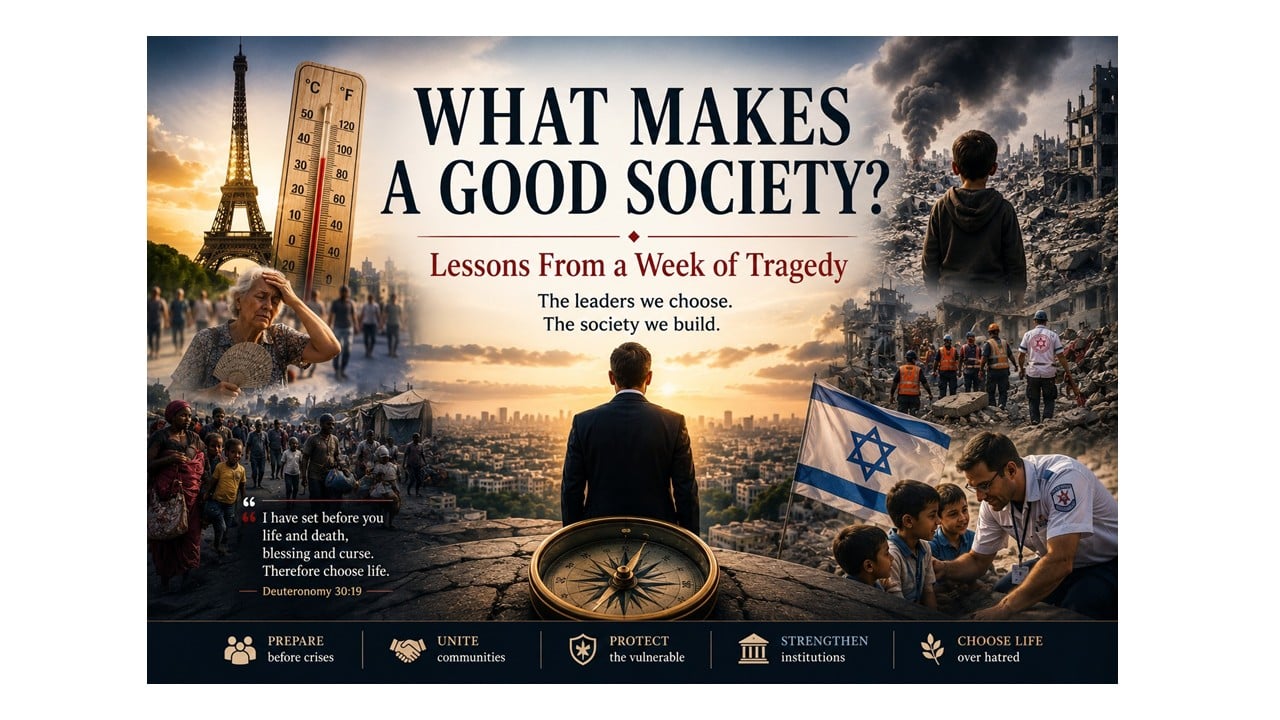
France mourns the victims of a deadly heatwave. Zimbabwean migrants have once again found themselves searching for food, shelter and safety after violence in South Africa. Venezuela struggles to recover from a devastating earthquake. Wars continue to destroy lives, families and communities.
At first glance, these are unrelated stories.
As I reflected on them, however, I realized they were all asking the same question.
What makes a good society?
I believe the answer begins with the leaders we choose.
Not leaders measured by opinion polls or election victories, but by whether they leave society stronger, more resilient and more united than they found it.
France reminds us that even prosperous societies remain vulnerable. An aging population, extreme temperatures and the quiet isolation of many elderly people combined to produce heartbreaking loss. Wealth alone could not prevent tragedy. Responsible leaders prepare before disaster strikes. They invest in resilient infrastructure, strengthen healthcare systems and ensure the most vulnerable are not forgotten when the next crisis inevitably arrives.
Southern Africa presents a different challenge.
Thousands of Zimbabweans who fled economic collapse have again found themselves displaced by violence. Yet millions of South Africans themselves continue to live in townships and informal settlements, trapped by poverty, unemployment, crime and failing public services. When hope disappears, frustration is too easily directed towards those perceived to be outsiders.
Good leadership refuses to allow one vulnerable community to become the enemy of another. It confronts poverty honestly while preserving the dignity of every human being.
In Venezuela, nature reminded us of its devastating power. Buildings collapsed within seconds. Families waited desperately as rescue workers searched through rubble.
Earthquakes cannot be prevented.
But the resilience of a society depends upon the strength of its institutions, the preparedness of its emergency services and the willingness of ordinary citizens to help complete strangers.
War presents perhaps the greatest leadership failure of all.
Unlike earthquakes or heatwaves, wars are rarely inevitable. They are the consequence of human decisions, failed diplomacy, destructive ideologies and leaders who choose conflict over coexistence.
Every child displaced.
Every family destroyed.
Every community devastated.
Each represents a failure of leadership.
Rabbi Lord Jonathan Sacks often reminded us that a society is judged not by its wealth or military strength but by the responsibilities its citizens accept for one another.
As a Jew and as an Israeli, those words have never felt more relevant.
The Torah commands:
“I have set before you life and death, blessing and curse. Therefore choose life.” (Deuteronomy 30:19)
Choosing life is more than preserving life.
It means choosing responsibility over indifference, compassion over hatred and building over destroying.
Perhaps that explains why Israel has so often been among the first nations to deploy search-and-rescue teams, field hospitals and humanitarian assistance following disasters around the world. It is why I was deeply moved this week when a Jewish cousin highlighted the plight of displaced Zimbabwean families and immediately began collecting food, clothing and practical assistance.
That is Judaism at its best.
Not asking first who deserves help.
Simply asking how we can help.
Yet there is another conversation I cannot avoid.
There are those who continue to argue that Israel itself was “born in sin,” usually pointing to the Nakba.
The suffering experienced by Palestinian (and Jewish) families during the 1948 war is real and deserves recognition.
But history did not begin with the Nakba.
The United Nations proposed two states.
The Jewish leadership accepted the compromise.
The Arab leadership rejected it.
When Israel declared independence, five Arab states invaded the new nation.
The war that followed produced two refugee tragedies. Around 700,000 Palestinian Arabs became refugees. At roughly the same time, around 850,000 Jews fled or were expelled from Arab countries, bringing to an end Jewish communities that had existed for more than two thousand years.
History is painful.
It is also complicated.
Recognizing Palestinian suffering does not require denying Jewish history or Israel’s legitimacy. Every nation has chapters it wishes had unfolded differently. The true measure of a nation is not whether its history is perfect, but whether it continues to build a society worthy of its ideals.
That brings me to leadership today.
This week, New York mayoral candidate Zohran Mamdani said he could not support Israel as a Jewish state because he could not support “any state that privileges one religion over another.”
I found that deeply troubling.
Israel’s Declaration of Independence guarantees equal civil, religious, and political rights to all its citizens, regardless of religion, race, or sex. Arab citizens vote, serve in the Knesset, sit on the Supreme Court, lead hospitals, universities and businesses, and participate throughout Israeli society.
Like every democracy, Israel has imperfections.
But I struggle to understand why the legitimacy of the Jewish state is questioned so readily while many other nation-states built around a national, religious or cultural identity are not subjected to the same test.
Responsible leadership requires consistency.
It also requires moral clarity.
Former IDF spokesman Jonathan Conricus recently drew an important distinction. He spoke movingly about the immense suffering of civilians in Gaza while also describing the reality of life under Hamas—a regime where there is no meaningful freedom of speech, no freedom of assembly and no safe way to criticize those who govern.
Those two truths can exist simultaneously.
We should grieve for Palestinians. We should grieve for Israelis killed by terror and our young men who have given their lives to fight this terror.
We should also recognize that Hamas denies its own people the very freedoms that many in the West claim to champion.
We should also recognize Iran’s direct hand with Hezbollah and their refusal to seek to a peaceful path.
A good society never confuses compassion with moral blindness.
As I look back on this remarkable week, I am convinced that tragedies do not ultimately define societies.
The leaders they choose do.
Responsible leaders prepare before crises arrive.
They strengthen institutions.
They unite rather than divide.
They tell uncomfortable truths.
They protect the vulnerable.
They build hope instead of exploiting grievance.
That, ultimately, is what makes a good society.
In my next article, as America celebrates its 250th birthday, I want to ask a related question.
This article is the first in a four-part series exploring what makes a good society.
America at 250: What Makes a Good Society?
–
Questions to Ponder
- What qualities should we demand from those who seek to lead us?
- Is a good society measured by its wealth, or by how it protects its most vulnerable?
- Can compassion for civilians coexist with moral clarity about those who oppress them?
- Should every nation be judged by the same standards, or do we apply different standards to different countries?
- Are we raising a generation that speaks more about rights than responsibilities?
- What institutions in our own communities need strengthening before the next crisis arrives?
- Does leadership unite people around shared purpose—or divide them through grievance and identity?
- What kind of leaders are we choosing, and what kind of society will they leave behind?
Related Topics