

A Mermaid in Jerusalem
Featured Post
What Mohamad’s grandmother taught him about Zionism
Every night she would pray God, protect my children. But when she said ‘my children,’ she didn’t only mean her own, she also meant the Jews
In Hebrew, we say pa’am shlishit glida — third time, ice cream. Which is why Mohamad, my taxi driver, and I joke that we owe each other a lot of ice cream by now.
We’ve run into each other so many times — sometimes by chance, sometimes by ride app, always with a story.
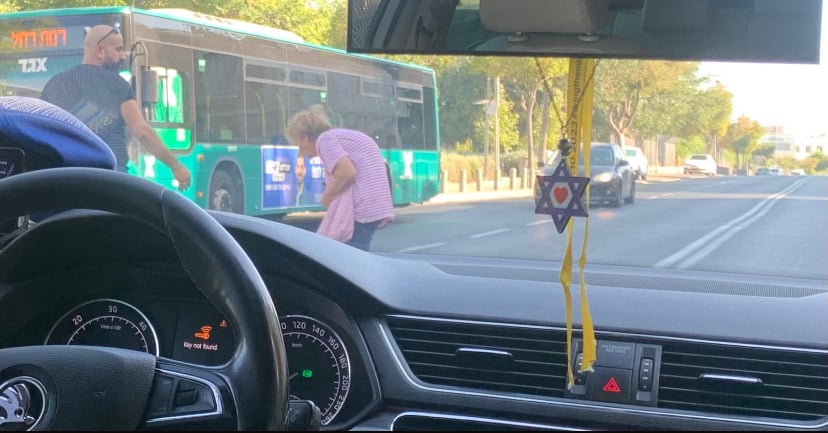
The first time we met was a year ago. I’d ordered a Gett taxi. The driver on the screen had a great smile. “Mohamad S.” A car pulled up, I climbed in, and froze. Hanging from the rearview mirror was a Magen David — a Jewish star — with a little heart in the middle.
I double-checked the app.
I looked at the star. Then back at the name. Finally I blurted:
“What’s your name?”
He smiled in the mirror. “Mohamad.”
“Forgive me,” I said, “but what’s going on with your rearview mirror decoration?”
He laughed. “Everyone asks me that. I’m proud to tell you: I love Israel. Yes, I know, I’m an Arab. Technically I’m only a resident here in Jerusalem. But this is my home. This is my country. I love it.”
I asked where he lived, and he named a village near mine — one with a reputation for producing terrorists, not proud Zionists.
“What do your neighbors think?” I asked.
He shrugged. “It doesn’t really matter what they think. They need to understand this is our country.”
He nailed every AIPAC talking point I’d ever heard, but somehow it didn’t sound rehearsed — it sounded like faith.
As we drove, he told me about his kids, his wife, about sometimes facing prejudice, and why it still matters to him to show up for Jewish people as a supporter.
Then, in mid-sentence, he suddenly slammed on the brakes.
My body slammed forward.
My stomach lurched.
For a split second I thought: this is it. All that goodwill was a set-up, and I’m about to be in a car ramming.
Shame on me.
The reason he braked was because an elderly woman with a walker was inching her way across one of the busiest streets in Jerusalem.
You know the blessing — “may you live to be 120”? Well, this woman looked just about to make it. And Mohamad seemed hell-bent on getting her there. He leapt out of the car, arms flailing, stopping traffic in both directions, and walked her across like a Boy Scout about to earn a merit badge.
When he slid back behind the wheel, I said, “Wow. That was really kind.”
He shrugged, smiling. “That could be my grandmother. And I would want someone to treat my grandmother the same way.”
Over the months, Mohamad and I kept running into each other. Sometimes he’d spot me walking and stop to say hello. Sometimes he was my driver. He always had that star-with-a-heart swinging from the mirror, and later he added a two-dollar bill — a gift from a passenger who told him it was rare.
Mohamad likes rare things, unusual things. I could relate — I collect old coins and maps from faraway places.
He also knew his history:
Once, he told me, back in the late Ottoman days, Jews and Muslims in Jerusalem got along well because they had a common enemy: the Russian pilgrims, who were making trouble for both.
“We’d make cookies and bread for the Jews for when Passover ended,” he said. “And we’d all eat together.”
I imagined it: the dusty Ottoman streets, the scent of warm sugar and browned butter carrying on the cool spring air.
“Maybe that’s what we need again,” I said. “A common enemy to bring us together.”
“No,” he said, shaking his head. “We just need to remember that many of us share the same hopes.”
The next time he picked me up, his smile was softer. “My grandmother just died,” he said.
She was 114. Born under Ottoman rule, she lived through the British Mandate, Jordanian rule, and finally Israel. She always stayed in the same village. Mohamad’s village.
He showed me a picture of her, and she had a dazzling smile with one shiny gold tooth on the left side.
“She lived through so many moments in history!” I said.
“Yes — she was incredible. When she was young,” Mohamad said, “she used to carry a jerrycan across the desert, half a day’s walk, just to fill it with water from the spring at Ein Prat. She carried it home on her back. That was life. There was no electricity, no running water, not until Israel came in 1967.
“She told us about the Ottomans — how the men in fezzes ruled from far away, while in the villages you just worked the land and prayed the rains would come. And then the British, striding around in their starched khaki, building roads and railways but mostly for themselves. She remembered the sound of their radios crackling at night, English voices floating through the hills, while she learned to read by candlelight.”
His voice softened.
“And then Israel came in ’67. She liked to say it was as if the house itself could finally breathe — there was water in the pipes, electricity in the walls, the road to Jerusalem no longer took a whole day’s walk.
“She was married at sixteen — but that wasn’t my grandfather…” His voice trailed off, and I decided not to ask what happened. “Later she married my grandfather, a wonderful man, God bless his soul. She had ten children and more grandchildren than stars in the sky, she liked to say. And she didn’t just count her blood children and grandchildren as her own — she was a grandmother to the whole neighborhood.
“And every night she would pray: God, protect my children. But when she said ‘my children,’ she didn’t only mean her own, or the ones in the neighborhood she helped raise. She also meant the Jews. She called the Jews her children. Because after ’67, everything got better. There was water. Electricity. Roads. She really loved the Jews because she said they were honest and dependable, and they treated her with respect.
“She was so proud of her family,” he continued. “And she taught us that we must live side by side with our Jewish brothers and sisters, because it’s in everyone’s best interest. She got to know our neighbors where you live, and they became friends. Their children still call her Savta.”
He paused, then added: “The Jordanians were terrible to us. The British were terrible to us. The Ottomans were terrible to us. Israel isn’t perfect — there’s always more to improve. But it has always been better living here. And I know there are ways that can get even better if we learn to trust each other.”
Mohamad pointed to the Jewish star with the heart in the middle, swaying gently from the mirror.
“She taught me this,” he said.
I got out of the car, dazzled by his story. I’ve heard so many stories from so many drivers that I thought nothing could surprise me, but this one did.
And now, hours later, I can’t stop thinking about it. This story doesn’t cancel out other Palestinian stories — of racism, prejudice, humiliation. I know his family must have faced those things too. But this story is also true. Her love for Israel is true. The relationships she built throughout her life are true.
Maybe the lesson is that we do better when we build bridges — with infrastructure, with respect, with kindness, with shared destiny.
When we treat each other as family and look for ways to help one another.
Maybe peace comes not from erasing each other’s experiences but from remembering that many of us share the same hopes.
And maybe the secret is simpler than we think: to treat our neighbors as well as we treat ourselves. Things can be better.
At the very least, we owe each other ice cream.