What Our Children Remember
Yesterday, I had two conversations that seemed separate at first, but the more I thought about them, the more I realized how connected they really are.
The first was about the kosher supermarket. We were discussing how quiet the kosher store had been earlier this week.
Before Passover, the stores are packed and the lines are long. People’s carts are overflowing with matzah, wine, meat, potatoes, cleaning supplies, foil pans, and enough food to feed a small village.
But this week, before Shavuos, it’s much calmer. Yes, people buy cheesecake, and yes, the dairy section gets a little more attention. But it’s not the same. Not even close.
The man I was talking to tried explaining to me, “Many secular Jews simply don’t connect to Shavuos the way they connect to Passover.”
And on a superficial level, of course, he is right. But why is that?
Because from a Biblical perspective, Shavuos is one of the greatest days in all of Jewish history. It is the day we stood at Mount Sinai and G-d gave us the Torah. It is the day the Jewish people became not just a family, not just a nation, but a people with a Divine mission.
Without Shavuos, there is no Judaism as we know it.
So why is Passover so much more celebrated? Why does Passover fill homes, memories, kitchens, calendars, and hearts in a way that Shavuos often does not?
There is a simple, yet deeply counterintuitive truth that explains this discrepancy between holidays quite powerfully.
We remember what we work for.
Passover asks a lot from us. It asks us to clean, shop, prepare, rearrange our homes, kosher our kitchens, cook, cook some more, and then sit down at a Seder that often begins late and ends even later.
It is without a doubt the hardest holiday to observe.
And that may be exactly why it is so deeply rooted in the hearts of many Jews who might not observe every other holiday.
A child will always remember the smell of that kitchen. The special dishes. The boxes of matzah. The family coming together. The songs. The questions. The feeling that something big is happening.
Long before the child can explain the difference between chametz and matzah, the child knows that Passover matters.
Why?
Because the adults acted like it mattered. Not just by talking about it. By working for it.
The same is true with Yom Kippur. It is not a “fun” holiday in the usual sense. There is no food. No party. No dessert table. We fast. We pray. We give up any comfort for the day.
And yet, Yom Kippur is the second most remembered and observed day of the Jewish year.
There is something about sacrifice that carves memory into the soul.
Other holidays, like Shavuos, Purim and Chanukah, have tremendous depth, beauty, meaning, and joy. But they demand far less preparation. Come hear the Ten Commandments and enjoy some cheesecake. Light the menorah and eat a latke.
All beautiful things.
Yet the reality is that many of our special moments, full of light and sweetness are significantly less observed then the harder, more demanding, and seemingly less joyful Holidays.
Because when Judaism asks very little from us, it often leaves a smaller mark on us.
Which brings me to the second conversation I had yesterday with a Hebrew School parent at our end-of-year celebration.
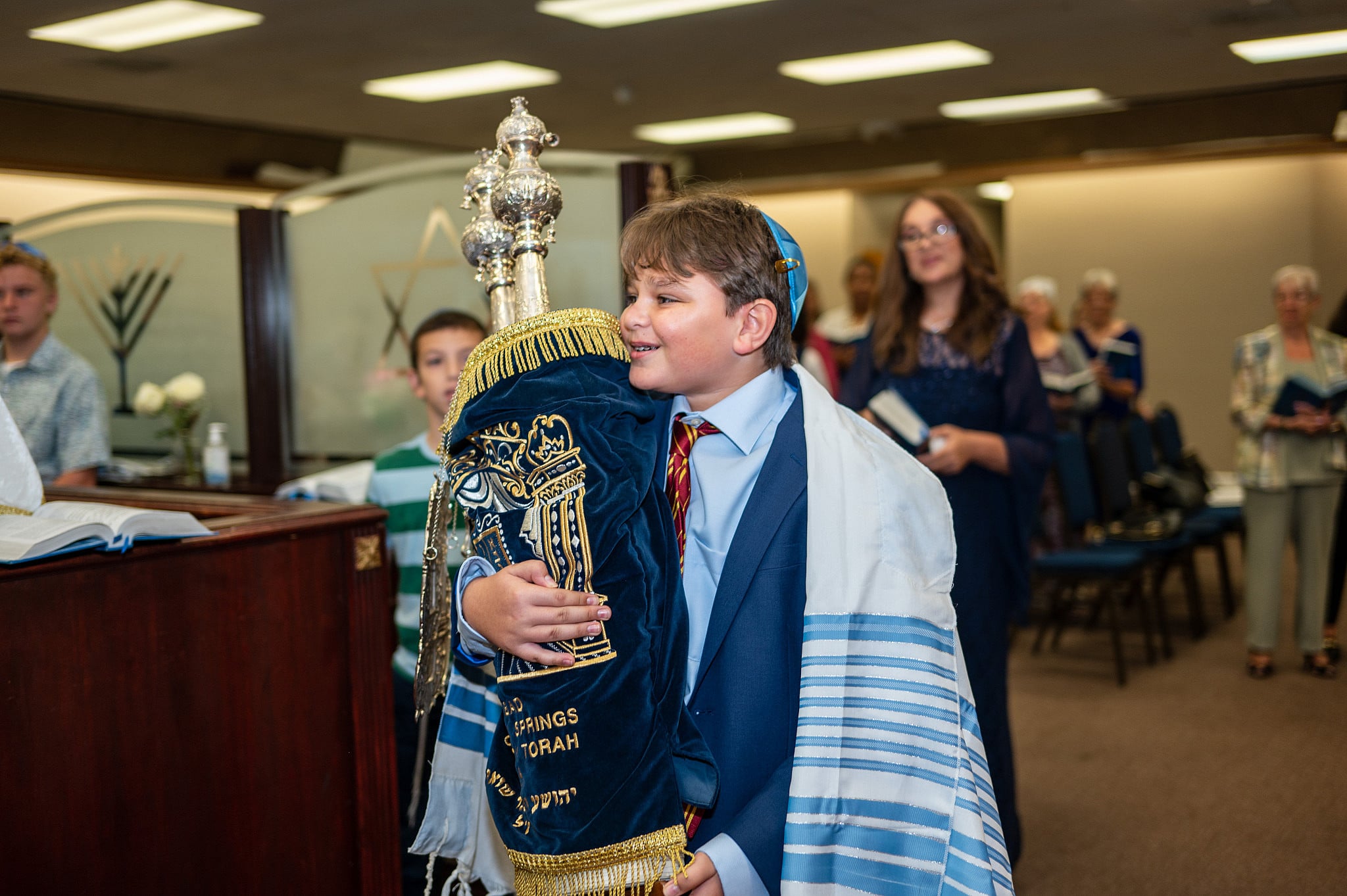
We were talking about how much her child had grown in the past year. We were also talking about how difficult it had been for her to bring him each week, and how much she had to sacrifice for his Jewish education.
She’s right. Prioritizing Hebrew School, or any Jewish educational activity, is also not always easy.
It means rearranging schedules. It means driving after a long day. It means sometimes saying no to something else. It means making Jewish learning a priority even when there are sports, homework, birthday parties, tired kids, tired parents, and a thousand other things pulling in every direction.
As we spoke, I kept thinking about this same earlier conversation.
I know that for many parents, making Hebrew School, or a family Friday night dinner with no distractions, an unbreakable priority in their home, is not simple. They feel afraid to demand too much from their kids, because they “don’t want to push them away from Judaism.”
But what they don’t realize is that when a child sees their parents make Hebrew School a priority over everything else, they learn something even more important than the alef-bet, the holiday projects, or whatever it is the teacher taught in the lesson of that particular day.
They learn that Judaism matters.
They learn that Torah is not just something we do when it is convenient. They learn that being Jewish is worth time, effort, commitment, and sometimes sacrifice.
And that is the most important lesson of all.
Children don’t only learn from what we say. They learn from what they see us rearrange our lives for.
I have talked with so many sincere Jewish parents who carry this fear of “pushing Judaism.” They don’t want their children to feel pressured. They are afraid if they tell their kids that Judaism is not negotiable, their children will rebel against it.
I understand the fear. No parent wants to turn Judaism into a burden. No one wants their children to feel that Torah is only rules, restrictions, pressure, and guilt.
But sometimes, with the best intentions, we can make a big mistake.
We may not realize that if we make Judaism so easy, so optional, so convenient… it stops feeling important.
If nothing is ever demanded of a child, why would the child think it matters?
If Shabbos changes nothing in the home, if holidays require no preparation, if kosher is only “when it works out,” if Hebrew School is skipped for every other competing activity, and if Jewish commitments are always the first thing to be moved, then we have taught our kids a terrible lesson. Even if we never said a word.
We have taught them that Judaism is nice. But not necessary.
To contrast: When it comes to taking care of our children’s teeth, we don’t give in to their complaints about brushing their teeth. We recognize that teeth are important for you, and therefore even if your child complains, we still insist on it, night after night. We still fight with them to go to the dentist. We are not afraid to make them resent their teeth, because we know that their health matters.
Are our children’s souls not even more important? And unlike teeth that can be replaced, their childhood foundations cannot.
If we love our kids enough to sacrifice for their teeth, should we not sacrifice, with warmth and love, for their Jewish soul?
More importantly, once your kid sees that Judaism is real to you, so real that you are willing to sacrifice something else you want for what you know is most important; you will have taught them the most powerful lesson you can ever teach them.
When you tell your child, “We cannot go there Friday night because we will be celebrating Shabbos,” the child may complain in the moment. But deep down, the child has just learnt that Shabbos is real.
When the whole family drives across town for Hebrew School and misses out on a soccer game, the child learns that Jewish learning is worth more than a soccer game.
When a parent says, “We are going to hear the Ten Commandments on Shavuos because this is the day we received the Torah,” the child learns that Torah is not just something we study. It is something we live for.
This doesn’t mean that Judaism should be forced or coerced. Not at all!
Judaism must be joyful. It must be warm, loving, and full of joy. A child must feel the beauty of Shabbos, the sweetness of a mitzvah, and the pride in being Jewish.
But joy is not the opposite of effort. In fact, real joy usually comes from succeeding at something into which you put great effort. And often, the greater the effort, the greater the joy after.
Raising children is joyful, but it takes endless work. Building a home is joyful, but it asks for sacrifice every single day.
The same is true with Judaism.
This Shavuos, let us give our children, and ourselves, the full Judaism. The sweetness. The joy. Even the cheesecake.
But also, the commitment.
Please join us Friday morning at 11:00 am to hear the Ten Commandments. Bring your children, even if it means rearranging your schedule. Let them see that Sinai still matters. That Torah is not ancient history. That the living voice of G-d is still calling to us today.
Because the Judaism we work for is the Judaism we remember.
And the Judaism we sacrifice for is the Judaism our children will one day cherish.
Wishing you a happy and meaningful Shavuos,
Rabbi Yankie & Chana Denburg