
What Philadelphia Got Right About ‘Never Again’
Eighty-eight years ago, on November 9–10, 1938, Jewish businesses across Germany and Austria were destroyed, synagogues were burned, and tens of thousands of Jews were arrested and sent to concentration camps. Kristallnacht, the “Night of Broken Glass,” marked a turning point in the history of the Holocaust, when neighbors and friends turned against one another simply because they were Jewish.
On November 8, 2026, nearly nine decades later, a small cycling group in Philadelphia organized a protest targeting Jewish-owned businesses. But this time, the response told a different story.
Jews and non-Jews, ordinary citizens and lawmakers, came together to support the six businesses being targeted. Many of those who showed up specifically cited their knowledge of Kristallnacht and the Holocaust as the reason they felt compelled to act.
For those of us who have dedicated our careers to Holocaust education, what happened in Philadelphia was a powerful reminder of why we do this work.
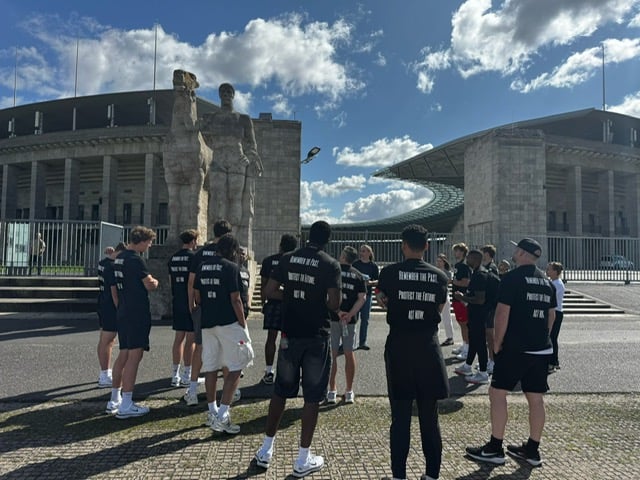
Earlier this year, I had the privilege of leading the Davidson College men’s basketball team on an educational trip to Berlin commemorating the 90th anniversary of the 1936 Olympic Games. Shortly after returning, I was interviewed on a podcast and asked a question inspired by a recent essay written by Dr. Dara Horn:
“If the goal of Holocaust education is to protect our society from antisemitism, wouldn’t it make more sense to teach the public about living Jews instead of dead ones?”
I have tremendous respect for Dr. Horn and the important questions she raises. However, I believe that the past, present, and future are inextricably connected. To understand contemporary antisemitism, we must understand its history. And to recognize the warning signs of hatred and discrimination today, we must understand how they manifested themselves in the past. Thus, to properly teach the public about living Jews inherently entails teaching about a period of time when people were murdering Jews on a massive scale simply because they were Jewish.
When I answered that question, the planned Philadelphia protest had not yet been announced. I could not have anticipated how clearly the events of November 8 would illustrate my point.
Kristallnacht did not occur in isolation. The violence of November 1938 was preceded by years of escalating antisemitism, discrimination, and the systematic exclusion of Jews from German society. The Holocaust did not begin with the Final Solution. It developed in a society where hatred was increasingly normalized and where too many people chose to look away.
The events in Philadelphia were not Kristallnacht, nor should they be equated with the atrocities of Nazi Germany. But the decision to target Jewish businesses should concern anyone familiar with that history. And the response demonstrated what can happen when people recognize those warning signs and refuse to remain silent.
That was perhaps the most important lesson the Davidson basketball players took away from our journey to Berlin and the reason why I am so proud to have led this trip.
Reflecting on his experience, one player wrote:
“It is easy to look back and wonder how people could allow something so terrible to happen. But being in these places made me realize that hatred and discrimination do not happen all at once. They can grow when people stop questioning what they are being told, look the other way, or convince themselves that something is not their responsibility.”
Another player described how the trip gave him “a new perspective on everything,” adding that what he learned made him motivated to speak out.
That is what meaningful Holocaust education can accomplish. It does more than teach students what happened. It helps them understand why it happened, recognize when similar patterns emerge, and appreciate their own responsibility to respond.
We often invoke the words “We Remember” and “Never Again” when commemorating the Holocaust. But remembrance without action risks becoming little more than an empty promise.
The people who stood together in Philadelphia understood that distinction. Their knowledge of the past informed their actions in the present.
Which brings me back to Dr. Horn’s question.
We absolutely should teach about Jewish life, identity, and the experiences of Jews living today. But we must also continue teaching the history of the Holocaust, because understanding what happened on November 9, 1938, helps us recognize why events on November 8, 2026, matter.
More importantly, Holocaust education has the power to cultivate something our society desperately needs: moral courage.
Following our visits to the Wannsee Conference site and Sachsenhausen concentration camp, Davidson basketball player Josh Scovens reflected on the responsibility each of us has to establish our own moral compass. He recognized that we cannot simply assume we would have the courage to do the right thing when confronted with injustice. That courage must be developed long before it is tested, through the choices we make every day.
Josh’s reflection captures precisely what Holocaust education should accomplish. It should challenge us to move beyond asking how ordinary people could have allowed the Holocaust to happen and begin asking what we would do when confronted with hatred and discrimination in our own communities.
On November 8, the people of Philadelphia answered that question. Jews and non-Jews alike refused to remain silent while Jewish businesses were targeted. Their actions demonstrated the kind of moral courage that Josh described: the willingness to stand by one’s values and speak out against injustice rather than simply look the other way.
We cannot change what happened on Kristallnacht 88 years ago. But we can teach future generations to recognize the warning signs, reject indifference, and develop the moral courage necessary to prevent history’s darkest chapters from repeating themselves.
That is why we teach the Holocaust. Not simply so that future generations will remember what happened, but so that when their own values are tested, they will have the courage to act and fulfill the promise of “Never Again.”