English Professor; Executive Director, Writing on the Wall
Featured Post
What Rembrandt saw in Balaam
In the rabbinic imagination, messengers from nature convey God's truth - whether stones, trees, or a donkey - when the people themselves don't see clearly (Balak)

But can you see? 'Self-portrait in a cap, open-mouthed,' a 1630 etching by Rembrandt.
What happens when those entrusted to see clearly fail to see at all? When the people we look to for direction misread the moment completely?
This week’s Torah portion, Parashat Balak, tells the story of Balaam, a prophet-for-hire set out to curse Israel. In Rembrandt’s 1626 painting, Balaam and the Ass, the prophet sits atop his donkey mid-journey, his arm raised in frustration. The animal has stopped abruptly. An angel stands in the road ahead — sword drawn, glowing — but only the donkey sees it.
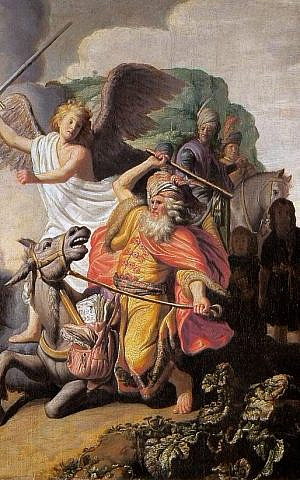
Balaam’s eyes are open, but he sees nothing.
Behind him, rolled in his saddlebag, are folded papers — dispatches, proclamations, perhaps already-prepared blessings or curses. Rembrandt paints Balaam not just as a prophet, but as a carrier of prepackaged speech — someone who speaks on behalf of the Divine, but with no connection to what he says. He performs, but does not connect.
He is, in a sense, a prophet of the newspaper. His words are true, but flat. Delivered, not discovered. Correct, but untouched.
This is the core of Balaam’s failure. It’s not that he lies. It’s that he sees too little. And even when he blesses, he remains blind.
The Prophet with One Eye
The rabbis of the Talmud say Balaam had “one eye.” Not just physically, but also spiritually. He is sharp in one direction, blind in another. He’s a prophetic hack, a mouth without vision. His name, Balaam (בלעם), is read as “swallower of the people.” He’s all mouth. A man of proclamations.
And that’s what makes him feel so familiar.
We live in a moment flooded with statements, declarations, positions. Public figures speak in templates. Their words move fast, but say little. Like Balaam, they perform certainty. Rembrandt catches this precisely. The donkey sees; the angel waits. Balaam — surrounded by signs — remains sealed off inside the noise of his own authority, striking his donkey in frustration.
Abraham, and Those Who Couldn’t See
The story of Balaam echoes another, the test of Abraham, the sacrifice of Isaac.
Both Abraham and Balaam rise early in the morning. Both saddle their donkeys. Both bring two attendants.
But when Abraham reaches the mountain, he stops, turns to his two attendants, Ishmael and Eliezer, and says, “Stay here with the donkey.” The tradition explains: they can’t see. The donkey and the boys remain below because they are unable to perceive what’s about to happen.
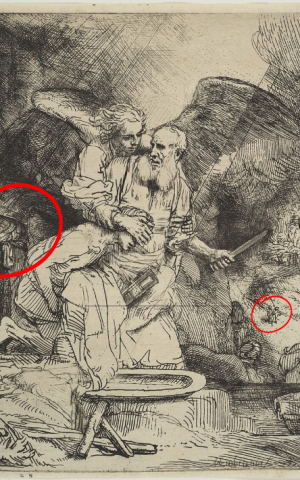
Abraham ascends into the unknown; Balaam never does.
In the earlier painting, two attendants follow behind Balaam. One appears reverent — hands folded, posture still. But look closer: his face is misaligned. One eye is shut.
The other is twisted. He isn’t watching. He’s going through the motions. Both begin to dissolve into the green landscape. Their bodies are present, but their perception is gone.
Rembrandt paints them like so many who surround power: polite, pious, and blind.
A Talking Donkey?
And yet — the donkey sees. She stops. She resists. She’s beaten for it. And then she speaks with the voice of Sinai, speaking words of fairness and justice: “What have I done to you that you punish me like this?”
In the rabbinic imagination, when human beings stop seeing clearly, the natural world responds. Stones cry out. The earth opens its mouth. Trees clap hands. Even a donkey can deliver divine truth. In this story, it’s the animal — not the prophet — who recognizes the sacred.
It’s a reversal of the sacrifice of Isaac: there, the animal is left behind with those who cannot see. Here, the animal sees everything — and the prophet is the one left behind.
What Balaam Missed
The question isn’t whether Balaam told the truth. He blessed Israel. The words came out right.
The question is: Does he see?
For Rembrandt, the real question (always) is: do we see?
We are the ones left to decide whether we will see clearly or speak blindly. Writing begins not with certainty, but with vision. With the willingness to see what others ignore, to read the world without shortcuts, and to write in a way that holds its complexity. That’s what Balaam lacks. That’s what the donkey, strangely, demands.
We don’t need more prophecy. We need the responsibility that comes with seeing—and the language that follows from it.
Related Topics
Related Posts