
What Season Two of Nobody Wants This Gets Right About Interfaith Relationships
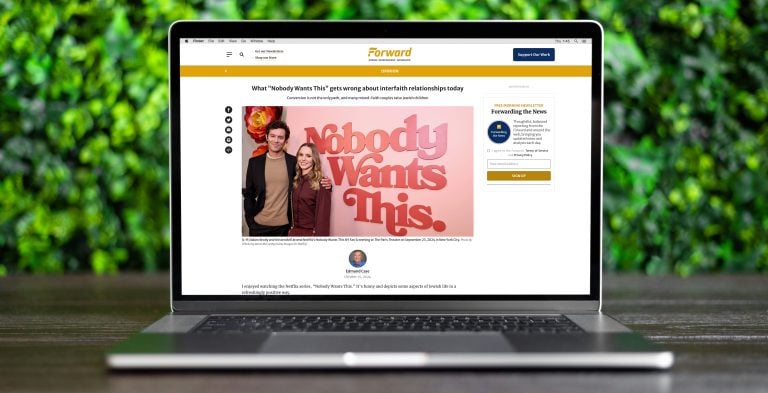
Last year, it was What Nobody Wants This Gets Wrong about Interfaith Relationships Today. This year, season two gets a lot right.
The first season’s blatant hostility to interfaith marriage is gone. There’s no glaring at Joanne, no calling her “shiksa.” Even Noah’s mother Bina’s opposition softens; after initial refusal, and realizing Noah won’t come without Joanne, Bina invites Joanne to Shabbat dinner. Noah’s sister-in-law Esther tells Joanne “you’re basically Jewish.” In the first season, the reason no one wanted the relationship was that Noah and Joanne’s future children wouldn’t be Jewish because interfaith families don’t raise Jewish children. That’s gone too.
The show still is not representative of interfaith relationships generally, not least because Noah is a rabbi. It focuses on conversion, but conversion occurs in a very small number of interfaith relationships. A recent Pew report found that 14% of adult Jews are converts, while 58% of Jews married after 2005 are intermarried.
Nevertheless, the show meaningfully depicts how interfaith couples process conversion. Within the first minutes of episode one, Noah illustrates two approaches. First, “I was hoping you’d want to convert eventually.” Second, “if you don’t, it’s a problem for me.” Joanne perceptively understands that the second approach overwhelms the first.
Noah reiterates the hopeful approach in episode five; Joanne reports to her sister that Noah says she has to want to convert for herself. Later, when Joanne says she’s been hoping that she might feel Jewish at the Purim party in that episode, but she hasn’t had that feeling yet, Noah is gently encouraging. He says he has complete faith in her and that he loves her, and in a speech at the end of the party, he says “sometimes the best things in our life are things that we didn’t plan for.”
But the pressure reappears in episode nine, when Noah says they can’t move in together without answering the question of conversion, fearing that if they do, they never will answer the question, and he will be “unhappy and even resentful.” Joanne responds, “I am inching towards it, but I can’t guarantee it. If you can’t move in with me now, I don’t see how we can move forward.”
I thought the season would have a classic Gift of the Magi ending, with each choosing what the other wants – Noah choosing Joanne and Joanne choosing to convert. That turned out to be half accurate – Noah says, as he had at the end of season one, “You are my soulmate. I don’t care if you’re Jewish, I choose you.” But Joanne only says, “you’re in luck,” leaving it ambiguous whether she will convert. Perhaps that will be determined in the season three that’s already being discussed.
Two key lines summarize the issues around interfaith couples’ discussions of conversion. In episode one, Joanne says, “I can’t decide if it’s what I want for myself with the pressure on me.” In episode nine, she says, “don’t we both deserve to be exactly who we are.” Noah gets it – in the last episode, he says, “nothing good happens when it’s forced. I don’t want to be the person who’s asking you to be someone different.” The takeaway messages: pressure to convert is likely to turn partners from different faith backgrounds away from Jewish engagement; partners from different faith backgrounds should be accepted for exactly who they are.
Beyond conversion, season two gets a lot right in what it says about the need for partners from different faith backgrounds to feel included. In a key line from episode one, Bina, who had been the main opponent of the relationship, realizes that Noah “won’t go anywhere where you are not included.” Esther says, “you’d be a good get for us.”
In the season’s final minutes, Joanne’s discussion with Esther depicts both how partners from different faith backgrounds can come to feel almost or kind-of Jewish by engaging in Jewish life, and also how impactful it can be when Jews think of those partners as Jewishly identified. When Joanne says she’s going to miss Shabbat, Noah’s sister tells her to “keep doing Shabbat. You’re basically Jewish…. The whole thing is just a feeling and enjoying all those little things [that you do] is the feeling. With or without Noah, you’re Jewish.”
In episode seven, Noah tells Joanne that Temple Ahava “could be just right for him, and that means for us.” He recognizes that he and Joanne need a Jewish community that is right for both of them, which means inclusive of her. By the end of the episode, Noah tells his brother he’s concerned that if Temple Ahava isn’t a place for them, then no place is.
(The worst thing about season two is the caricatured depiction of Temple Ahava as a place lacking any Jewish content or substance, and the implication that that is because Seth Rogen’s snarky, superficial rabbi is intermarried. Many viewers may not understand that no liberal synagogue resembles Temple Ahava.)
In episode one, Joanne says, “we’re doing the whole interfaith thing.” If there is a season three, that’s what I’ll still be looking for: Noah and Joanne continuing their relationship, marrying and raising children with Judaism; Joanne feeling that she is considered and treated as equal, and therefore belongs; Noah leading a synagogue of substance that is open to rabbis having partners of any cultural or religious identity; Joanne perhaps taking an introduction to Judaism course to learn about what Noah loves so much, but without conversion as the goal.
As I said last year, “Who knows – after experiencing the beauty and meaning of Jewish life, and being embraced and made to feel included, [Joanne] might convert later.” But we need to be careful not to generate feelings of exclusion by promoting conversion too much. The underlying reality is that only 27% of people in intermarriages say they feel a great sense of belonging to the Jewish people – a feeling that is essential for engagement in Jewish life. Too much emphasis on conversion can make partners from different faith backgrounds feel that they are not accepted exactly as they are – that they don’t belong.