


What the Bennett-Lapid Merger Really Means
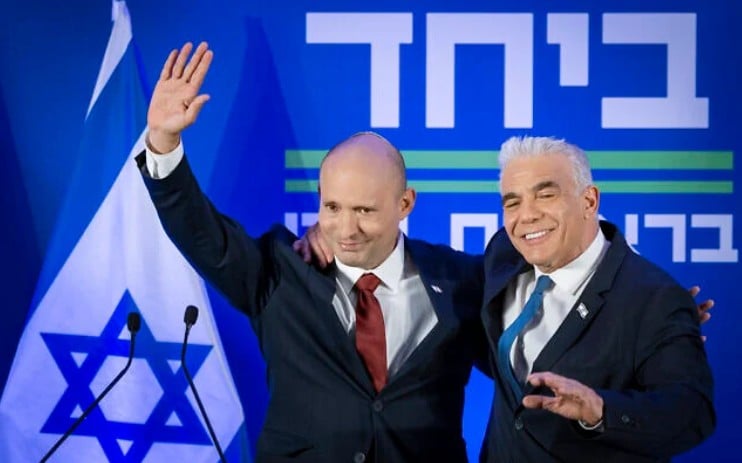
On Sunday evening, in a well-lit hall in Herzliya, two former prime ministers stood together and declared, with considerable rhetorical flourish, that the era of division was over. Naftali Bennett and Yair Lapid, long-time rivals who have nevertheless repeatedly found each other’s company useful, announced the merger of their parties into a single electoral list called Together, to be led by Bennett. Lapid, magnanimously stepping aside, told Israeli voters that “the entire Israeli center must rally behind Naftali Bennett.”
It was a striking scene. And it raises the central question: does this merger actually change anything, or is it the political equivalent of rearranging deck chairs?
What They Did — and Why
The mechanics are straightforward. Bennett’s party, Bennett 2026, and Lapid’s Yesh Atid — There is a Future — are merging into a unified Knesset list. Unlike their previous arrangement in 2021, which featured a prime ministerial rotation, this deal installs Bennett unambiguously as the top. Lapid, who currently holds 24 seats in the Knesset but was polling at a meager seven before the merger, made the rational political calculation that his electoral brand had eroded since 2022 and that attaching his remaining base to a stronger vehicle was better than a dignified collapse.
For Bennett, the merger consolidates the center-left flank of the opposition under his banner, giving him the credibility of a broad coalition without the organizational headache of managing a multi-party alliance. He immediately used the announcement to call on former IDF Chief of Staff Gadi Eisenkot, whose Yashar! party has been polling around twelve seats; to join as well, a door has been reportedly left open in the party framework.
The optics matter too. This is, as both men framed it, not just a political maneuver but a statement that the fractured Israeli center-right and center can produce a unified front. Bennett described it as “the most Zionist and patriotic step we have ever taken for our country.” Lapid invoked Hungary, where a unified opposition recently broke polling expectations to defeat an entrenched government.
The Numbers: Opportunity and Obstacle
Here is where the picture gets complicated.
Before the announcement, polls showed Bennett at roughly 21 seats and Lapid at seven — a combined 28, which makes Together potentially the largest single party in the Knesset, ahead of Netanyahu’s Likud at 25. On the surface, that is a significant moment. Being the largest party gives the leader the presumptive right to be asked to form a government.
But a first post-merger poll tells a more sobering story. The new unified list is projected at 26 seats — less than the two parties’ combined pre-merger projection. Meanwhile, Eisenkot’s party rose to 15, benefiting from voters apparently unimpressed by being absorbed rather than allied. Netanyahu’s coalition, though internally fragile, holds at around 51 seats. The opposition bloc — including Together, Eisenkot, Yisrael Beiteinu, the Democrats, and National Unity — sits at 59, one or two seats shy of the 61 needed to form a government without relying on Arab parties.
That is the core arithmetic problem. Bennett and Lapid have explicitly ruled out a coalition with Arab parties. The previous government’s inclusion of Ra’am was, in Bennett’s own telling, a one-time emergency measure he will not repeat. Netanyahu has already weaponized that precedent, posting an old photo of the two men with Ra’am leader Mansour Abbas captioned: “They did it once, they’ll do it again.”
Without Arab parties, the path to 61 currently does not exist, unless Eisenkot joins, and several smaller factions consolidate further. Bennett’s response to questions about how they form a majority was cryptic but telling: “We are in the middle of a process much larger than that.” Read: more mergers are coming.
The October 7 Factor
It would be a mistake to analyze this election as if it were primarily about personalities or ideological positioning. The shadow over everything is October 7, 2023.
Bennett and Lapid have both been scathing in their criticism of Netanyahu’s handling of the catastrophe and the wars it unleashed. One of Bennett’s central pledges is that on the first day of a government led by him, he will establish a national commission of inquiry into the failures leading up to October 7, something Netanyahu’s government has emphatically blocked. For a large portion of Israeli society, this is not a policy question but a moral one. The families of the murdered, the surviving hostages and their relatives, and the reserve soldiers who served for hundreds of consecutive days, they want accountability, and they want it from the top.
This is Bennett’s strongest card. Netanyahu’s security credentials, the basis of his political identity for three decades, have been seriously damaged. His critics argue, with considerable force, that the man who built his career on being the indispensable guardian of Israeli security presided over the worst security failure since the Yom Kippur War. The commission of inquiry question is a slow-burning fuse at the center of Israeli political life, and Bennett knows it.
The Haredi Conscription Question
There is a second structural issue that works in the opposition’s favor: ultra-Orthodox military exemptions.
Netanyahu’s coalition depends on Haredi parties — Shas and United Torah Judaism — whose central demand is that their communities be exempt from mandatory military service. The Supreme Court has ruled that such exemptions are unconstitutional. The IDF has warned publicly that the military is overstretched after years of grinding multi-front conflict. A large majority of Israeli Jewish society, including many traditional Likud voters, believes that Haredi men must serve.
Netanyahu cannot satisfy both his religious partners and this public demand. It is a coalition contradiction he has managed through delay and obfuscation, but it is becoming untenable. Bennett and Lapid both favor conscription and, critically, would not need Haredi parties to form a government. For the secular middle class and for combat veterans and their families, this is an electrifying distinction.
What Netanyahu Will Do
Netanyahu is not politically dead, and it would be foolish to assume otherwise. He has survived more obituaries than any figure in Israeli political history. His campaign will run on two tracks.
The first is the Arab-coalition attack. The Likud party has already begun posting inflammatory content associating the Together merger with an inevitable return to an Arab-supported government. Bennett’s explicit pledge against such a coalition has some credibility given his track record of hostility to Palestinian statehood, but Netanyahu’s messaging machine will hammer the association relentlessly.
The second track is Trump. Netanyahu will campaign on his relationship with the American president as a unique geopolitical asset, the architect of the joint U.S.-Israeli strike on Iran in February 2026, the man who knows how to navigate Washington in the Trump era. Whether Israeli voters credit him for that operation or blame him for the Iranian missile retaliation that followed is an open and genuinely contested question.
Three Possible Outcomes
Scenario One: Opposition Consolidation Succeeds. Eisenkot joins Together, additional smaller parties align, and the opposition bloc crosses 61 seats without Arab parties. Bennett becomes prime minister, launches the October 7 commission, advances Haredi conscription, and Israel enters a period of contested but significant domestic reform. This is the optimistic scenario for the opposition — possible but requiring several more dominoes to fall.
Scenario Two: Stalemate and Another Round. The opposition falls short by a handful of seats. Neither bloc can form a stable government. Israel faces its sixth election in seven years. Political exhaustion deepens, and the institutional damage of perpetual electoral cycles continues. This is, depressingly, not an unlikely outcome.
Scenario Three: Netanyahu Survives. The merger fails to produce a bloc majority. Netanyahu maneuvers among smaller factions, possibly prying a centrist partner away from the opposition with ministerial promises, and forms a new government — perhaps a slightly different coalition. The commission of inquiry is blocked. The Haredi exemption crisis simmers. Netanyahu’s trial continues in the background. The status quo, battered but intact, endures.
The Deeper Question
What Bennett and Lapid have done is politically significant, but it is not yet decisive. The structural problem of Israeli coalition arithmetic has not been solved by this merger; it has been clarified. The opposition now has a single large vehicle and a credible leader. It does not yet have the numbers.
The announcement in Herzliya was an opening move, not a checkmate. What follows, whether Eisenkot joins, whether other consolidations occur on the right flank, or whether the war situation shifts public sentiment further, will determine whether this is remembered as the moment the tide turned or as another promising start that fell a few seats short.
Israeli voters have learned not to bet heavily on political promises made at joint press conferences. But they have also learned, painfully, what staying the course looks like. Together is making a simple argument: that changing direction is both necessary and possible. Whether that argument is sufficient to cross 61 is a question the polls will answer, eventually, and the election, due by October, will decide.