What the sukkah lets in
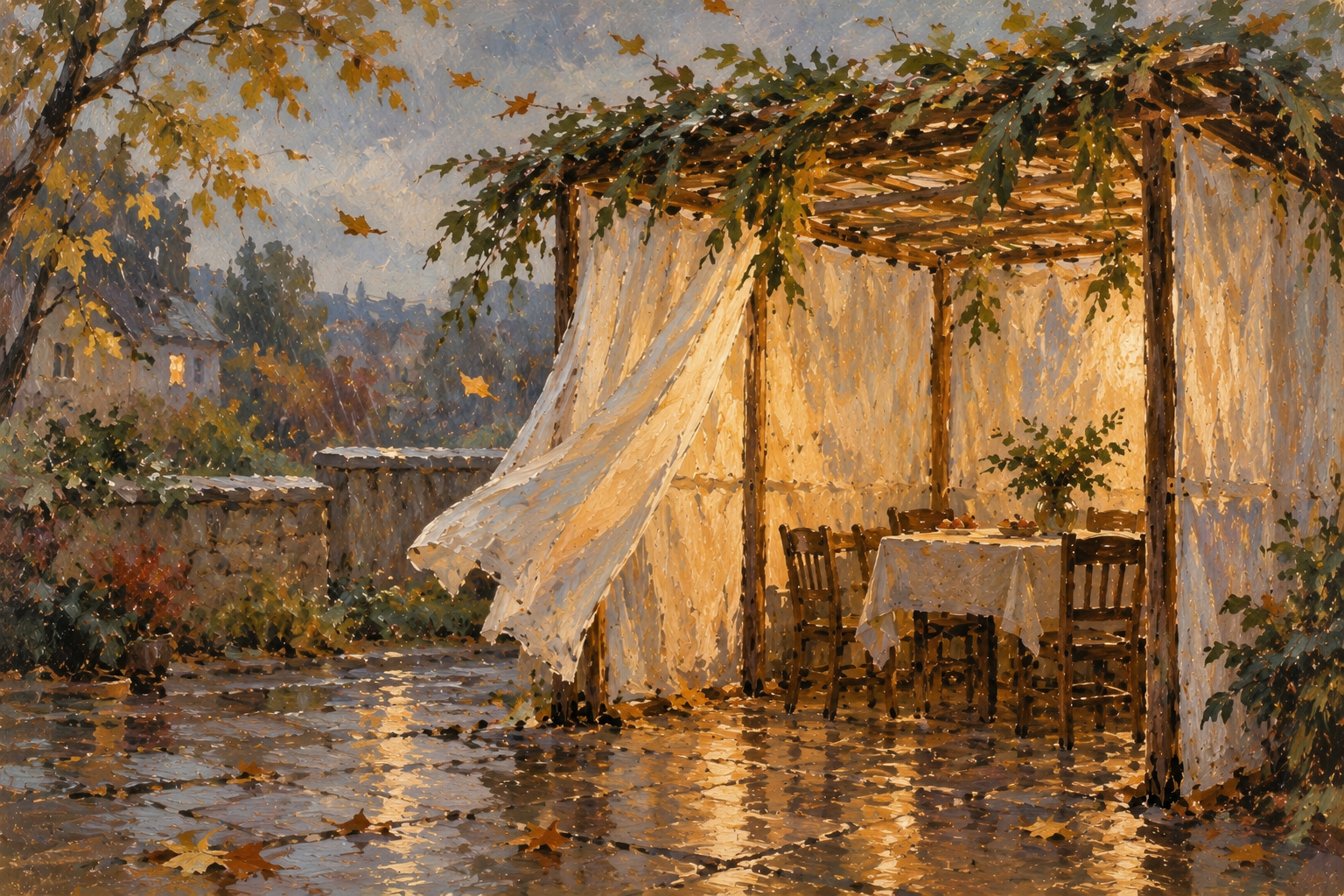
In the 1950s, in Williamsburg, Brooklyn, my father was a boy living in an apartment building called the Harding, built around a shared courtyard.*
Every year, several of the Jewish families in the building shared one large communal sukkah there. The families my father grew up with were Orthodox, but very American, and strongly Zionist. After the establishment of the State of Israel, two large flags hung inside the entrance to the sukkah: an American flag on one side, and the new Israeli flag on the other.
But Williamsburg was changing.
In the years after the Holocaust, Hasidic survivors from Europe began moving into the neighborhood and into my father’s building. Among them were Satmar Hasidim, whose community was strongly opposed to Zionism.
At first, though, everyone used the same sukkah.
My father remembers the newly arrived Hasidic families coming home from shul later than the other families, and the joy with which these recent survivors of the Holocaust sang and danced in the sukkah.
For a time, these Jews with very different histories and very different ideas about Jewish life were all sitting in the same sukkah.
But in 1956, when my father was thirteen, some of those differences came to a head over the Israeli flag.
One of the newer residents, Mr. K, had recently become president of the main Satmar shul. Mr. K himself apparently had no ideological objection to the Israeli flag. But he now represented a community that did. And he felt they could not sit in a sukkah with an Israeli flag.
So he asked my grandfather whether the flag could be removed.
My grandfather sent my father – who was the designated sukkah decorator – to speak to Mr. G, one of the longtime residents responsible for the sukkah.
Mr. G felt passionately in the other direction. For him and the other Zionist families in the building, the newly established State of Israel was something precious, something to celebrate. He went into another room, came back holding a freshly folded Israeli flag, and told my father, essentially: This flag has gone up every year, and it is going up this year. If Mr. K has a problem with it, he can come speak to me himself.
So there was my 13-year-old father, carrying messages back and forth between the two men, and in some ways between two Jewish communities, with profoundly different relationships to the new State of Israel.
Neither side changed its position.
The Israeli flag went up.
And when word of the controversy spread and there was a threat that someone might tear the flag down, my 13-year-old father and Mr. G stood guard on each side to protect it.
But something else happened that year.
For the first time, there were two sukkot in the courtyard.
The original communal sukkah, with its American and Israeli flags.
And a small sukkah for the K family.
Over the years, as more Hasidic families moved into the building, more private sukkot appeared, until the courtyard was filled with them, surrounding the original communal sukkah.
Six years later, on Sukkot of 1962, my father, then a student at Brooklyn College, was walking back to his parents, who still lived in the same apartment building, when he heard fire engines and people shouting:
“A sukkah is burning!”
He ran toward home.
Smoke was pouring from the building. His parents were huddled in blankets on the fire escape outside their apartment. Firefighters were carrying hoses and hatchets up the stairs. My grandfather, who had Parkinson’s, could not make his way down on his own, and my father had to arrange for him to be carried down on a stretcher.
It was frightening. People were in danger. No one yet knew how far the fire would spread or what they would find when they were finally able to return to their homes.
The fire had begun when candles in one of the private sukkot ignited a tablecloth. The flames spread to the adjoining sukkot and then into the apartments above.
And in the middle of all of this, my father witnessed an exchange that stayed with him.
One Hasidic man, looking up at the flames coming from one of the apartments, asked another man in Yiddish:
“Zenen zay fun unzere?”
“Do these people belong to one of ours?”
The man he asked – Mr. L, one of the longtime residents of the building – became upset:
“Mir zeinen nit fun unzere?”
“Are we not also ours?”
Are we not also ours?
How much do we feel for another person when that person is not quite “one of ours”?
How much do we try to understand people whose experiences or perspectives are different from our own?
How much responsibility do we feel when someone we don’t consider “our own” needs our help?
And perhaps the harder question: How much responsibility do we feel when someone we consider “ours” is doing something destructive or hurtful? Can we say: That is not ours. It isn’t us. It isn’t our responsibility.
There is a phrase in the Hineni prayer that the shaliach tzibbur says before Musaf on Rosh Hashanah and Yom Kippur that I love.
The prayer leader stands before God with tremendous humility, acknowledges his shortcomings, and asks God to accept his prayers on behalf of the community.
And among the qualities he asks to have is:
מְעוֹרָב בְּדַעַת עִם הַבְּרִיּוֹת
Me’urav b’da’at im habriyot.
It is difficult to translate exactly.
Me’urav means mixed in, involved, intermingled.
Da’at can mean knowledge, but also mind, awareness, perspective.
The shaliach tzibbur, the person entrusted to carry the prayers of the community, needs somehow to be me’urav with other people – to be mixed in with their minds and concerns, in touch with how they feel, with how they experience the world.
To represent a community in prayer, it isn’t enough to know the words, to have a beautiful voice, or even to be deeply connected to God. You have to be connected to people. You have to be someone who notices what other people are carrying, who can be affected by their concerns, who can somehow let their experience enter your own emotional awareness.
In my clinical practice, I work with some children who are extraordinarily emotionally aware. They feel things deeply. Their own feelings are easily stirred – if someone seems upset with them, if they think they have disappointed someone, if something feels unfair. Their feelings are easily affected, in part because they are so attuned to the feelings of others. They notice when someone is left out. They can be acutely aware of unfairness or injustice. Someone else’s sadness can become almost palpable to them. Something sad can happen far away, to people they have never met, and somehow that sadness becomes mixed in with their own.
That sensitivity can be a beautiful quality. And it can also make life hard sometimes.
In psychology, we talk a lot about boundaries and differentiation – about knowing where I end and another person begins. Your feelings are not my feelings. Your problem is not necessarily mine to solve. We talk about not becoming enmeshed in someone else’s experience. We talk about developing a thicker skin.
And often, that is exactly what someone needs to learn. We cannot absorb every feeling around us or take responsibility for every problem.
But I sometimes wonder about the other direction too. Can we become so good at protecting ourselves from what belongs to someone else that we stop allowing it to affect us at all?
Maybe part of being me’urav b’da’at im habriyot is remaining open enough to be affected. To be troubled by a struggle or an injustice that isn’t happening to us. Even when it would be easier to say: Those are their feelings. That’s their problem. That’s not mine to fix.
But being open to other people doesn’t only mean being open to their pain.
That same sensitivity that allows another person’s pain to reach us can also allow their joy to reach us. We can hear of someone else’s happiness and feel some of it ourselves. We can witness a beautiful moment that doesn’t belong to us at all – and experience some of its beauty as our own.
Maybe being sensitive means that the boundaries of what can move us become a little wider. It isn’t only my joy that can bring me joy, or my sorrow that can make me sad. Our lives become larger because the lives of others can become part of our own.
Being me’urav asks us to remain fully ourselves and nevertheless allow ourselves to be affected by another person.
To let another person’s trouble trouble us.
To let another person’s perspective complicate our own.
To let another person’s need create some responsibility in us.
We need boundaries. But maybe our boundaries need to be more permeable.
In fact, our tefillot sometimes seem designed to do just that. We say words that ask us to care about things we could otherwise not feel. To imagine hunger when we are not hungry, illness when we are healthy, danger when we are safe, slavery when we are free.
Prayer asks us to become a little more permeable.
And that permeability asks something of us beyond feeling what others feel. It asks us to allow what happens to them – and sometimes what they do – to make a claim on me.
There is another Jewish word that echoes for me the word me’urav:
Arevut.
כָּל יִשְׂרָאֵל עֲרֵבִים זֶה בָּזֶה.
Kol Yisrael arevim zeh bazeh.
All of Israel are arevim for one another.
We usually translate that as “All Jews are responsible for one another.” But an arev is literally a guarantor. If I guarantee someone else’s loan, it remains their debt – but I have said that, if necessary, I will take responsibility for it.
Their debt has, in some sense, become mine.
And what is striking is the context in which the Talmud develops this idea.
The Gemara reads the words of warning, from Vayikra, וְכָשְׁלוּ אִישׁ בְּאָחִיו – “they shall stumble, each person over his brother” – to mean that one person can actually be held responsible for the wrongdoing of another. And from there comes the principle:
כָּל יִשְׂרָאֵל עֲרֵבִים זֶה בָּזֶה
All of Israel are responsible for one another.
But that raises a question: How can that be fair? Why should I be held responsible for something someone else did?
The Talmud answers: שֶׁהָיָה בְּיָדָם לִמְחוֹת וְלֹא מִיחוּ
Because it was in their power to protest, and they did not protest.
So arevut isn’t only about helping another person when they are in trouble.
Sometimes it is: I cannot simply look away from the harm you are causing and say it has nothing to do with me.
So in arevut we have several things bound up together:
I try to understand you.
I care what happens to you.
And I accept that what happens to you – and sometimes what you do – may make a claim on me, too.
Being me’urav with another person doesn’t mean believing that person is always right. And sometimes this becomes much harder – when another person’s da’at, their belief or perspective, is very different from our own.
But perhaps being me’urav means that even then, we don’t completely close ourselves off. We can still try to understand how another person sees things. We can still care about what happens to them.
Maybe this is something the sukkah itself can teach us.
A sukkah is a terrible structure for keeping the world out. Its walls are flimsy. Its roof has holes in it. Rain drips through. The sounds of the people around us get through. The boundary between inside and outside is thinner.
Maybe we need something of that permeability too. Not without boundaries. Not without judgment. Not without protecting what needs to be protected. But still open enough for the world outside those boundaries to reach us.
To hear another person’s story. To try to understand a da’at that is not our own. To notice when someone else is hurting. To feel responsible when there is something we can do. And to remember that what happens to other people can make a claim on us.
None of this makes our differences disappear. But perhaps our differences don’t release us from the responsibility to see, to understand, to care.
“Mir zeinen nit fun unzere?”
Are we not also ours?
–
*Philip Fishman, A Sukkah is Burning (2012)