Head of the Hannaton Educational Center
Featured Post
What Torah will we receive this year?
We must choose the Torah that perceives Divinity throughout the world and not one that teaches contempt for everything that is not Jewish
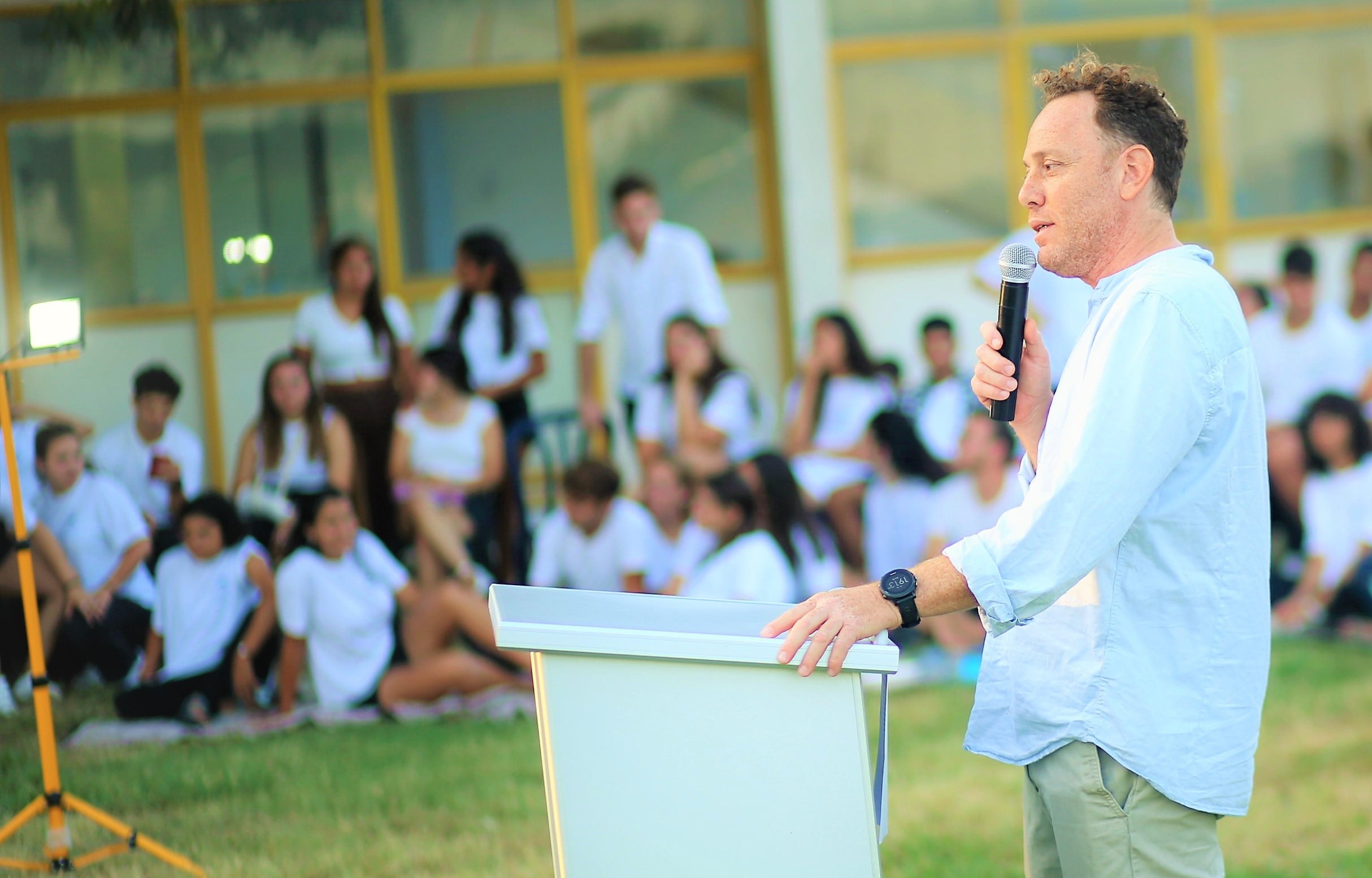
At the Hannaton Educational Center. (courtesy)
Shavuot is approaching. The wheat fields have already been harvested, the straw bales have been gathered, and we are preparing once again to wear white, bring greenery, and celebrate one of the fundamental holidays of Jewish identity. A holiday that connects earth and spirit, the harvest and morality, the Exodus and the giving of the Torah.
We counted the days. Seven weeks of anticipation. We left Egypt, and now we stand once again at the foot of the mountain. But this year, more than ever, one difficult question must be asked: What Torah will we receive this year?
For the Torah is not just an ancient text, and it is not in heaven. It is here in our lives, in our values, in the way we speak, educate, judge, love, and hate. The Torah is the book of books. A teaching for life. But our sages have already taught: it can be an “elixir of life,” but also an “elixir of death.”
It is not the Torah that determines which it will be, but we. So the real question of Shavuot is not whether we receive the Torah, but which Torah we choose to receive.
Will we accept a Torah that dishonors everything that is not Jewish? A Torah that breaks symbols of other religions, that spits on nuns and priests, that teaches contempt, superiority, and humiliation? Or will we receive a Torah that recognizes that there are different ways to single out God’s name in the world, a Torah of patience, human dignity, and respect, a Torah that remembers that “and all the families of the earth are blessed in you”?
Will we accept a Torah of burning hatred, a Torah that justifies violence, fanaticism, vengeance, and the intoxication of power? Or a Torah of “Khabib Adam Who Was Created B’tselem” – a Torah of humanity, responsibility, and mutual guarantee, a Torah of “Thou shalt not stand for thy blood,” of “The sound of thy brethren shouting at me from the earth”?
Will we accept a Torah of polarization, boycotts, and contempt, a doctrine in which disagreement is war, and a person who thinks differently becomes an enemy? Or a doctrine of “These and these are the living words of God” that knows disagreement can be for heaven’s sake, that wisdom grows precisely from a plurality of voices, and that enlightenment is sometimes more important than certainty?
Will we accept a doctrine of eternal war, of unbridled messianism, of fear of compromise, of faith that only power will solve everything? Or a doctrine of moderation, responsibility, and peace? A Torah that seeks to uphold the vision “and place their swords into shovels,” a Torah that knows faith also needs humility, and that even in the name of the Holy One, we must not lose our humanity?
Will we accept a Torah of absolute certainty, or a Torah that knows how to live with doubt as well? A Torah of the “chosen people” only or a Torah of the electing people, choosing daily which Judaism to shape, what morality to instill, which country to build, and which person to be?
For the Torah, in truth, contains everything, “Reverse in it and reverse in it, dwell in it.” There is war, and there is peace. There is kindness in it, and there is vengeance. There is zeal in it, and there is compassion. It has a majority voice as well as a minority voice. It has uplifting moral peaks, and also stories of profound human falls.
The question is not what the Torah says, but how we interpret and live what is written in it. The Torah is our story, and the question is how we will tell our story, knowing that the story must also direct not only where we came from, but where we seek to go, who we seek to be, and what tradition we choose to pass on to the next generation.
Because people are not born haters. A man vandalizing a cross in a Christian town does not wake up that way in the morning. Whoever spits at a nun, berates a priest, or invokes violence in the name of religion is not operating in a vacuum. Anyone who burns a house on its inhabitants, or believes that murder in the name of faith is a mission, has been educated for this. Education can also be changed. In fact, we have to change. If it is possible to spoil, it is also possible to repair.
Related Topics