

What We Create When We Don’t want to Forget
My greatest fear is forgetting my mother.
It is a simple sentence, but for me it carries the weight of what I have lost and what I have created.
I am 46 years old, a mother of three, a personal stylist, and, until recently, a fashion design student. I came to Haifa from Eilat during my military service in the Navy and fell in love with the city. I built my life here. For years, I dreamed of studying fashion design, but like so many, I kept putting that dream aside for the demands of family, work and everyday life.
Five years ago, I found myself working backstage at a University of Haifa fashion show, watching students bring their ideas to life. I was surrounded by creativity and possibility. Something shifted in me. I realized that the dream I had postponed for so long had not disappeared. It was still waiting for me.
So, at 42, I finally went back to school. I could not have known then that my years of study would also become years of profound loss.
During my first year at the academy, my father died. During my second, I lost my mother.
Design gave me somewhere to put the emotions I did not know how to carry. I discovered that creating something with my hands could be a form of healing.
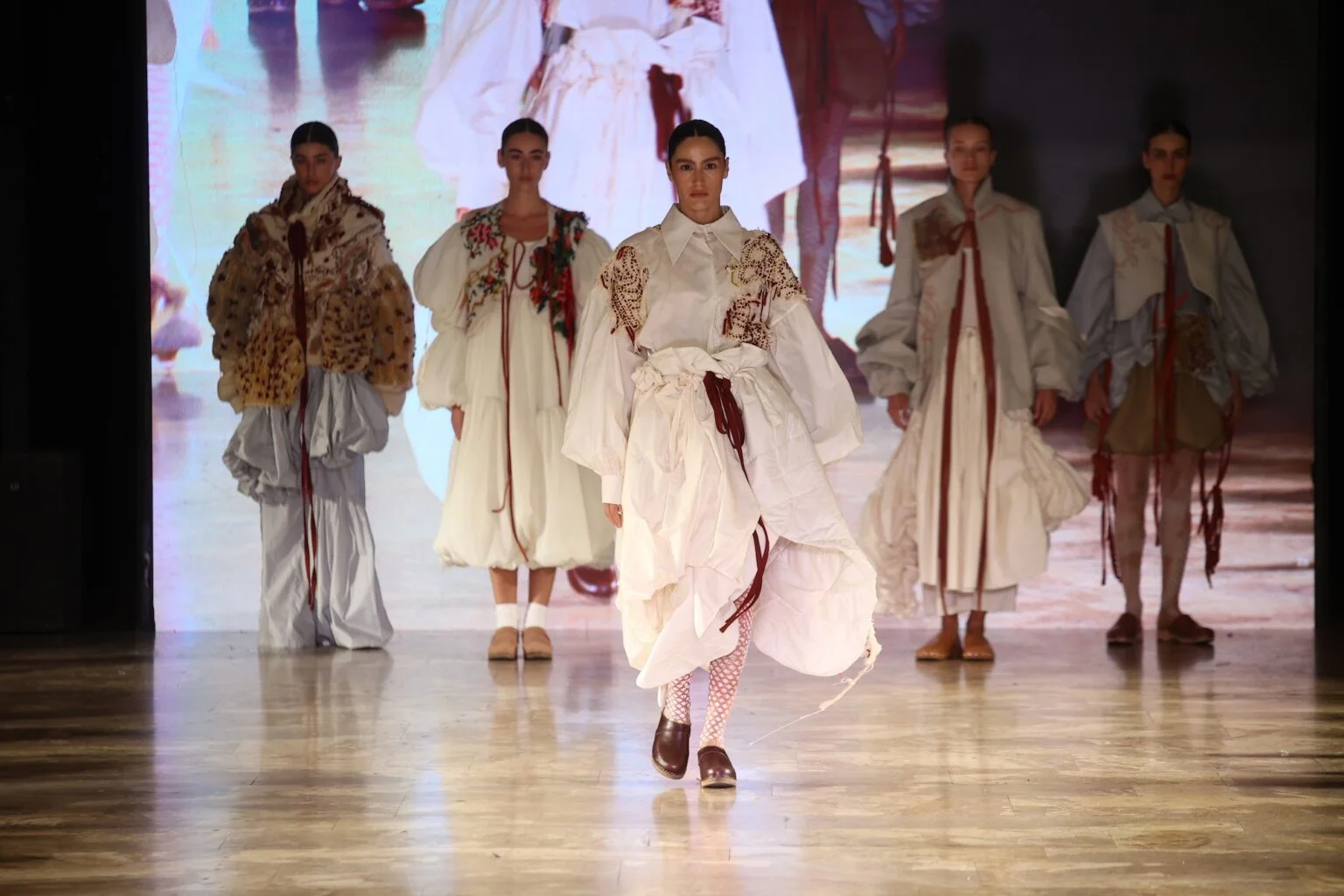
My graduation collection is dedicated to my mother.During the final year of her life, she lived with dementia. I watched thea disease gradually take away abilities that had once been part of who she was. My mother loved crafts and embroidery. She made things with her hands. But as the dementia progressed, she could no longer continue the work she had started.
After she died, I went through her belongings and found unfinished pieces of embroidery and tapestry.
I could have packed them away. Instead,I decided to finish them, and that decision became the foundation of my collection.
I took elements of my mother’s tapestry work and collaborated with a company specializing in 3D printing directly onto fabric. Through that process, her handmade work became part of my designs. Something she had started with her own hands could continue in a new form through mine.
In a way, it allowed us to create together one last time.
There was another memory I could not let go of. During her illness, my mother was often cold. She relied on a warm blanket for comfort. The silhouette and feeling of that blanket became another important element of my collection.
Dementia makes the fear of forgetting particularly complicated. When someone you love loses pieces of their memory, you begin to wonder what will remain when the memories become harder for you to hold as well.
For me, creating became a way of holding on. My collection cannot bring my mother back. It cannot restore the work she was no longer able to finish. But it can carry something forward. And perhaps that is one of the most powerful things art can do: it can hold on to what we are afraid of losing.
My years as a student were also shaped by another reality that has become impossible to separate from life in Israel. We studied through war. We lost our routines. At one point, during the war with Iran, we were away from the academy for almost two months.
As a mother, I was frightened for my family. As a student, I was trying to continue working from home while alarms and uncertainty disrupted everyday life.
Under normal circumstances, it is difficult to be a student, a parent and a working professional at the same time. During war, the challenge becomes something else entirely.
What kept many of us going was not simply the curriculum or the studio. It was the people.
Our mentors from the University of Haifa met with us on Zoom. They checked in on us. They understood that we were not living through normal circumstances. When we returned, they gave us space to process what we had experienced, as well as the flexibility and time to complete our work.
That experience changed the way I think about what education can mean. Education is often described in terms of knowledge, skills and professional preparation. Those things are important. But education can also be a community that tells you: You can keep going. You don’t have to go through this alone.
I was the oldest student in my group. Many of my classmates were much younger than me, yet I learned from them as much as I hope they learned from me. Each student arrived with a different story, a different set of experiences and a different way of seeing the world.Those differences became part of what made our work, and the experience of creating it together, so meaningful.
And when I finally stood at the fashion show as a graduating designer, rather than someone working behind the scenes, I understood how much had changed.Five years earlier, I had been helping and mentoring others at the show. Now I was the one presenting my own collection.
I had come full circle. But standing there on the runway did not feel like an ending. It felt like the beginning of something new.
The runway became my way of stepping back into the world and saying: This is what happened to me. This is what I lost. This is what I made from it.
I don’t believe art erases grief. It doesn’t make war disappear, and it doesn’t make dementia less cruel. What it can do is give us a way to move through those experiences without allowing them to erase us.
My mother could no longer finish her embroidery.
So I finished it.
I could not stop losing her.
So I found a way to carry her forward.
That is what I hope my collection represents, not only a daughter’s tribute to her mother, but a reminder that unfinished things can still have a future.