


What the Jews need now is a really good Passover Seder
The most common complaint in our neighborhood shelter this week isn’t about the missiles or the war, the sirens or the politicians. It’s Passover. Who thinks it’s a good idea to have Seder in the middle of all this?
I do.
A good Seder is exactly what Jewish families need right now, from Jerusalem to Los Angeles and around the world. In this unstable and polarizing reality, as vulnerability permeates Jewish life and alliances shift underfoot, what we need is a good family meal, those memory-inducing dishes, and a dose of our homemade Jewish story. The stakes for Seder night this year are high: it can serve as an emotional and moral balm. But the magic won’t happen by accident. It requires some framing and a few surprising objects: a pillow, half a matzah, a bunch of green onions and a big cup.
Here’s how.
Inside our comfort zone
After years of being thrust from our comfort zones, Seder this year should offer a soft landing. Enter the pillow. Not one wedged uncomfortably between your back and a folding chair, more like a lush divan to sink into, wine in hand. Seder this year should be simple. Everything is so overwhelming; we deserve to stay in our comfort zones. This is not the year to fret about pulling off the most complex recipes or the latest educational tricks for the Seder. The Rabbis instructed us that Seder should be all about reclining: staging our freedom and celebrating it. Keep it simple, keep it close. Let’s keep this Seder in our comfort zone.
So much of the much-needed magic happens simply by successfully gathering together and putting the tensions aside. Bunching up alongside family, who share our oldest memories and our unique history, imbues the rootedness and belonging so needed in this moment of upheaval. We recline on Passover not because we have reached the Promised Land, or because we agree about what that land should look like, but because we come from the same big family, a family that has a story to tell, and never misses the meal where we tell it.
The Passover Pillow holds a more complex message: we do not recline throughout the entire Seder, but rather move back and forth between the awareness of our prosperity and the memory of our suffering. Never in my lifetime has this movement felt so pertinent: we Jews are simultaneously at our most powerful and our most vulnerable. Luckily, the Haggadah is one of the rare Jewish texts that addresses Jews in both scenarios. As Rabbi Jonathan Sacks puts it:
“In times of suffering – and there were many – the Haggadah keeps hope alive, the hope expressed that ‘this year we are slaves, next year we will be free.’
“In ages of prosperity, the Haggadah becomes a tutorial in mutual responsibility. Teaching the great lesson of human solidarity: that we cannot enjoy the food of affluence while others eat the bread of affliction. We are not fully free if others are oppressed.”
Depending on what news we’re reading or who we’re talking to, we might feel Jewish strength or Jewish vulnerability. Rarely does someone admit that both might be true. The Haggadah offers us the rituals and lessons that hold these experiences in creative tension. As we move between leaning back and leaning in, we train our bodies and our families in the responsibility and maturity needed to hold both our vulnerability and our power.
An Afikomen for anxiety
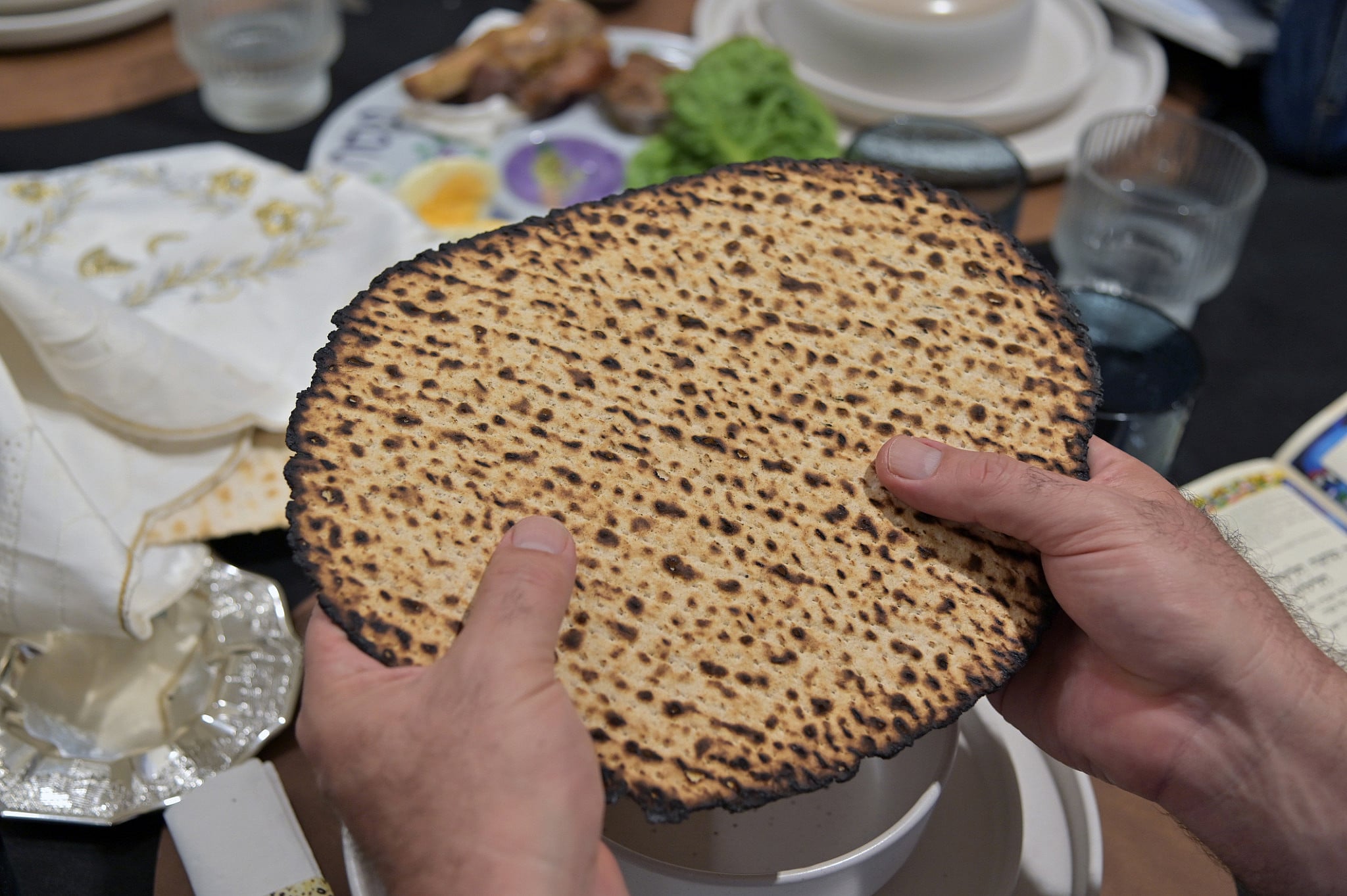
Seder begins with the breaking of a matzah. It is a gesture of anxiety: the pauper’s habit of rationing bread against an uncertain tomorrow. Many of us were born to families where rationing was passed on by inheritance. How fitting that the Passover Seder begins with storing half a matzah (the larger half!), a neatly wrapped package of generational anxiety. The Haggadah then adds to that anxiety by requiring the parcel be consumed at the end of the Seder. Halakhically speaking, the Seder cannot end without it. Here’s where one might expect legal fastidiousness to take over.
Instead of Jewish pedantry, Jewish playfulness makes an appearance: Instead of becoming a caricature of Jewish neurosis, we let children steal the parcel, showing that they, too, are part of the story. The next generation reminds us to see the potential for joy and surprise in a tense situation, reframing that which is dearest to us into playful engagement.
Anxiety is no laughing matter. The concerns are real, the hereditary lessons well learned. But for one night a year, we repackage our anxieties into afikomens and reframe our concerns into playful moments that shape the memories of future generations. When we trade the afikomen back for a gift or two, we find that we too have received a gift from the next generation: our anxieties need not control us.
Green onions: A Persian Jewish lesson in gratitude
Iran will surely be on everyone’s mind at this year’s Seder, so we might as well invite it through the strangest Seder ritual there is:
Deep into the Haggadah, as the family is singing Dayenu, Persian Jews pull out green onions and beat each other over the head. It is a custom both ancient and surprising, originating in Iran and spreading to families across the Jewish world (popularized, among others, by my father Noam Zion’s A Different Night, and our shared A Night to Remember). What better way to show our solidarity with Iranian Jews everywhere, and to remind us of the long and rich history Jews have in Persian lands?
But the tradition has a deeper meaning as well, a much-needed one: While Dai-yenu is all about thanking God for having dai – enough – along every step of the Exodus journey, the Jewish people were anything but thankful and appreciative. Instead, they kept complaining about how much they missed the “watermelons, garlic and onions of Egypt” (Numbers 11:5). To remind ourselves of our tendency to be stiff-necked and unappreciative, Persian Jews have taught us to beat each other into gratitude with green onions as we sing Dayenu. It’s also the best way to turn Seder into an unforgettable memory for all. This year, we need that ability to be thankful for every stop along the way, even if we don’t quite know where we’re headed. All it requires is a bunch of green onions.
A cup of hope
In all the editions of Zion family Haggadahs, we always include the words Anne Frank wrote in her diary:
It’s really a wonder that I haven’t dropped all my ideals, because they seem so absurd and impossible to carry out. Yet I keep them, because in spite of everything I still believe that people are really good at heart. I simply can’t build up my hopes on a foundation consisting of confusion, misery, and death. I must uphold my ideals, for perhaps the time will come when I shall be able to carry them out.
We read these words each year when we get to “Next year in Jerusalem,” and their message has never been more important. As cynicism and criticism, greed and force take hold in the seats of power, believing in ideals might seem a thing of the past. Yet as we have done before, Jews must hold on to our ideals, even if they seem impossible to carry out at the moment. Seder night is about reminding ourselves what our ideals are: freedom and faith, belonging and generosity, memory and solidarity. Then serving them on the menu and ingesting their lessons, bite by bite. It is also a night of rekindling the hope that those ideals are possible.
Towards the end of the night, we pour a fifth cup, the cup of Elijah. A custom inspired by Hasidic rebbe Naphtali of Ropshitz feels like it was created specifically for this year: Instead of pouring the cup of Elijah from a single wine bottle, we pass the cup around the table, inviting participants to pour from their own cup, and add a hope or ideal for the world in the coming year. When we open the door for Elijah at the end of the meal, we recall the world we wish to live in. We’ve willed it before and it was no dream. This Seder we shall will it again.
A pillow, half a matzah, green onions and a big cup — that’s what I’ll be bringing to this year’s Seder. And when the meal is done and the dishes are clean, I hope I’ll have provided my family – and myself – with the comfort, challenge and charge the Seder has offered generations of Jews, through thick and thin. Our family has a story to tell, a story that leads to action. It begins in Egypt, and it will lead us to freedom. It will lead us to Jerusalem