
What we lose when we acknowledge Palestinian suffering
Around 3,000 years ago, Elijah the prophet made an ominous statement: no rain or dew would fall in Israel as a result of King Ahab’s idol worship.
God, anticipating Ahab’s vengeful wrath, encouraged Elijah to hide in a wadi in the north. There, God would send ravens to bring Elijah food.
Why ravens? Malbim, a 19th-century commentator, viewed the use of them as symbolic, implying Elijah should think harder about his choice to bring drought to the land.
“Ravens are creatures cruel by nature,” explained Malbim. Elijah was supposed to “remember how he too had been cruel toward the people, causing them to die of hunger.”
If that was the message, Elijah did not internalize it, and the wadi eventually dried up. God instructed him to leave the area and travel elsewhere to the home of a widow, whom Elijah asked for sustenance.
The widow agreed to bring him water but not bread. “I have nothing baked, nothing but a handful of flour in a jar and a little oil in a jug,” she told Elijah. “I am just gathering a couple of sticks, so that I can go home and prepare it for me and my son; we shall eat it and then we shall die.”
Elijah performed a miracle for the widow: he assured her that if she made him a small cake, the flour and oil would replenish until the drought’s conclusion.
It all happened as he promised. But then the widow’s son died.
* * *
Much of what we know about the effects of starvation are due to the efforts of Jewish doctors in the Warsaw Ghetto, who painstakingly recorded the slow demise of thousands of Jews as they themselves starved. Their manuscript was published in 1979, titled Hunger Disease: Studies by the Jewish Physicians in the Warsaw Ghetto.
Prolonged undernutrition is a torturous thing. It starts with the feeling of gnawing hunger that we in the western world avoid at all costs. Eventually, this sensation becomes a constant, and the body stops growing, reduces its energy output, and re-regulates its hormones.
This effect is seen most profoundly in the bodies of young children, who have neither the fat storage nor the skeletal integrity of adults.
A young child who is experiencing malnutrition would start to lose her body fat, and then her muscles, leaving her feeling cold and lethargic. Her body would start to consume its organs; her heart and breathing would begin to slow and her blood pressure lower, so she may feel weak and dizzy. She might lose the ability to retain and excrete fluids properly, so her belly might bloat. Her lymph nodes and tonsils — the body’s immune organs — would begin to atrophy, making her susceptible to illnesses. And eventually, her brain cells and structures would begin to die and reduce in size, so she would begin to lose her memory and motor function — irreversibly.
If her circumstances changed and she suddenly had increased access to food, she would still be at risk. The drastic caloric addition would cause her body to surge in insulin and stop creating new glucose, resulting in certain electrolytes flooding the body. She might begin to sweat and feel weak. Her pulse and breathing would speed up. And then her heart might fail.
* * *
Elijah didn’t heed the message of the ravens.
And he also didn’t learn from the encounter with the widow and her son.
Certainly, his intervention saved the boy’s life — he prayed to God for the child’s resurrection, arguing that the woman’s hospitality should shield her from the tragedy.
But seeing their suffering did not move him to reverse the drought for everyone. He saw the widow and her son as worth saving only because they had saved him. He did not see beyond them, to the homes nearby, to the hungry children and the hopeless widows, to the thousands of other miserable people who would eat what little they had until there was nothing more, and then die.
God did not directly address Elijah’s misapprehension. But God, eventually, had enough. In the end, after three years of anguish and death, God stopped the drought.
There’s another story of a prophet parallel to the one of Elijah — that of Jonah, God’s unwilling messenger.
After running away from God’s mission, Jonah found solace in a kikayon plant. When it withered away, he was so devastated, he wished for death.
Unlike in Elijah’s story, God voiced His disapproval to Jonah. “You cared about the plant, which you did not work for and which you did not grow, which appeared overnight and perished overnight,” God chastised. “Shouldn’t I care about Nineveh, that great city, in which there are more than a hundred and twenty thousand persons who do not yet know their right hand from their left, and many animals as well?!”
* * *
What do we lose when we acknowledge the suffering in Gaza?
Nothing.
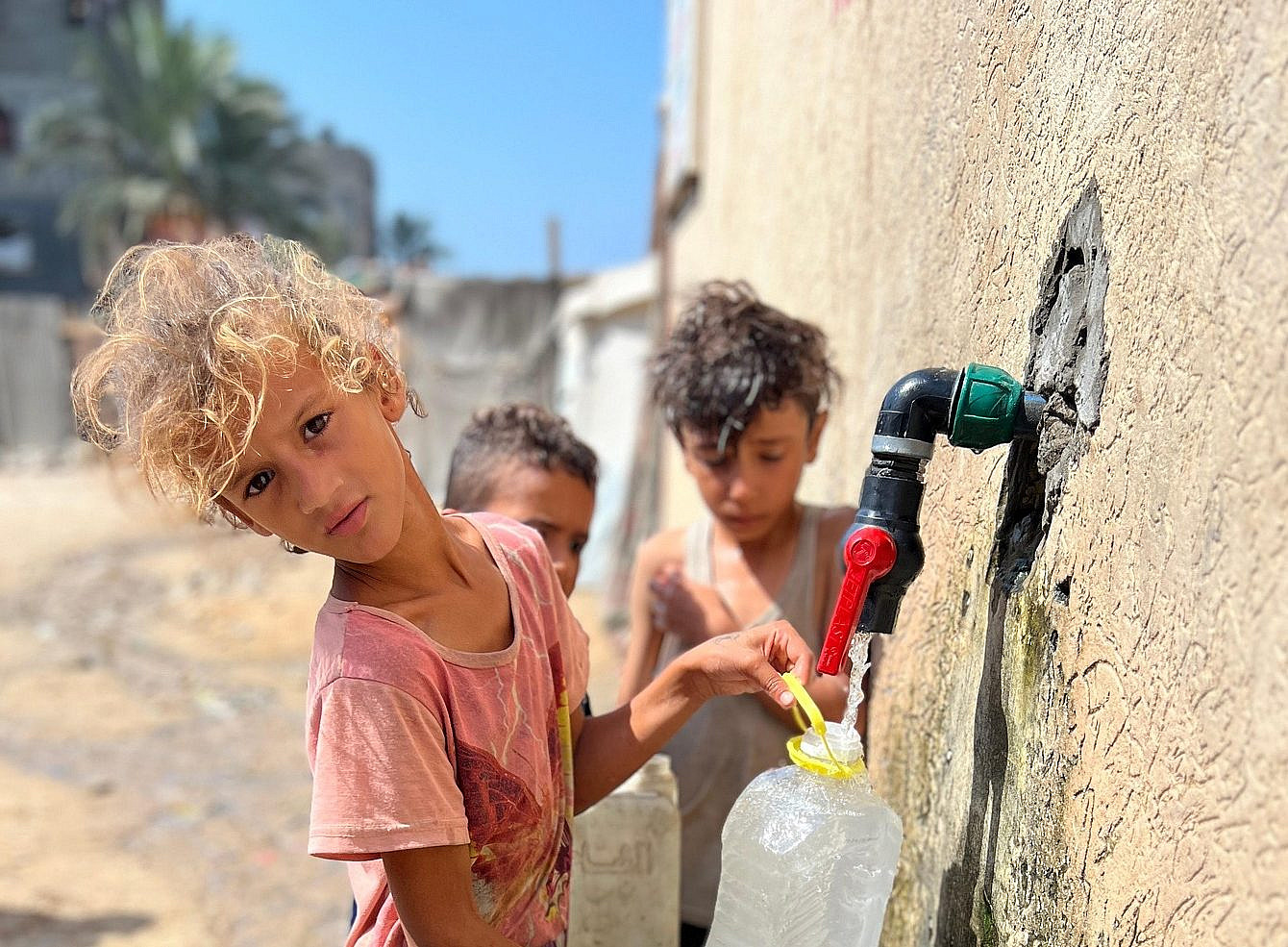
To start with, there is clear evidence — from leading Israeli doctors; independent research bodies; video, photographic, and even satellite imagery — that many Gazans are living in rubble with little access to medical care. It would be denying reality to argue that there is no malnutrition in Gaza.
On a strategic level, there is a good argument for helping civilians in these terrible circumstances. John Spencer, chair of War Studies at Madison Policy Institute, recently wrote that Israel should flood Gaza with aid because “a military must balance its operational objectives with humanitarian imperatives, including the prevention of starvation and the protection of civilian life.” Ultimately, this aid will help post-war recovery and prevent unnecessary death.
Beyond that, Ahmed Fouad Alkhatib explains, it’s pragmatic to resolve the hunger because Hamas is using it as the only weapon left in its arsenal: “If the hunger crisis and humanitarian issues are addressed, Hamas can no longer use the suffering of Gazans to generate an international outcry or use the resultant leverage to end the war on its own terms.”
Haviv Rettig Gur also makes the point that Hamas loses the financial benefit of hijacking humanitarian aid only if Israel floods Gaza “with so much aid that… the prices [of food] crash.” That, too, weakens and neutralizes Hamas.
There are strategic reasons why solving this humanitarian crisis are worthwhile. But in the end, the strategy is not the only argument — and maybe not even the strongest one.
Instead, as Eric Goldstein of UJA recently argued when UJA made an unprecedented one million dollar donation to IsraAID’s relief efforts in Gaza, there is a strong moral argument for recognizing the plight of civilians. There is abundant textual and ethical precedent to recognize the pain of those suffering, especially the children. (And there is a tremendous basis against the argument categorizing Gazan children as “guilty” because of their parents’ actions or inactions.)
Acknowledging human suffering doesn’t make us less human — it makes us more human.
Recognizing Palestinian pain doesn’t deny or diminish our own. It doesn’t mean we reject the plight of the remaining hostages and their families. It doesn’t mean that we ignore the trauma and suffering of Israelis since October 7th. It doesn’t mean we hold Israel or the IDF culpable in any way for Palestinian suffering. It doesn’t mean that we are blind to the prevailing anti-Israel sentiment of many Palestinians. It doesn’t mean that news outlets are representing Israel unfairly. And it doesn’t mean we will not ultimately eradicate Hamas. It just means that we don’t lose our humanity.
We can choose to be like Jonah, and only grieve our people and their losses. We can choose to be like Elijah, and only help those who help us.
Or we can choose to emulate God.