Documenting Hidden Jewish Histories and Legacies
What West Bloomfield Revealed About Michigan’s Interfaith Tradition
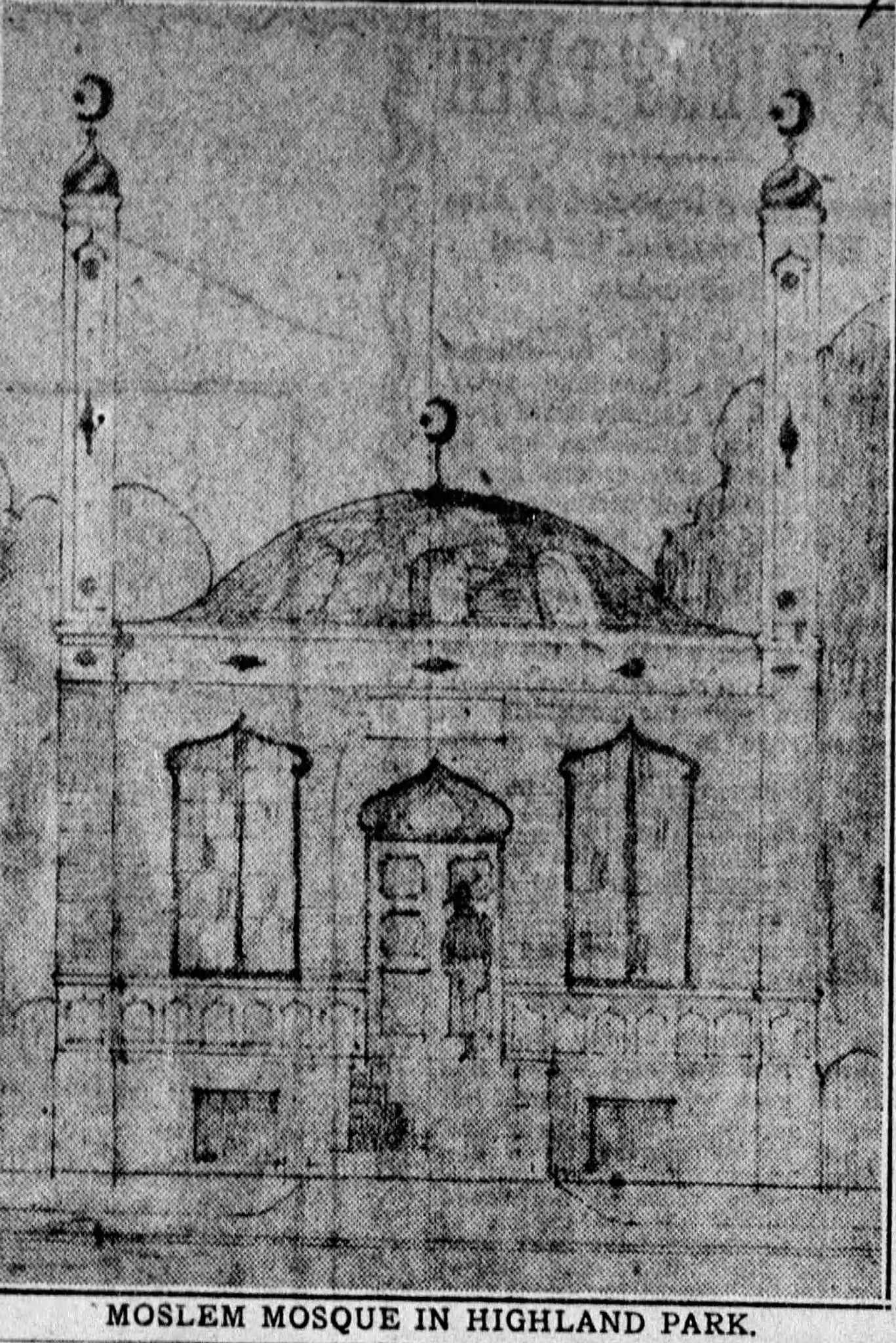
A newspaper rendering of the mosque built in Highland Park, Michigan in 1921, widely reported at the time as the first purpose-built mosque in the United States.
In March, after an anti-Jewish attack on Temple Israel in West Bloomfield, Michigan, a ballroom across the street became a place of refuge.
The Shenandoah Country Club, which serves the area’s Chaldean Iraqi Christian community, opened its doors to the Temple Israel community. Children from the temple’s day care center were brought inside. By afternoon, families were reunited there. The next evening, the same room held Shabbat services for roughly 1,000 congregants.
Rabbi Jason Bennett of Temple Israel said the two communities had long been “inextricably linked.” Jibran Jim Manna, a Chaldean community member, recalled that, before leaving Iraq, “our neighbors were Jewish, and we loved them.”
In Michigan, such gestures across lines of faith have precedent.
In 1864, when a small group of Jewish families in Jackson dedicated a synagogue, the wider city turned out. A national Jewish newspaper reported that city and county officials joined the procession carrying the Torah. Local stores closed. Christian residents contributed material support to help secure the building, a former church. Women from the broader community sang in the synagogue choir.
In Grand Rapids, when Temple Emanuel dedicated its building in 1882, Christian clergy were among those present. A decade later, after a fire damaged the synagogue’s interior, Fountain Street Church opened its doors to the congregation. The arrangement was not one-sided. In earlier years, Temple Emanuel had hosted Christian groups who lacked a space of their own.
Decades later, in Detroit, another community was building. In 1921, what was widely reported as the first mosque in the United States was dedicated in Highland Park. Newspapers described a procession marking the end of Ramadan. Flags of the United States, Syria, Turkey, and Mexico were carried through the streets. Several hundred gathered for prayer on a floor that had not yet been finished. Rugs were spread over packed earth.
That summer, a report noted that “Moslems and Christians are united for oriental relief.” A Christian speaker addressed the gathering and encouraged cooperation in supporting charity both locally and internationally.
The building itself did not endure. Within a few years, the mosque stood in disrepair. Its windows were broken. Its future became entangled in legal disputes and internal conflict. By 1927, the city listed it for sale.
But for a time, it stood as Michigan’s first mosque, and while it did, it formed part of the same pattern.
Across these earlier episodes, the communities were small. In Jackson, there were about 10 Jewish families. In Highland Park, attendance at the mosque’s opening fell well short of the numbers newspapers had predicted. The community was still taking shape.
The recent acts of interfaith support in West Bloomfield belong to this longer history. The response at Shenandoah Country Club did not emerge from nowhere. It reflects relationships formed over time.
It also reflects a choice.
The historical record in Michigan does not present a single, unbroken story. There are moments of belonging and moments of hate. Buildings rise and fall. Communities grow, contract, and change. But again and again, there are instances in which people made space for one another across lines of faith.
Those moments are part of the state’s inheritance.
They do not sustain themselves. They depend on people who are willing to open a door.
Related Topics
Related Posts