


Founder | Children’s Book Author | Empowering Women & Supporter of Global Peace Initiatives | Mom | Yemma
What Would Yitzhak Rabin Say About Israel Today?
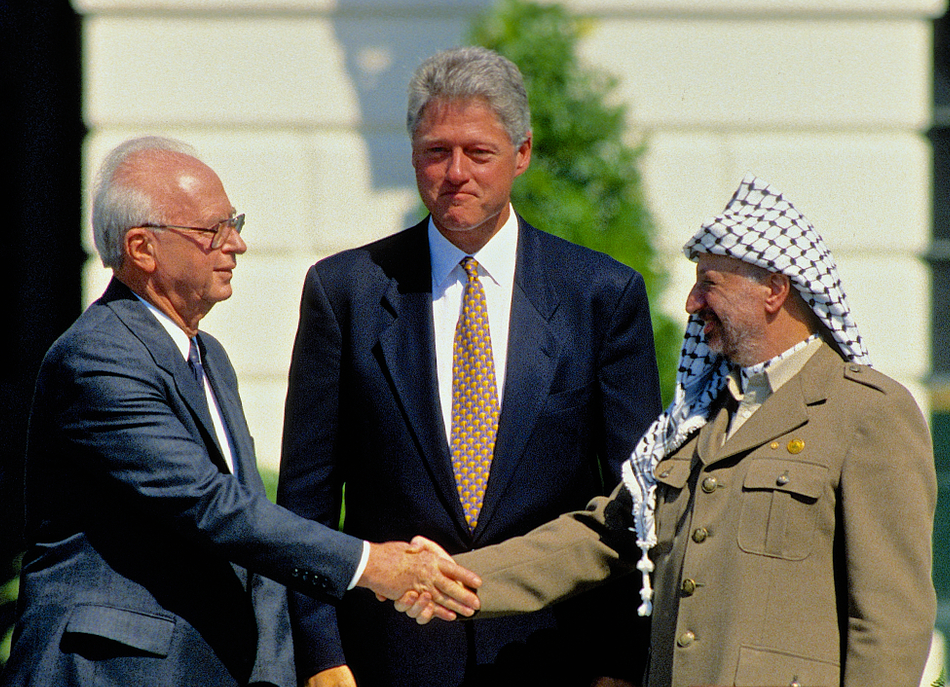
Washington, DC, Sept. 13, 1993 — Israeli Prime Minister Yitzhak Rabin and PLO Chairman Yasser Arafat shake hands after signing the Peace Accords. (Shutterstock)
I was a young mother of two when I first watched Yitzhak Rabin and Yasser Arafat shake hands on the White House lawn in September 1993. Two years later, at a peace rally just before his assassination, Rabin said, “Permit me to say that I am deeply moved.” I felt the same—hopeful, anxious, moved to tears—though I knew the road ahead would be difficult.
For me, it was not just politics. It was personal. I was born in Israel. My family came from Spain and Morocco, Jews who had lived as outsiders, sometimes welcomed, sometimes persecuted. In Israel, my grandparents finally felt something they had never known before: belonging.
That handshake meant we might keep that place, not only as a homeland but as a home built on dignity and peace. Like Rabin, I believed peace was possible. Not naïve, not easy, but necessary. “This government,” he declared, “decided to give peace a chance—a peace that will solve most of Israel’s problems.”
Thirty years later, his vision still challenges us to choose compassion over fear.
A Different Kind of Leadership
Rabin was no showman. He did not rally crowds with slogans or pretend to be infallible. He led with humility and purpose. “He didn’t come to score political points,” his aides recalled. “He came to understand—and to serve.”
He believed democracy allowed differences but that “the last decision… will be made in democratic elections.” At schools, army bases, and public squares, he asked simple questions: How are you sleeping? Are you eating enough? Where is your family from?
Compare that to today, when too many leaders divide rather than unite, exploiting fears instead of easing them. Rabin’s leadership was grounded in empathy and principle, focused not only on survival but on building a nation. That is the kind of leadership Israel misses most today.
A Soldier for Peace
“I was a military man for 27 years,” Rabin reminded us. “I fought while there was no chance for peace. I believe there is now a great chance.”
He pursued peace not as a dreamer but as a realist. He knew that unless Israel separated from the Palestinians, one day the nation would have to choose: remain Jewish or remain democratic.
He was right. And today, the two-state solution feels more distant than ever. On October 7, 2023, like so many Jews, something in me broke. The horror of the attack, the brutal loss of life—it shattered what little optimism I had left.
And yet I ask: what would Rabin say now?
I believe he would raise a trembling but steady voice and remind us: “We must take advantage of this opportunity—for the sake of those standing here, and for those who are not here—and they are many.” Even after catastrophe, he would call on us to do something braver than war: to imagine peace.
Security Without Cruelty
Rabin never denied the reality of Israel’s enemies. He fought them on the battlefield. He buried soldiers. He carried the cost of war.
That is why he said: “We must fight terrorism as if there is no peace, and strive for peace as if there is no terrorism.” He would support defending Israeli lives against Hamas, Hezbollah, the Houthis, and Iran-backed militias. But he would also remind us that security is not an identity. It is a responsibility.
When fear becomes an excuse for cruelty, when it silences dissent or erodes compassion, we are no longer defending ourselves. We are losing ourselves. Rabin believed in strength, but never brutality. In justice, not vengeance. That distinction matters now more than ever.
The Danger Within
Rabin’s life did not end with a Palestinian bullet. It ended with a Jewish one.
“I do not believe that a Jew would harm a Jew,” he said shortly before his assassination. Those words still haunt me. But today, extremism is again rising—targeting judges, soldiers, political opponents—all from within.
Rabin warned: “Violence erodes the basis of Israeli democracy.” He urged us to isolate it, condemn it, never excuse it. He knew the greatest threat to Israel was not only beyond our borders, but within our own ranks. Internal hatred, he would remind us, is more dangerous than any external enemy.
Zionism’s Moral Core
For Rabin, Zionism was not about conquest, but conscience. Not domination, but dignity. He believed in a Jewish state, but also a just one.
“The will to exist,” he said, “was not survival in itself, but peace.” Today, as we argue over religion and democracy, over whose Judaism is “authentic,” Rabin would bring us back to first principles: How do we treat one another? How do we treat those who are not us?
For him, preserving Israel as both Jewish and democratic was not a contradiction. It was the mission.
Rabin’s Voice, Our Choice
Rabin was not perfect. He was cautious, sometimes gruff, often uncomfortable with praise. But he was steady. Decent. Brave enough to act on what he believed.
We lost him at the worst possible moment, just when his courage was becoming contagious.
What would he think of Israel today, the country he so dearly loved? His values would not change. He would still champion unity and hope. He would still insist that peace is possible.
Rabin’s voice is still here. The question is whether we will have the courage to listen—and the will to act.