
What Yair Garbuz painted back into view
There is a sentence Israelis say: “Europe will not teach us.” It comes up at dinner tables when European criticism is in the news, in op-eds, in Knesset speeches, on radio panels. It travels at the speed of speech. The reasoning, when reasoning is offered, is that the continent that produced the Inquisition, two world wars and the Holocaust is in no position to lecture us about morality. The discussion ends before it begins. The sentence does not feel like an opinion. It feels like a fact about reality.
What is interesting about a sentence like this is not whether it is true. It is how it works. The sentence works because it stays verbal, because it moves between people fast enough that no one has to look at what it covers. It works because it offers a clean opposition, a moral “us” against an implicated “them,” and clean oppositions are easier to hold than complicated truths. Sentences like this are built to function at speed. Their power lies in not requiring you to see anything. The moment something forces you to look, a painting, a surface, a context, the sentence begins to lose its certainty.
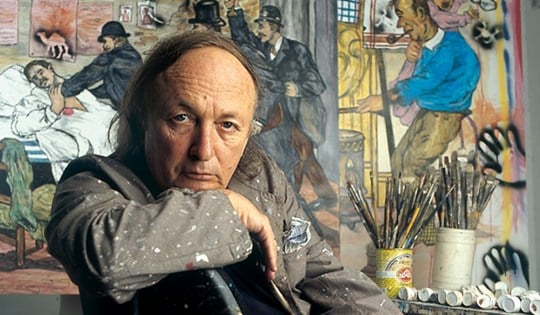
Yair Garbuz, who died on Wednesday at 80, painted works in 2001 under that exact title. He was among the central figures of Israeli painting for over half a century, awarded the Israel EMET Prize in 2004 for his contribution to Israeli art. One such painting, Europe will not Teach Us, hangs in the Israel Museum, large, on plywood, in acrylic, graphite and spray paint. The materials are themselves a position. Garbuz had emerged in the late 1960s from the Tel Aviv circle around Rafi Lavie known as Dalut HaHomer, the poverty of materials, an aesthetic of plywood and newspaper clippings and scribbles, the modest stuff of a young state. By the time he sits down in 2001 to address what Europe can or cannot teach, the questioning is already inside the surface he is painting on.
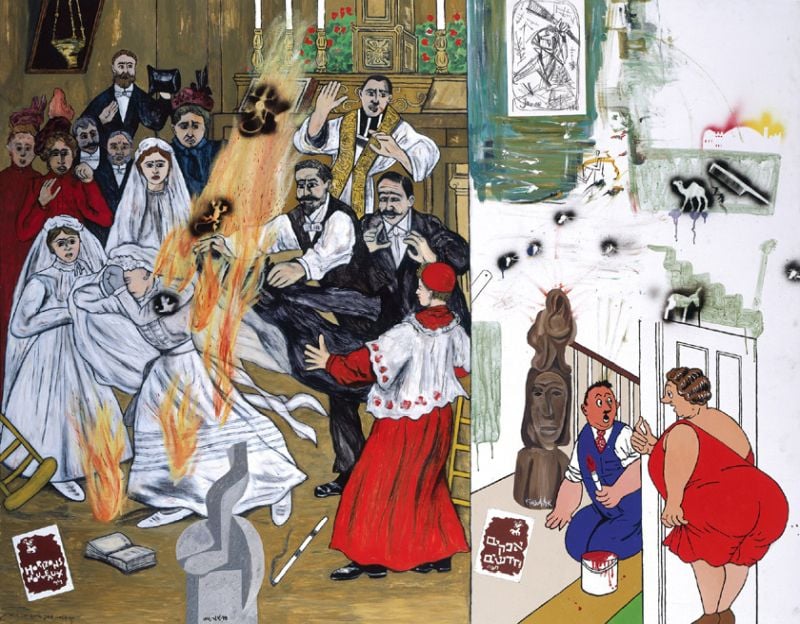
The left two-thirds of the panel depict a Catholic ceremony. White dresses, clergy, a child in cardinal red, dignitaries arranged for a sacrament. At the center, figures are on fire, the flames rising from inside the rite, not from outside it. The historical case the title rests on is real, and Garbuz paints it without softening. If the painting stopped here, it would be illustration, the kind of pictorial agreement that adds little to the words.
The right third is where the painting begins to do its work. An Israeli artist kneels with a brush in his hand, his back to a dark wooden sculpture on a pedestal, his face turned toward a woman who has appeared in the doorway. The sculpture is the kind of “primitive” object European modernism kneeled before when it taught modern painting how to see. The woman is drawn in the heavy, rounded volumes of Picasso or Botero. The sign at the painter’s feet reads New Horizons, the name of the 1948 group around Yossef Zaritsky that brought European modernism into Israeli painting. He is kneeling under the sign of that tradition, between two of its citations, and we are not shown what he is making. Bullet holes are stenciled on the wall behind him; small spray-painted camels run along the top. The conflict and the Middle East itself are part of the room.
On the floor of the burning ceremony across the panel, another sign sits in another language, placed exactly the way the New Horizons sign sits on the right: rituals labeled, ceremonies named, the two scenes built to the same syntax.
Now the sentence has a problem. The sentence assumed a clean opposition, and what one is looking at is not a clean opposition. It is one continuous Israeli scene with Europe folded inside it: European citations, bullet holes, modernist volumes, vernacular bodies, graffiti, signs in two languages, none of which adds up to a thesis, none of which can be summarized. None of this argues against the sentence. It simply makes looking unavoidable.
Roland Barthes, in Mythologies, called this kind of sentence a myth: a piece of language that has performed the quiet operation of taking ideology and presenting it as nature. Slogans repeated long enough stop sounding like slogans. Historical claims, repeated across enough textbooks and ceremonies, stop feeling like claims. “Europe will not teach us” is a myth in this precise sense: not a falsehood, but a sentence that has drained its own history out of itself, until the speaker no longer remembers it is a position someone chose. Barthes was clear that no culture is exempt from this operation. The secular, cosmopolitan milieu Garbuz himself worked from has its own myths, its own sentences that arrive faster than thought.
He demonstrated this himself. In 2015, at a rally in Rabin Square, Garbuz produced a sentence of his own, about amulet-kissers and those who prostrate themselves on graves, that worked exactly the way “Europe will not teach us” works: clean opposition, dispatched at speed, sealed against looking. The country argued about it for years. What the episode showed was not that the discipline failed, but that it is not a state one arrives at. It is a practice one performs, or fails to perform, sentence by sentence. The naturalized sentence is available to everyone, including those who have spent decades learning to see it. That is also part of what the painting teaches.
What Garbuz leaves is not an argument. It is a discipline: the capacity to notice when a sentence is functioning at the speed of what passes for common sense, and to put it in front of something that operates more slowly, until it has to account for itself.
There are days when this country runs almost entirely on sentences moving faster than thought. The painting still hangs. The sentence is still said. Anyone who walks past the panel and stops learns what Garbuz spent 50 years teaching: some things only function in the absence of looking, and the work of an artist, in some moments, is to make the looking unavoidable.