
What’s Another Year? Ireland’s obsession with Israel and the Eurovision
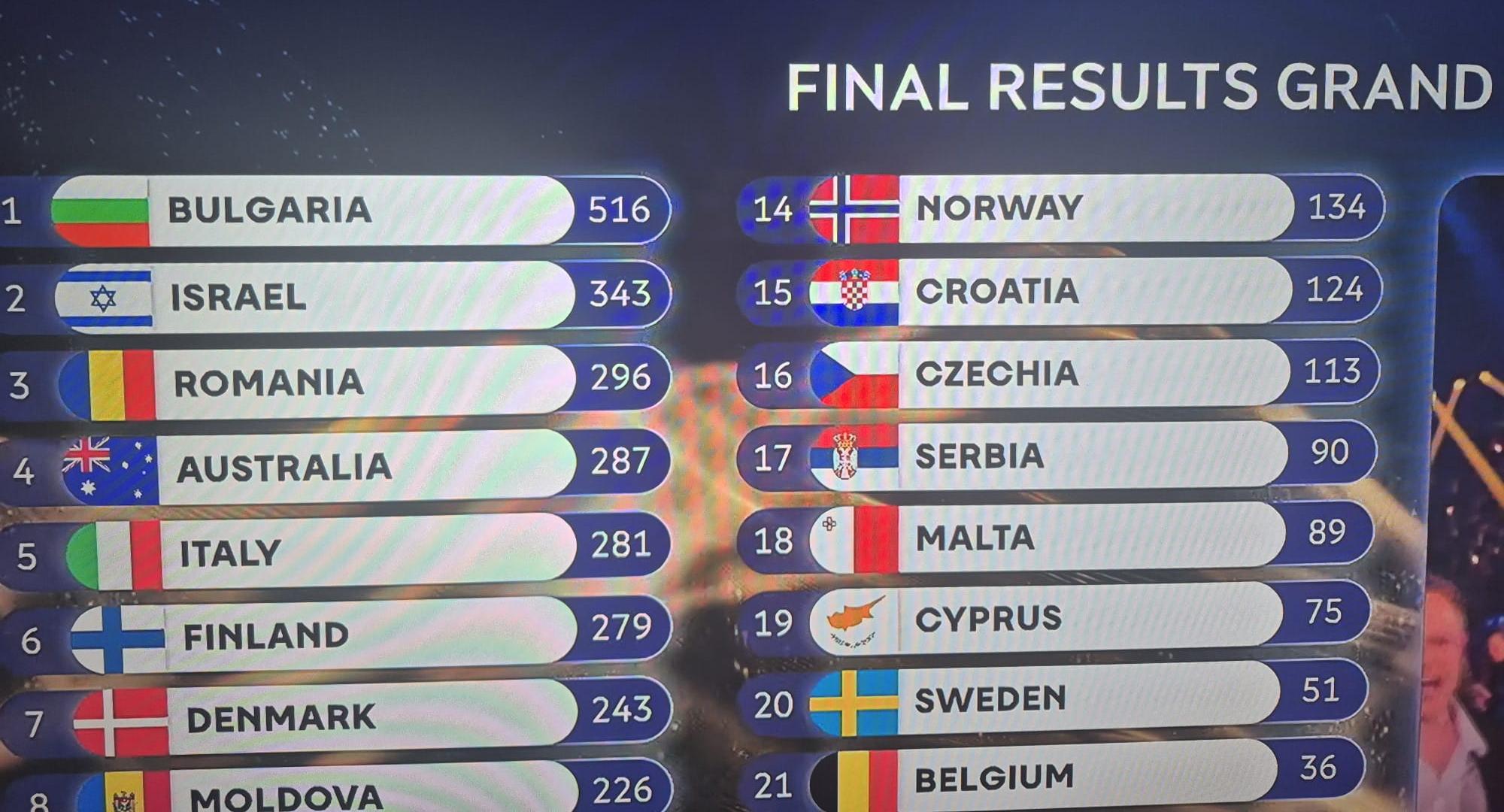
The 2026 Eurovision is finally over, but the political controversy rumbles on.
Despite calls for a boycott and a months-long campaign to try to have Israel expelled from the competition, Israel has once again finished second, now for the second consecutive year. But unlike last year, when there was a huge discrepancy between the jury and the public (televoting), this year Israel performed well in Vienna, coming in 8th among the international jurors and finishing third in the public vote.
The critics are not happy.
The UK-based Sunday Times review published today describes Israel’s support as “fueled by a hefty campaign budget” and calls the second-place finish controversial.
Ireland, of course, officially boycotted this year’s Eurovision.
In Ireland, at least on social media, the reaction to Israel’s 2nd place finish has been met with a mix of indifference, resignation, and renewed speculation about voting patterns and alleged Israeli media campaigns to influence the vote.
On Sunday morning, a popular host on the national broadcaster RTÉ pushed back against the moralising tone of the boycott debate, joking that it wasn’t a crime to watch Eurovision. A reminder, perhaps, that the Irish debate around the contest has at times taken on an unusually charged and censorious character.
What has struck many observers is that the arguments in Ireland in support of the Irish boycott have varied widely.
For the Irish national broadcaster RTE, the reason it chose to officially boycott the contest was the presence of Israel, and that to broadcast the show with Israel participating would have been “unconscionable given the appalling loss of lives in Gaza and the humanitarian crisis there…”. That decision to be fair can be defended on political grounds, including Israel’s conduct in Gaza and its restrictions on foreign journalists reporting freely from the territory.
Others have instead focused on allegations of past Israeli efforts to promote its entry and maximize votes, and of unduly politicizing the event – the latter a slightly ironic accusation, unintended, one has to presume, for anyone familiar with the history of voting in the contest.
The Irish media has repeatedly focused on the role of the Israeli state in funding public promotion campaigns for its entry. That storyline risks being read by some as, at best, a source of po-faced indignation, and, at worst, as echoing familiar historical tropes about undue influence and manipulation.
What is troubling, however, is the continued media reports suggesting that Israel may have manipulated Eurovision televoting. This is despite the fact that more than one year ago, the European Broadcasting Union (EBU) explicitly stated that it found no evidence of vote manipulation. Against that background, an Irish Times editorial late last year nonetheless referred to “alleged vote-tampering on behalf of Israel in recent contests.”
Just this week, the Irish Times once again returned to the same story, with a provocative subheading asking: “Eurovision 2026: Israel almost won in 2025, could a new mass voting exercise see it triumph?”
RTE the Irish national broadcaster not only officially boycotted the event but also chose not to broadcast the song contest in Ireland – a decision some in Ireland viewed as unduly morally and politically censorious. Instead, on Saturday night, Irish television viewers were treated to a rerun of the Irish comedy classic Father Ted, including its well-known Eurovision skit.
The scheduling of Father Ted on Eurovision night was presumably intended to signal a light-entertainment choice – a mocking gesture to the glitz and camp in Vienna. However, in the context of a politically charged debate, some observers suggested that it inevitably undercut the seriousness of RTÉ’s own argument that to even broadcast the show was simply “unconscionable”. Mixed messaging? Perhaps.
Perhaps aware that the boycott campaign had not produced the desired outcome some expected and that claims about voting influence remain disputed, RTÉ leaned into irony in its Eurovision coverage – a case of that dark Irish humor, sarcasm? misfiring on the night.
But in the context of a very recent UN report on the depth and scale of the humanitarian crises in Gaza, the choice of Father Ted could be seen as risking the trivialization of the boycott’s rationale in the first place.
But after the dust and glitter have settled, is there a broader question worth asking about what this episode reveals about the limits and effects of high-profile boycott campaigns targeting Israel in Europe? And might those very vocal calls for a boycott, whatever their intent, have had unintended political effects by reinforcing existing domestic sentiment in Israel?
A more important, and arguably more difficult, question is whether the Eurovision vote reflects a widening gap between the visible pro-Palestinian demonstrations across Europe and a quieter, less visible public at home. Or whether it simply reflects something more mundane: that most viewers engage with Eurovision primarily as entertainment, not as a political statement.
Back to the voting itself.
It is possible — though this is necessarily speculative — that many voters across Europe responded to all the songs, including Israel’s, on their merits. Whatever one thinks of the entries, most commentators and fans agreed that Israel’s recent entries have been strong pop performances.
Still, the suggestion that the Israeli songs in recent years simply succeeded on their own merits will strike others as unconvincing — particularly among those who are already inclined to view Eurovision voting (or Israeli participation) through a lens of suspicion.
On to Sofia 2027.
What’s another year?