What’s in a Name?
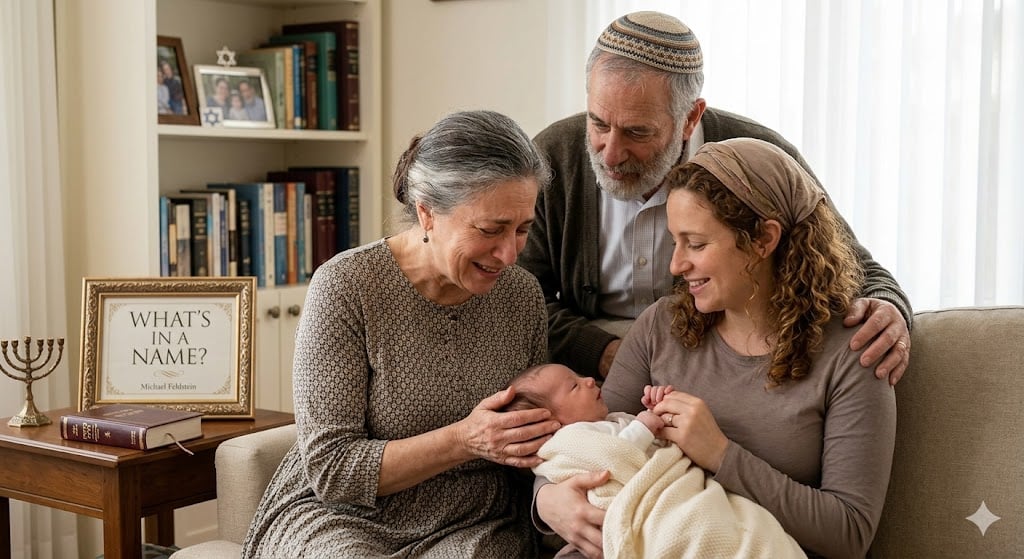
Have you ever wondered how we decided on our deeply ingrained customs for naming children?
If you grew up in an Ashkenazi household, you probably take it for granted that you name a baby after a beloved relative who has passed away. It’s so widespread today that many people assume it goes all the way back to Avraham, Sarah, and the rest of our biblical ancestors.
But as it turns out, history tells a much more complicated—and fascinating—story.
If you flip through the Tanach, there is virtually no evidence that Jews named their children after deceased relatives. Instead, biblical names were usually chosen for their literal meaning or the specific circumstances of the birth.
Yitzchak got his name because Sarah laughed (tzachak) when she heard she would give birth in her old age.
Yaakov was named because he came out gripping the heel (akev) of his twin brother, Eisav.
Occasionally, names reappeared across generations, but there was no formal pattern. Avraham and Sarah didn’t name Yitzchak after an ancestor, and Yitzchak and Rivkah didn’t name Yaakov after Grandpa Avraham.
So, when did things change? We first start seeing hints of modern naming conventions toward the end of the Second Temple period. The famous Hasmonean family, for instance, repeatedly reused the classic Maccabees names—Mattathias, Simon, Judah, and Jonathan—across generations. By the time the historian Josephus was writing, recycling ancestral names had become quite trendy.
The formal customs we recognize today didn’t really solidify until the medieval period, between the 10th and 13th centuries. And as Jewish communities dispersed, two entirely different traditions evolved.
In the Jewish communities of Germany and northern France, naming children after deceased relatives became the golden rule. This happened for two main reasons:
Perpetuating a Legacy: A name served as a living memorial. It was a powerful way to keep the memory, values, and soul of a departed parent or grandparent alive.
A Little Bit of Superstition: Let’s be honest … many of our ancestors were a bit superstitious and deeply concerned about the Angel of Death. Folk traditions suggested that naming a child after a living person might accidentally cut that person’s life short. While this was never a binding law, it became a powerful cultural taboo.
Meanwhile, in Spain, Portugal, North Africa, and the Middle East, the custom developed in the exact opposite direction. For Sephardic Jews, naming a child after a living grandparent was—and still is—the ultimate sign of honor and respect.
In fact, it’s a beautifully structured tradition. In many Sephardic families, the first son is named after the paternal grandfather, the second son after the maternal grandfather, and a similar pattern follows for daughters. To have a grandson named after you while you are alive to see it is considered one of life’s greatest blessings.
Why the massive divergence? Historians aren’t 100% certain, but they have some solid theories.
Sephardic Jews were likely influenced by the broader Mediterranean cultures around them, where honoring living patriarchs was standard practice. On the flip side, Ashkenazi Jews were heavily shaped by the devastating tragedies of the Crusades, particularly the massacres in the Rhineland in 1096. In the wake of such immense loss, memorializing the dead became an urgent communal priority.
An important halachic note: Neither tradition is actually required by Jewish law. There is no Talmudic decree forcing you to name a child after a living or deceased relative. Both are beautiful examples of minhag (communal custom).
To put it into perspective: if an Ashkenazi family names a newborn after a living grandfather, some relatives might squirm with discomfort. But in a Sephardic family, that same grandfather would be deeply touched and moved to tears. Both reactions are completely valid, rooted in centuries of distinct traditions.
Of course, there is one major exception to the Ashkenazi rule. The Chabad-Lubavitch community has a long-standing tradition of naming children after their Rebbes—regardless of whether those leaders are dead or alive.
While average Ashkenazim avoid naming babies after living aunts, uncles, or parents, honoring a towering spiritual giant has always been treated differently. Throughout Jewish history, naming a child after a living sage was seen as a way to seek a blessing and inspire the child to emulate that scholar’s virtues.
Within Chabad, children were frequently named Shneur, Dov Ber, or Menachem Mendel while those Rebbes were still alive. By the 20th century, thousands of Chabad families named their baby boys Menachem Mendel in honor of the Lubavitcher Rebbe, Rabbi Menachem Mendel Schneerson.
(I have often wondered what it must be like to be a kindergarten teacher in a Chabad community, calling out “Menachem Mendel!” and having fifteen boys turn around at once!)
The Rebbe himself responded favorably to this practice in numerous letters. He didn’t view it as a personal ego boost, but rather as a beautiful aspiration for the child to grow in Torah, mitzvot, and good character. In Chabad philosophy, naming a child after a tzaddik (a righteous person) creates an immediate spiritual lifeline for the child.
So…whether we are trying to ward off the Angel of Death, pay tribute to a living patriarch, or connect our children to a spiritual leader, our names carry the weight of our history. They are the first gifts we give our children—anchoring them to where we’ve been … and guiding them toward who we hope they will become.