
What’s moral? A response to Yossi Klein Halevi
In contemplating our unfinished war in Gaza, Yossi Klein Halevi laments that “the Israeli public has avoided a moral conversation about the war.” This is simply false. Moral debate and moral posturing about the war are the main fare of Israel’s public discourse, and one side of the debate – Klein Halevi’s – gets preferential exposure, in this newspaper and in Israeli media in general.
The Israeli right and the Israeli left have deep differences regarding what is moral. In my view Klein Halevi wears moral blinkers, so that what he regards as moral imperatives are actually immoral. Moreover, Klein Halevi ignores important facts regarding the war in Gaza, so that some of his concerns are irrelevant and others misplaced. If the strictures that the Israeli left levels at the right leave the latter unmoved, it is not because rightists are human beasts immune to moral argument but that we find Klein Halevi and those who think like him unconvincing.
Let’s start with something that Klein Halevi claims we – presumably everybody – “knows”: “That the Netanyahu government, a coalition of the fanatical and the corrupt, is disgracing the Jewish state.” Sorry, but I don’t “know” this. It is true that the government is disgracing itself in the eyes of European (and Israeli) progressives, but I think it both futile and against Israel’s interest to cultivate their good opinion at the expense of the goals of this war. “Fanatical” is a political epithet whose real meaning is “I really, really disagree with you and dislike you into the bargain, so I’m going to shout that you’re beyond the moral pale.” That excuse for an argument leaves me unmoved.
As for corruption, it would serve no useful purpose to get into a “whatabout” debate, but I think Klein Halevi would do well not to throw stones of this nature at the Israeli right. I don’t think the Israeli right is more corrupt than the public officials the Israeli left holds up as paragons. The Israeli right is more frequently investigated and investigations against it get more publicity, because the “paragons” possess the exclusive right of investigation and the press is their friend.
Bunglers at the top
One point that Klein Halevi and I agree on is that “something has gone very wrong in Gaza.” In my view what has gone wrong is that Israel’s ground forces, particularly the high command, have no idea how to conduct effective ground operations, and therefore a mission that should have taken 90 days, 180 at most – taking over all of Gaza, quickly and decisively sequestering unarmed noncombatants in a humanitarian zone and killing every Hamasnik outside it – has dragged on for two futile years.
I blame the government for not getting rid of the whole layer of bunglers at the top. That they are bunglers is the recently expressed opinion of Brig. Gai Hazuth, whom Chief of Staff Zamir called back into uniform to head the ground forces’ battlefield analysis section and now wishes he hadn’t. So when Zamir warns of a catastrophe in Gaza I take his warnings with more than a grain of salt. If there is a catastrophe, it’ll be his fault. And if anybody bears more responsibility for the dysfunction of Israel’s ground forces than the Netanyahu government, it is former Chiefs of Staff Benny Gantz and Gadi Eizenkot, whom Klein Halevi would no doubt want to see back in charge of the show, which God forbid.
Another point we agree on is that settler vigilante violence against Palestinian civilians, not to mention against the Israeli army, must be put down with a heavy hand and stiff sentences.
Battlefield morality
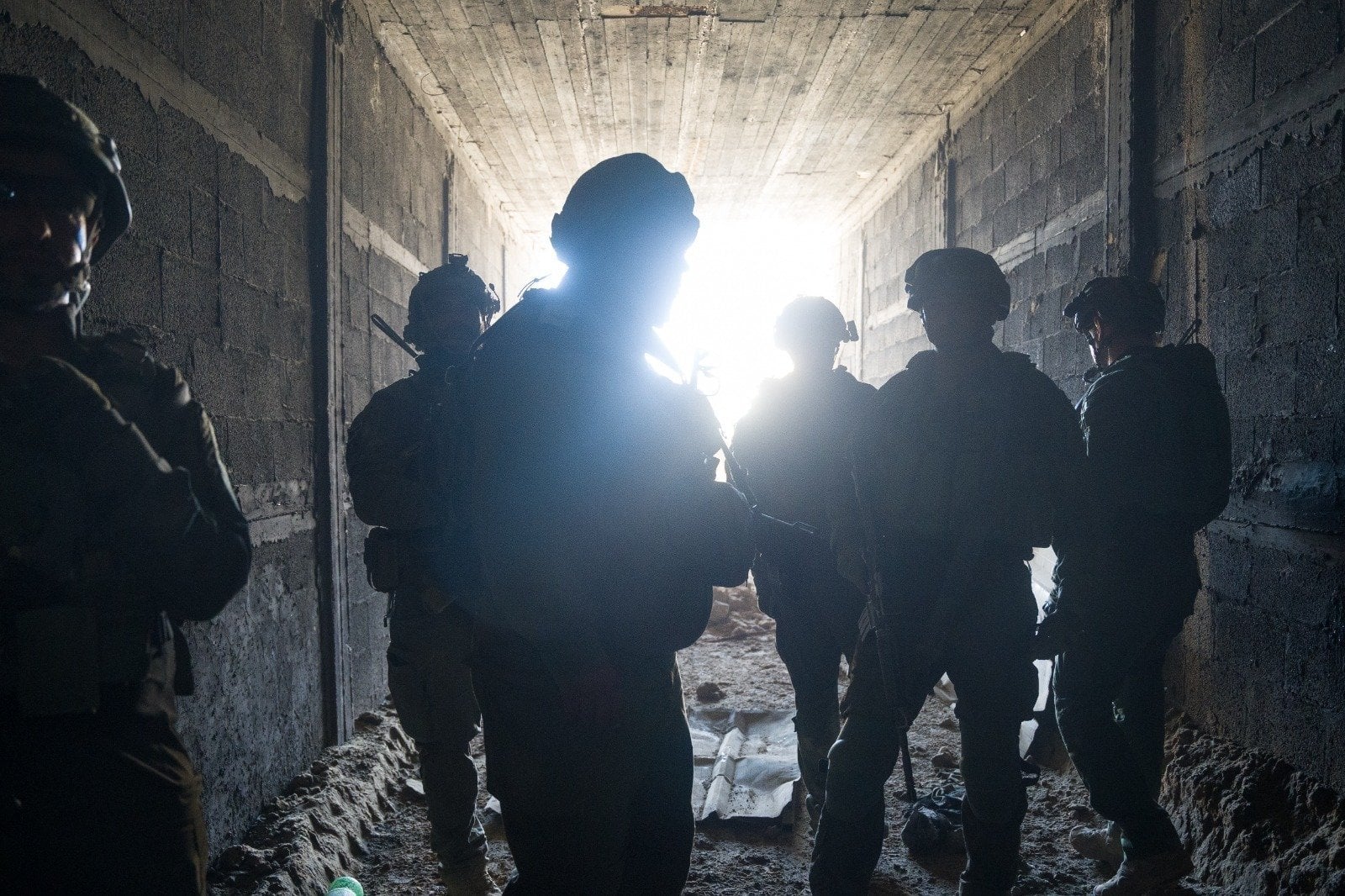
Now as to morals. Israeli society is defending itself against a deadly enemy in Gaza. Our children are on the front lines. The greatest moral imperative is to do everything in our power to ensure that they do their job with as much security as possible and come back home alive and whole. That’s the first moral concern, which Klein Halevi doesn’t mention, and everything should be secondary to it. It has consequences for how this war is fought. As Klein Halevi points out, part of our ethic is not to deliberately target noncombatants, and it’s appropriate to warn noncombatants to evacuate areas where we plan to fight. But if in the course of combat against armed enemies artillery and drones can be used in a way that spares more Israeli lives that’s how they should be used, even at the expense of more Palestinian noncombatant lives. Our soldiers’ lives come first. Anything else is immoral, a betrayal of our own children.
This consideration is also relevant to some of the other questions that Klein Halevi raises. Our children were not brought up to be indiscriminate murderers. But Klein Halevi would like us to adopt what I would call “a legal adviser’s mentality,” subjecting every act of soldiers in the field to moral scrutiny and the power of indictment, so that the soldier in the field feels constrained not only by the threat of an armed enemy to his front but a legal adversary to his rear. Talk to soldiers – nothing does more to undermine their morale and effectiveness. So I think that battlefield morality means ensuring that Klein Halevi and his ilk are kept as far away as possible from the soldiers in the field, or their commanders. It may mean that Klein Halevi is consumed with the niggling ethical doubts he tasks us with, for which he adduces no evidence, but I don’t want my son or anyone else’s son bothered with them when they’re trying to survive on the battlefield.
Klein Halevi defines Israel’s war objectives as “saving the hostages, defeating Hamas and ensuring a new post-war government for Gaza,” and calls them “noble goals.” I think the order in which he lists those goals is morally flawed, but more on that later. He is shocked, shocked, to realize that many people on the right want to expel the Palestinian civilian population from Gaza, or part of it, and annex that part to Israel. He contrasts them unfavorably with the Allies in World War II, who had “a plan to rehabilitate Germany.” This rewrites history. At Yalta and Potsdam, the Allies planned to impose a Carthaginian peace, despoiling Germany of its industry (and German industrial workers of their livelihood) and much prewar territory. It’s only when the Soviets and the Western allies each discovered they needed a German army that plans changed. Moreover, the Allies had no plans to “rehabilitate” the millions of Germans living in East Prussia, Silesia or Sudetenland, who were summarily expelled.
Klein Halevi notes that “the Allies weren’t squeamish in their war against evil.” Let’s spell this out. In 1942, the commander of RAF Bomber Command, Arthur Harris, produced a plan to kill 900,000 German civilians from the air. By the end of the war, he had achieved 2/3 of his goal. Meanwhile, the Red Army killed nearly two million young Germans in uniform, wounded millions more, and in the last months of the war added one or two hundred thousand German civilians to Harris’ toll. It is wrong to claim that the German people were re-educated and denazified after the war. They were denazified by the war. At the war’s end the only thing most of them wanted was for it all to be over.
Progressive historians have condemned Harris. It’s important to understand the view of Harris’ strategy expressed by Dr Noble Frankland, historian of Bomber Command:
The great immorality open to us in 1940 and 1941 was to lose the war against Hitler’s Germany. To have abandoned the only means of direct attack at our disposal would have been a long step in that direction.
The great immorality open to Israel today is to allow Hamas to survive and to continue to perpetuate its murderous ideology on our doorstep.
Israel is unlikely to de-Hamas Gaza during this war, far less after it. Israel doesn’t even know how to control radical aggressive Islamic ideology within its own borders, as Arab riots in Lod and Akko showed in 2021. Some years ago, my colleagues and I visited the education department of the town of Umm el-Fahm and got an earful from the head of the town’s education department, whose salary was paid by the state, as to why Israel should cease to exist. For Israel, the East Prussia-Silesia-Sudentenland part of the Allied plans for Germany becomes even more important.
In the 77 years since World War II, progressives, partly in America but mainly in Europe, have been sheltered from the realities of war. During that time, they have fecklessly played at redefining warfare so as to render impossible victory in a war against a fascist, ideologically mobilized society such as Gaza’s. One half-wishes them a good, hard war against Russia so that they can regain some comprehension of how such wars are fought. As for us, yes, we should not fight unethically. But the so-called ethics of Europe and progressives in America and on the staff of the Times of Israel would hold us to guarantee that Hamas’s war against us and our children’s children will never end. That’s the ultimate immorality, and Israel is right – morally justified – to refuse to be governed by it.
Is this illiberal? Here is John Locke – the original liberal, but never so unconnected to reality as to be “progressive” – on the question:
The State of War is a state of enmity and destruction: And therefore declaring by word or by action, not passionate or hasty but a sedate settled design upon another man’s life, puts him in a state of war with him against whom he has declared such an intention, and so has exposed his life to the other’s power to be taken away by him . . . it being reasonable and just, I should have a right to destroy that which threatens me with destruction: for, by the fundamental law of nature, man being to be preserved as much as possible, when all cannot be preserved, the safety of the innocent is to be preferred: and one may destroy a man who makes war upon him, or has discovered [i.e. disclosed] an enmity to his being, for the same reason that he may kill a wolf or a lion: because such men are not under the ties of the common law of reason, and so may be treated as beast of prey. (All emphases original) (Locke, 2nd Treatise on Government, Section 16.)
Locke, suffering from none of the illusions that afflict Klein Halevi and other progressives, justifies far graver measures against a society that, from generation to generation “has discovered an enmity to [our] being” than merely inducing them to go away.
The tragedy of the hostages
I will now touch that third rail of Israeli public discourse, the hostages and their fate.
I was amazed that the government succeeded in freeing as many live hostages as it did. On the morning after October 7th, I was sure we would never see any of them again. Nonetheless, I think that that path forward has exhausted itself. Hamas will never willingly free all the hostages, no matter what they agree to on paper. The hostages’ value as an insurance policy and as a lever with which to manipulate Israeli society is too great. Those shouting at the government to give up the war in order to free all the hostages are victims of an illusion. (The devil in me sometimes wishes that Gadi Eizenkot and Yair Lapid got a chance to try to reach such an accord. I’m sure they’d fail – they’d end the war with hostages still held captive.) I believe Hamas has resolved to free no more and merely wants to use negotiations to buy time. Only the IDF can free any more live hostages. We will rescue some and, alas, fail to rescue others. That’s the nature of the tragedy we find ourselves in.
Should Klein Halevi argue that the opinion of Israel’s military professionals is against me, I retort that one thing this war has proven is that our current “military professionals” know precious little about their own profession, far less about politics and diplomacy. The government no doubt feels it has no choice but to rely upon its own poor lights rather than on the advice it may be getting from our current “professionals,” and they are right to do so. Netanyahu, in fact, consults widely with former military leaders whose judgment he may rely on more than those currently in uniform.
But even if the deal the shouters want were a real possibility – Agreeing to Hamas’ terms, giving up the war, evacuating Gaza and enabling Hamas to restore its position to that on the 6th of October 2023, in return for all the hostages, I believe it would be immoral to accept it. To paraphrase George Bernard Shaw, it is immoral for a person to take his head out of a noose – or demand that his relative’s head be taken out – at the price of putting some other person’s head in. And that’s what the relatives of the hostages who demand a deal at any price are doing. They are betting that when Hamas uses our surrender to stage another October 7, the price will be paid by someone else, not them. Moreover, in the aftermath of Israel’s victories in Lebanon and Iran, capitulating to Hamas would destroy Israel’s military prestige around the world. Egypt and Turkey would note our poor morale, and the state would be placed once more in mortal danger. I cannot conceive how anyone could consider that ethically acceptable.
Klein Halevi’s and my own views of ethics and morality are incommensurate. Morality, as expressed in his blog, starts with what we should do to be considerate to the enemy, whereas my morality starts with what we owe ourselves and especially our children in uniform. He perhaps focuses on freeing the hostages as the greatest moral obligation, whereas I cannot understand how any act, including this one, can be contemplated without taking into account its likely effect on others and on the welfare of the community as a whole. We each can appreciate the moral arguments the other makes, but our ethical priorities lead us to irreconcilable conclusions. I believe that for me to accept his moral preoccupations would be profoundly immoral.