


What’s Said vs. What’s Seen: Israel Unvarnished
Every year, students in my Zionism class are desperate to talk about current events – the hot-button stories that dominate their social media feeds. In response, I have to implore patience – and explain that without learning about the past, they cannot truly understand the present. The examples are countless: Protesters who justify the massacre of October 7 who know nothing about the formation of Hamas, its charter and explicit goals, or the fact that Israel had completely withdrawn from Gaza nearly twenty years before. Or pundits who claim that Zionism is modern and colonial without knowing about the Jewish People’s ancient and continuous connection with the Land. Or politicians who blame only Israel for Palestinian statelessness with no mention of the multitude of opportunities they had and rejected. Ignorance may be bliss, but justice it is not.
Still, there is an argument that ongoing recitations about history are of limited value when trying to forge a different future. But constructive discourse about what’s next requires honest descriptions of what’s now. To be sure, Israel is imperfect and even her steadfast supporters have recently argued that the next government has serious work to do in order to improve the State’s international standing. Consider a Wall Street Journal article here, Tal Becker’s comments here, or Rahm Emanuel’s interview here. Yet too many influential leaders continue to peddle misinformation ranging from hyperbole to mendacity. None more so than New York City Mayor Zohran Mamdani whose obsessive rhetoric is replete with baseless accusations & egregious double-standards. For instance, he criticizes Israel for being a “Jewish” State – despite its religious diversity – but he spares every other country in the world with an official state religion, including 27 Islamic ones which have repressed or completely eliminated their non-Muslim populations, especially Jewish. His silence on this inconsistency is deafening. But it’s less about hearing, and more about seeing – which brings me to my most recent trip to Israel. The purpose of which was two-fold – to attend a family wedding and to visit with high-tech entrepreneurs. Both provided unvarnished insights into a reality rarely reported.
***
The bride’s family was religious, but politically liberal. The groom’s was decidedly secular – from a kibbutz in fact – and also politically liberal. Two of the young men there had recently served in Gaza and Lebanon. They spoke softly, not boastfully, of finding booby-trapped children’s dolls and copies of Mein Keimpf, and of watching as armed men surrounded themselves with women and children when moving from one tunnel to another.
On Shabbat afternoon we sipped tea on an outdoor deck in Jerusalem. A middle-aged aunt on the bride’s side ranted about Bibi, as she described her work-place environment, a landscaping design firm. Her office is filled with Jews and Arabs, men and women, observant and non-observant – a diversity that works harmoniously without regard to the politics that surrounds them. It’s the same daily co-existence and collaboration I saw at Hadassah Hospital on a previous visit. To be clear, there remains a palpable sense of pain and hurt. A husband who lost his hearing, a brother who lost an eye, friends who buried friends, and loved ones who are suffering emotionally in profoundly changed ways. There is an anger, frustration and distrust that suffuses a still traumatized society. And yet, there is joy – like the wedding itself – as well as a dark humor to help cope, and a gritty determination to thrive, not just survive. The company founders I met with exuded these same, relentless positives.
***
Novalink has designed the world’s first flat optical antenna for space communication. The company’s CEO, Uri Oron, graciously offered to make me a coffee and then proceeded to explain the physics of the specially designed satellite. Clad in blue jeans and a black t-shirt, typical for Israeli start-ups, Uri shared that he had worn his military uniform for more than 150 days in the past three years. At 57, he didn’t fly planes, but the former air force general was called up to oversee specific missions. The silver-haired Oron spoke about handling both responsibilities – serving his country and his company – without any sense of pretense. It was simply the life of an entrepreneur in Start-Up Nation.
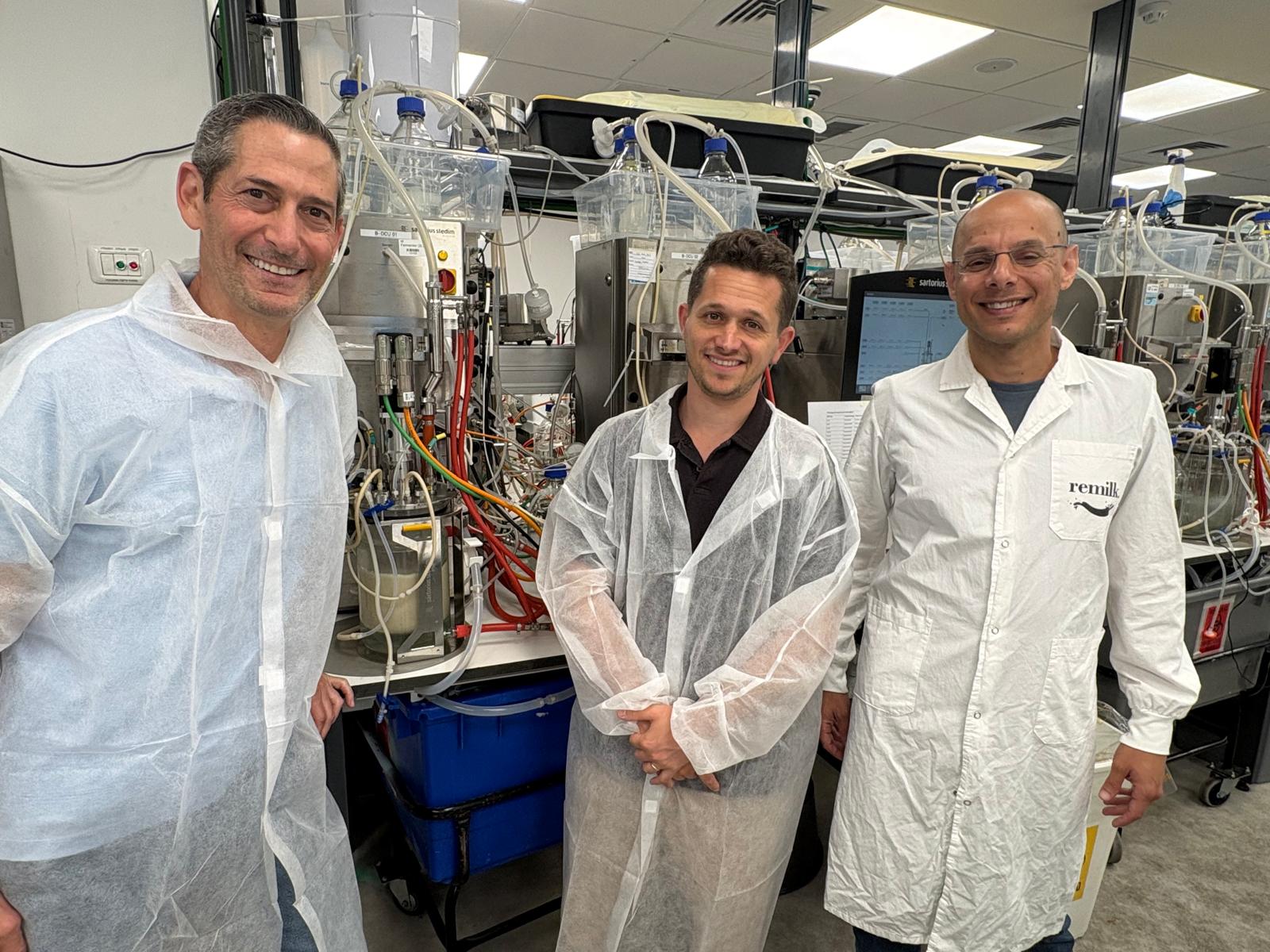
Not surprisingly, the other CEOs I met were younger. Effie Arditi of Longevitix, a health-tech company, and Guy Benromano of LightYX, a construction-tech company, each effused a passionate optimism about their tireless efforts. Their professional goals are about more than just making money, they are committed to genuinely disrupting their respective industries in the most creative and dynamic ways. Further along in doing just that are the co-founders of Remilk – a company that is producing and selling actual dairy products without relying on animals! Aviv Wolff and Ori Cohavi are leading a team of food scientists whose work is not only better for the environment and human health (not to mention cows!), but is also economically advantageous for consumers. All of this in a country the size of New Jersey that has been fighting a war on seven fronts since October 2023.
***
Back to my classroom: I often remind my students that political issues are almost always more complicated than proponents of one side suggest; that it’s critical to consider multiple perspectives when learning; and that it’s wise to avoid espousing with certainty without actual or first-hand knowledge. Sadly, opposing Israel has become a litmus test in an increasingly two-dimensional, zero-sum, hyper-polarized political world. And while legitimate criticism of any nation-state is fair, pillorizing the only Jewish one without remotely understanding her past or her present isn’t. My high schoolers know this. Educated adults should too.