


When Age Stops Weighing Anything
“.Do not pervert the justice due to the orphan”
לֹא תַטֶּה מִשְׁפַּט יָתוֹם
Deuteronomy 24:17
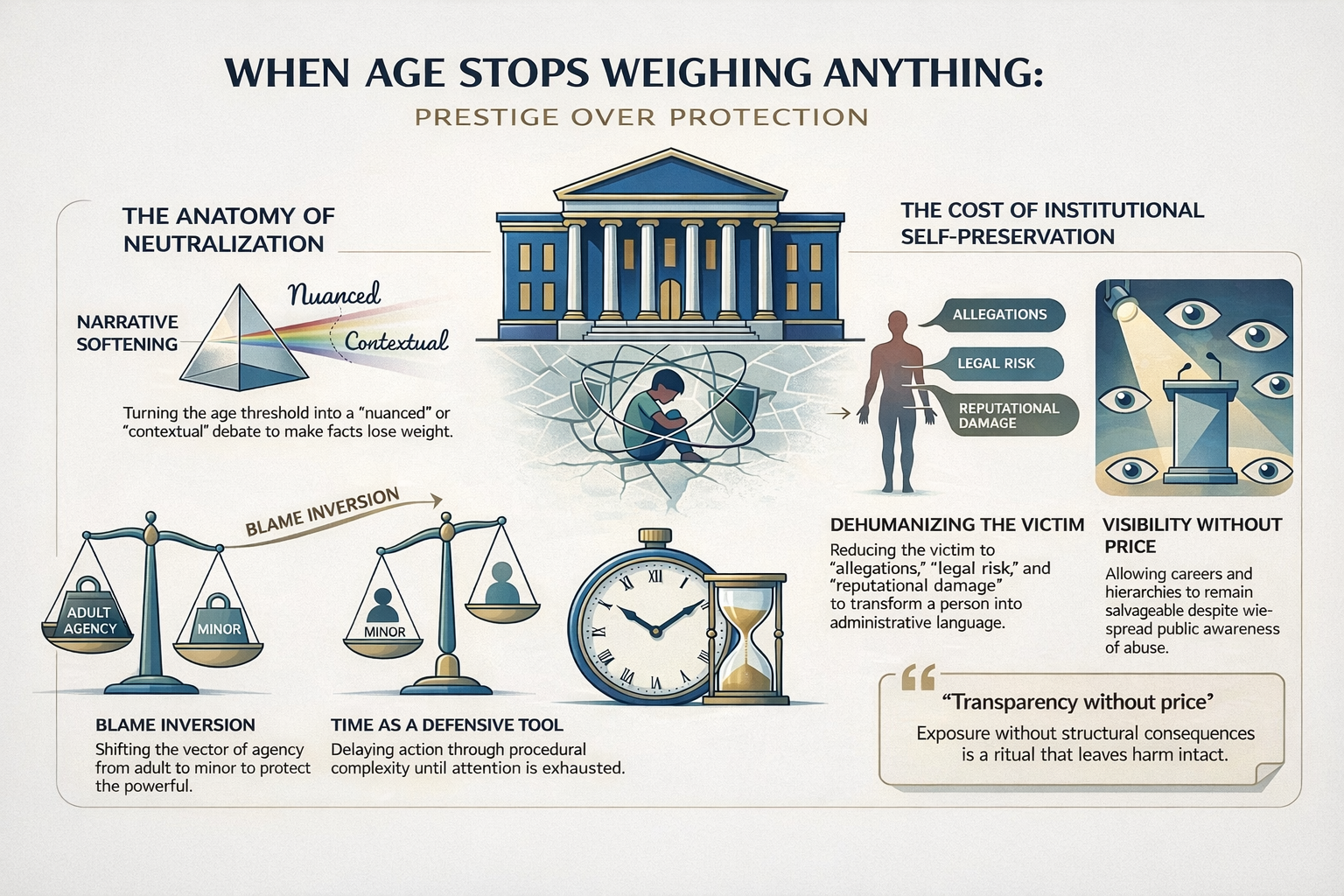
There is no shortage of information. There is a shortage of weight. In much of today’s public discussion, the boundary of age is formally present but practically light: it exists as a word, not as a threshold. The moment prestige enters the frame—office, money, institutional authority, a recognizable name—the category of age is quietly reclassified as “complicated,” “contextual,” “nuanced.” The event does not need to be denied. It only needs to be narrated in a register that prevents it from producing consequences.
This is why “one scandal” is never the point. A scandal is merely a visible symptom of a deeper capability: the ability of elite environments and large institutions to dissolve a hard boundary into a soft story. The public is offered a spectacle rather than a structure. A spectacle can be consumed. A structure would have to be touched, and touching would change what remains possible afterward.
Mainstream debate repeatedly confuses two different orders: the order of facts and the order of admissibility. Facts can be widely known while admissibility remains intact. People can “know,” and yet the same careers remain salvageable, the same hierarchies intact, the same protective networks operational. This is why the scandal format is so effective as a neutralizing device. It delivers intensity without leverage. It produces faces, headlines, clips, outrage, counter-outrage, and finally fatigue—until the topic becomes old, and once old it becomes harmless. The narrative closes. The harm does not.
What is being managed here is not primarily truth, but access. A society can know the facts and still remain structurally incapable of letting those facts touch power. The crucial operation is translation: the moment a harmed minor is converted into an administrative object—an “allegation,” a “claim,” a “case,” a “risk,” a “sensitive matter”—the event is already being moved into a space where the child cannot function as the centre of gravity. This is why victims vanish without censorship. They are not silenced; they are reformatted. And once reformatted, protection flows upward, toward offices and institutions, rather than downward, toward the vulnerable.
The deepest distortion happens early, through a manufactured symmetry. The language shifts into “two sides,” “a controversy,” “he said/she said,” a “relationship,” “let’s hear everyone.” This does not represent neutrality. It is structural falsification. Age and power are not background conditions; they are the axis. Once the discourse becomes symmetrical, the boundary has already been softened. The threshold has already been managed.
Then comes the oldest social maneuver, still the most toxic: the displacement of blame onto the minor. “She wanted it.” “He looked older.” “They knew what they were doing.” In this inversion the adult becomes tempted, seduced, confused, trapped; the child becomes the agent. The vector flips. And that flip allows prestige to do its work. The defense is rarely of the act. The defense is of the position: “he would never,” “it’s impossible,” “it’s a witch hunt,” “think of all the good he has done.” What is being protected here is not a child. It is a world-image in which authority is presumed to be moral, and in which power is entitled to the benefit of interpretive doubt.
This is where the most revealing absence in public debate becomes visible: the victims are missing. Not because someone forbids their presence, but because discourse assigns them a role in which they cannot be central. They are translated into administrative language. First they become “accusers.” Then they become “allegations.” Then they become “a sensitive topic.” Finally they become “legal risk” and “reputational damage.” The centre of gravity shifts to the adult: career, office, institution, party advantage, brand survival, the possibility of a comeback. Public attention bends toward the strong, while the minor becomes background noise, a moral prop in someone else’s crisis-management.
The temporal gap makes this inversion even more brutal. Media cycles run on hours and weeks. Victims live in years. Recovery does not follow the news schedule. Trauma does not respect the rhythm of headlines. A scandal can be “over” while a life is still being rebuilt. The closure that matters to the public is narrative closure; the closure that matters to victims is often unavailable. The mismatch is not incidental. It is one of the main conditions that make neutralization succeed: attention can be exhausted while harm persists.
Large institutions have an additional advantage: they can manufacture “responsibility” as delay. The language of carefulness—“this is complex,” “due process,” “we must be cautious,” “there is no definitive proof”—sounds like maturity. Functionally it is time. Time is not passive here; it is demonstrably active. With enough time, the topic becomes stale. With enough staleness, the public begins to treat reopening the matter as “unproductive,” “divisive,” or “cruel.” The distance from the event becomes an argument against consequences. Meanwhile the institutional machinery remains intact.
In hierarchical and sacralized environments, especially religious ones, the same neutralization can become more severe because it is sanctified. Harm to minors is absorbed into a vocabulary of “sin,” “fall,” “scandal,” “temptation,” “the good of the community.” The institution is positioned as the carrier of something higher, so the child’s reality becomes a threat to that carrier: a danger to unity, mission, tradition. Internal discipline replaces external accountability; procedural containment replaces structural change. The victim disappears not merely by neglect but by design: the institution’s self-preservation requires the victim to be managed as an internal disturbance rather than addressed as a public wrong.
When pressure mounts, modern systems often switch to a proxy war: “culture,” “sexualization,” “gender.” Instead of naming concrete mechanisms of protection—who shielded whom, by which channels, through which procedural techniques—the debate is redirected into ideology. Children are invoked as symbols rather than defended as persons. This move is cynically double. It performs concern for children while avoiding the question of violence against children. And it smuggles the old displacement back in through the side door: if “culture” is blamed for “corrupting youth,” minors can once again be treated as the problem, while adults and institutions retain the role of guardians.
None of this depends on conspiracy fantasies. It depends on a far more ordinary and therefore more reliable reality: prestige changes the grammar of accountability. Prestige softens thresholds. Prestige produces interpretive doubt. Prestige reorganizes attention so that “protection” flows upward—to office, to reputation, to institution—rather than downward to the vulnerable.
That is why the only question worth keeping at the centre is a simple one, and it is almost never asked in a sustained way: what becomes impossible afterward. Not who apologized, not who sued, not who won the narrative of the week. What positions become untenable. Which protective networks break rather than get repainted. Which institutions lose the ability to hide behind procedural solemnity. Whether the boundary of age regains weight in practice, rather than surviving merely as a slogan.
If, after all the revelations, the same careers remain salvageable, the same hierarchies intact, the same comebacks imaginable, the same defenses reusable—then the scandal was not a breakthrough. It was a neutralization ritual. Visibility without consequence. Transparency without price. Outrage without change. In such a regime, age is not abolished. It is suspended whenever prestige demands it.
Yochanan Schimmelpfennig