
When AI Becomes an Excuse
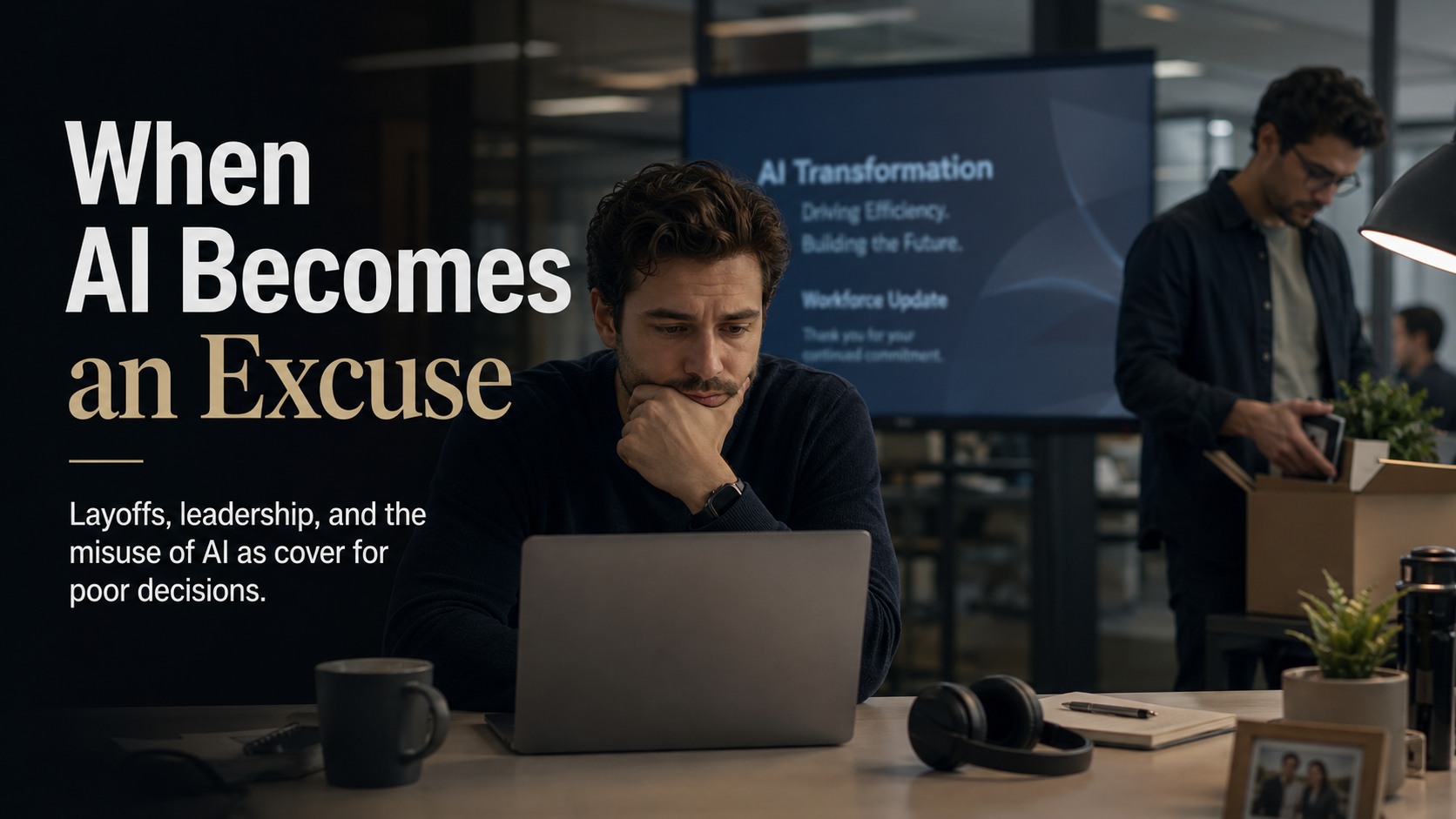
A friend of mine was recently laid off from a major High-tech company. I have changed identifying details to protect the people involved, but not the substance of what happened.
This person had helped build some of the company’s internal AI tools. During the week before the dismissal, one of the people involved in the decision asked for help understanding how those tools worked.
A few days later, the employee was told that the role had been eliminated as part of an AI-driven restructuring.
There is something absurd about a leader using a technology they do not yet understand to explain why the person who built it is no longer required.
Except there is nothing funny about losing your job.

I believe in AI
I am not an AI sceptic. Quite the opposite.
AI has already made me substantially more productive. In sales, research, financial analysis, meeting preparation, writing, and the development of new ideas, it allows me to do more in less time. It can give an individual or a small team capabilities that once required an entire department.
That is precisely why the current explanation for so many layoffs bothers me.
Technological revolutions have always disrupted work. The agricultural revolution changed how societies produced food. The industrial revolution transformed manufacturing and transport. The digital revolution eliminated some tasks while creating industries that previous generations could not have imagined. Over time, each expanded human productivity and raised living standards, even though the transition was painful for many people.
Few people today would choose a horse-drawn carriage over a car. The car more directly and completely performed the carriage’s central function. It was faster, more scalable, and eventually supported an entirely new economic system.
AI is already replacing certain tasks, and it will eventually eliminate some roles altogether. But much of today’s office technology is not yet a car replacing a carriage. It is closer to giving the driver better navigation, a more efficient engine, and the ability to travel further in the same amount of time.
In many workplaces, AI allows capable employees to produce more. Whether that productivity becomes growth, better service, new products, reduced working hours, or a smaller payroll is not a decision made by the technology. It is a decision made by leadership.
The responsibility of leadership is to redesign work around the technology: identify which tasks can genuinely be automated, retrain and redeploy strong employees, reduce unnecessary hiring, and measure whether the promised gains are actually appearing.
When leaders do not know how to do that, “AI transformation” becomes a sophisticated phrase for an ordinary cost reduction.
Show me the financial evidence
As someone with a master’s degree in financial economics, I keep returning to a simple question: where is the causal bridge?
I have not yet seen a public filing that cleanly connects a specific round of layoffs to a quantified AI productivity gain: a defined set of tasks removed, a measurable increase in output, and a demonstrated improvement in revenue, margins, or free cash flow that could not have been achieved through ordinary restructuring.
I have seen many presentations about AI. I have seen fewer financial statements that establish that link.
Consider two recent, real examples from publicly traded technology companies in Israel. The companies are deliberately unnamed here because the point is the pattern, not to turn the essay into an attack on two employers.
One listed payments company announced that it would eliminate more than 4,000 jobs, cutting over 40% of its workforce as it reorganized around AI. In the same reporting period, quarterly gross profit increased 24% year over year. The company forecast 22% gross-profit growth for the following quarter and raised its full-year growth outlook.2
A large enterprise-software company reduced its workforce by approximately 10%, explaining that it wanted to redirect resources toward AI and enterprise sales while strengthening its financial profile. In the next reported quarter, revenue rose 32% year over year, free cash flow reached $561.3 million, and cash and cash equivalents stood at approximately $1.1 billion.34
Those figures do not prove that either decision was commercially wrong. A growing, cash-rich company can still have duplicated teams, an unsuitable cost base, or a strategy that needs to change. Management also has a duty to plan for future conditions rather than wait for financial distress.
But the figures do show that these were choices about capital allocation. They were not simply instances of a machine mechanically making thousands of people obsolete.
The honest explanation might be:

That explanation would still hurt. But it would at least accept responsibility.
AI is a more convenient explanation because it makes the outcome sound inevitable. It transfers agency from the executive suite to an unstoppable technological force. It can turn a failure of forecasting into a story about innovation.
Hiring people you never needed was also a decision
During the years of cheap capital, headcount became confused with progress.
Companies hired faster than they could determine what those employees should actually do. Teams overlapped. Management layers multiplied. Projects were approved because resources were available rather than because customers needed them. Recruitment itself became a competitive weapon.
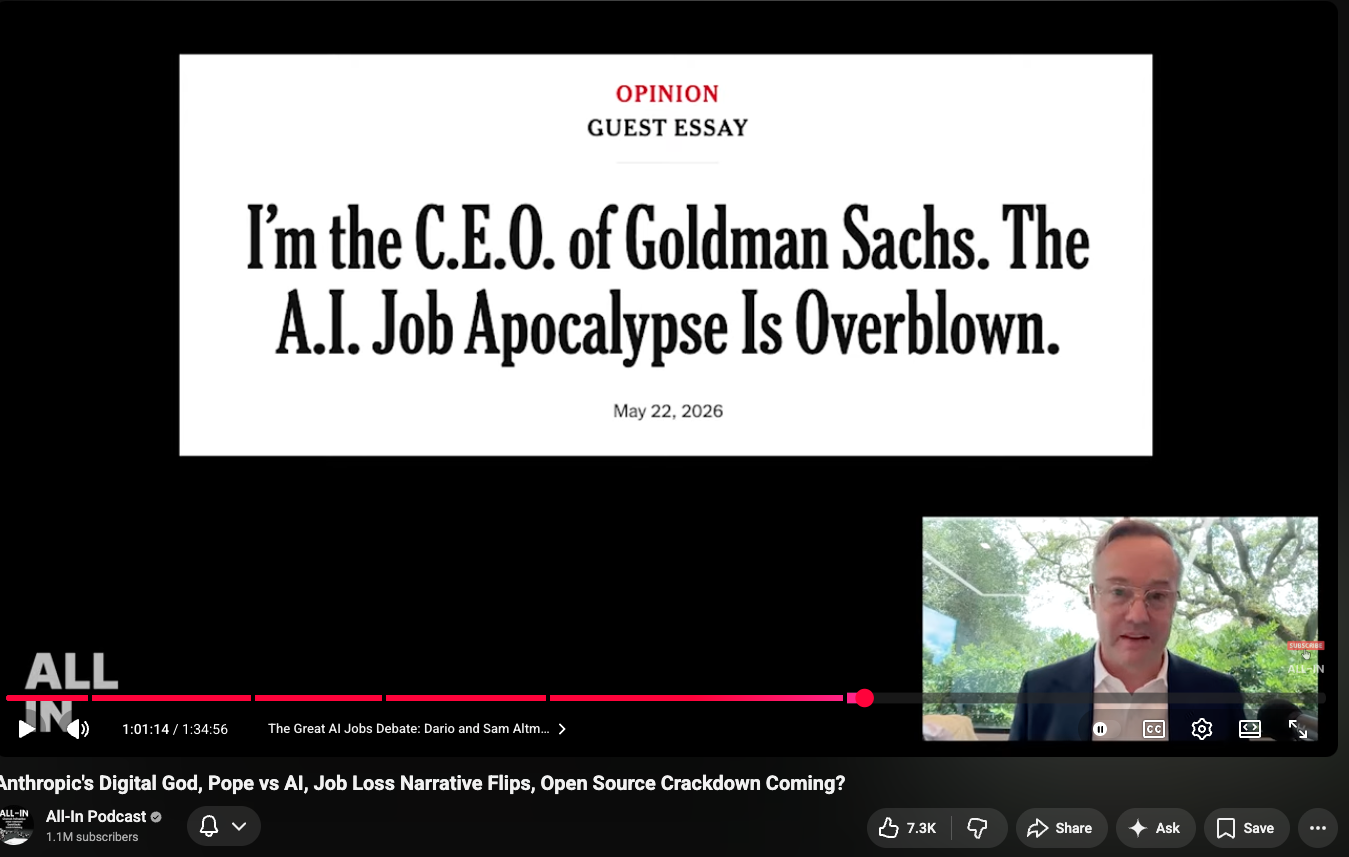
A May 2026 episode of the All-In Podcast captured the debate unusually well. Several participants argued that companies were using AI as cover to correct years of over-hiring and poor management. Others pushed back, arguing that the technology is now genuinely consolidating roles and allowing smaller teams to ship more.1
That disagreement is important. The serious position is not that AI will never remove jobs. It already has, and it will remove more. The serious question is whether each particular layoff reflects direct technological substitution or an overdue reversal of decisions that leadership made years earlier.
During the same discussion, Jason Calacanis described a hiring strategy he said had been explained to him by the founders of one of Silicon Valley’s largest companies: “We hire people and then we figure out what to do with them later.”1
The panel described the strategy as taking talented people off the market so they could not strengthen a competitor or create one of their own. An abundance of cash made the approach possible, and it gradually became part of the wider Silicon Valley culture.
That is not innovation. It is talent hoarding.
And when the economics of that strategy eventually became harder to defend, many of the people hired into bloated organizations were told that artificial intelligence had made them unnecessary.
AI did not approve the original hiring plans. AI did not create vague mandates, duplicate teams, or unnecessary layers of management. AI did not set projections that the company later failed to meet.
Leadership did.
A company that hired people merely because it could should not later describe their removal as an unavoidable act of technological disruption. Sometimes it is simply the bill arriving for a strategy leadership chose.
Accountability cannot apply in only one direction
Technology companies speak constantly about values. They describe themselves as families. They publish statements about transparency, ownership, empathy, and trust. They impose office-attendance rules in the name of collaboration.
But standards lose their meaning when they apply only downward.
It is difficult to take rigid office mandates seriously when senior leaders are exempt from the same expectations. It is difficult to listen to lectures about accountability when the executives who authorized aggressive hiring and unrealistic projections remain untouched. It is difficult to believe that leadership “cares deeply” when employees are treated as the fastest available lever for improving a quarterly margin.
Layoffs may sometimes be necessary. Pretending otherwise would be naive. A company cannot preserve every role indefinitely, and keeping an organization bloated can ultimately endanger everyone who remains.
But responsible leadership should exhaust less destructive options first: freeze unnecessary recruitment, reduce contractors and external spending, allow natural attrition, remove duplicated management layers, retrain and redeploy capable employees, and put executive compensation and status on the table.
Boards should also confront leaders whose forecasts and strategies repeatedly fail. Authority without consequences is not accountability. When judgment has been materially wrong, the people who exercised that judgment should carry a greater share of the cost.
Too often, reducing headcount is selected not because it is demonstrably the best long-term business decision, but because it is the easiest action to execute and the simplest signal to sell to financial markets.
One company announces an AI restructuring and its share price rises. Others copy the language. Soon, following the trend is presented as courageous leadership.
It is not independent thinking. It is imitation dressed as decisiveness.
Israel’s confidence – and its danger
I am proud to be Israeli.
Israel’s confidence, speed, improvization, and willingness to challenge convention are among its greatest strengths. Those qualities helped a small country with limited natural resources build world-class companies, technologies, and institutions.
But confidence has a shadow.
When confidence is left unchallenged, it can become arrogance. Arrogance becomes complacency. Complacency creates the belief that yesterday’s success proves today’s judgment.
This is not true of every Israeli company or every Israeli leader. Our history contains powerful examples of leaders who remained close to the people they served, understood the burden carried by ordinary citizens, and recognized that authority required personal responsibility.
The danger begins when leaders become insulated from the consequences of their own decisions.
Israeli chutzpah is powerful when it challenges conventional wisdom. It becomes dangerous when it prevents us from listening to warnings, questioning assumptions, or admitting that we were wrong.
This weakness is not confined to government, and it is not confined to high tech. It appears wherever leaders begin to believe that the rules, sacrifices, and standards imposed on others no longer apply to themselves.
Professionalism does not mean abandoning Israeli confidence. It means combining confidence with preparation, humility, discipline, and accountability.
A lesson for olim – and for every employee
For an oleh, choosing an employer can carry particular risk.
You may not have decades of school, army, and professional relationships behind you. Your family safety net may be elsewhere. You may still be learning the language, the culture, and the informal rules through which much of Israeli professional life operates.
That means you should be especially selective about the people to whom you entrust your career.
Do not interview only for the role. Interview the leadership.
Ask how the company handled its previous downturn. Look for evidence that executives share in sacrifice. Notice whether the values on the website survive contact with difficult decisions. Determine whether leaders can explain how AI will change actual workflows, or whether they simply repeat the vocabulary currently rewarded by investors.
Most importantly, stop confusing company branding with loyalty.
A company calling itself a family does not make it one. A beautifully written values page is not a covenant. Loyalty is meaningful only when it is reciprocal.
That does not mean becoming cynical. It means building your own foundation: your skills, your network, your reputation, your financial resilience, and your ability to create value independently of a single employer. For some people, it will also mean building companies of their own.
People who lose their jobs deserve the space to be angry and to grieve. They should also remember the stubborn vigour that runs through Jewish and Israeli history: the ability to rebuild, adapt, and refuse to remain defeated.
Pick yourself up. Keep building. Leave complacent institutions behind.
The leaders AI will expose
AI will change employment. It will eliminate certain tasks, transform many professions, and create possibilities that we cannot yet fully imagine.
It will also expose the difference between leaders who genuinely innovate and those who merely follow the latest trend.
The companies that succeed will not be those that invoke AI most frequently. They will be those whose leaders understand how to combine technology with capable human beings, measure the results honestly, and accept responsibility when their own judgment fails.
AI should make us more ambitious about what people can build, not less honest about why leaders choose to let them go.
Sources and verification notes
- All-In Podcast, May 30, 2026. The relevant discussion begins at approximately 1:05:26 and includes the debate over AI-driven job loss, over-hiring, and talent hoarding. Watch the episode.
- Public reporting on a listed payments company: more than 4,000 job cuts, quarterly gross-profit growth of 24%, a 22% next-quarter growth forecast, and a raised full-year outlook. Read the report.
- Public company team update announcing an approximately 10% workforce reduction and explaining the strategic rationale. Read the team update.
- Public Q3 FY2026 earnings release reporting 32% year-over-year revenue growth, $561.3 million in free cash flow, and $1.1 billion in cash and cash equivalents. Read the earnings release.
Note: The financial examples are factual and intentionally anonymised in the article. The opening account is based on a real experience, with identifying details changed to protect the individuals involved.