
Writing on Jewish life, relationships, trauma, and resilience
When America Says ‘No’, Israel Must Remember Who Pays the Price
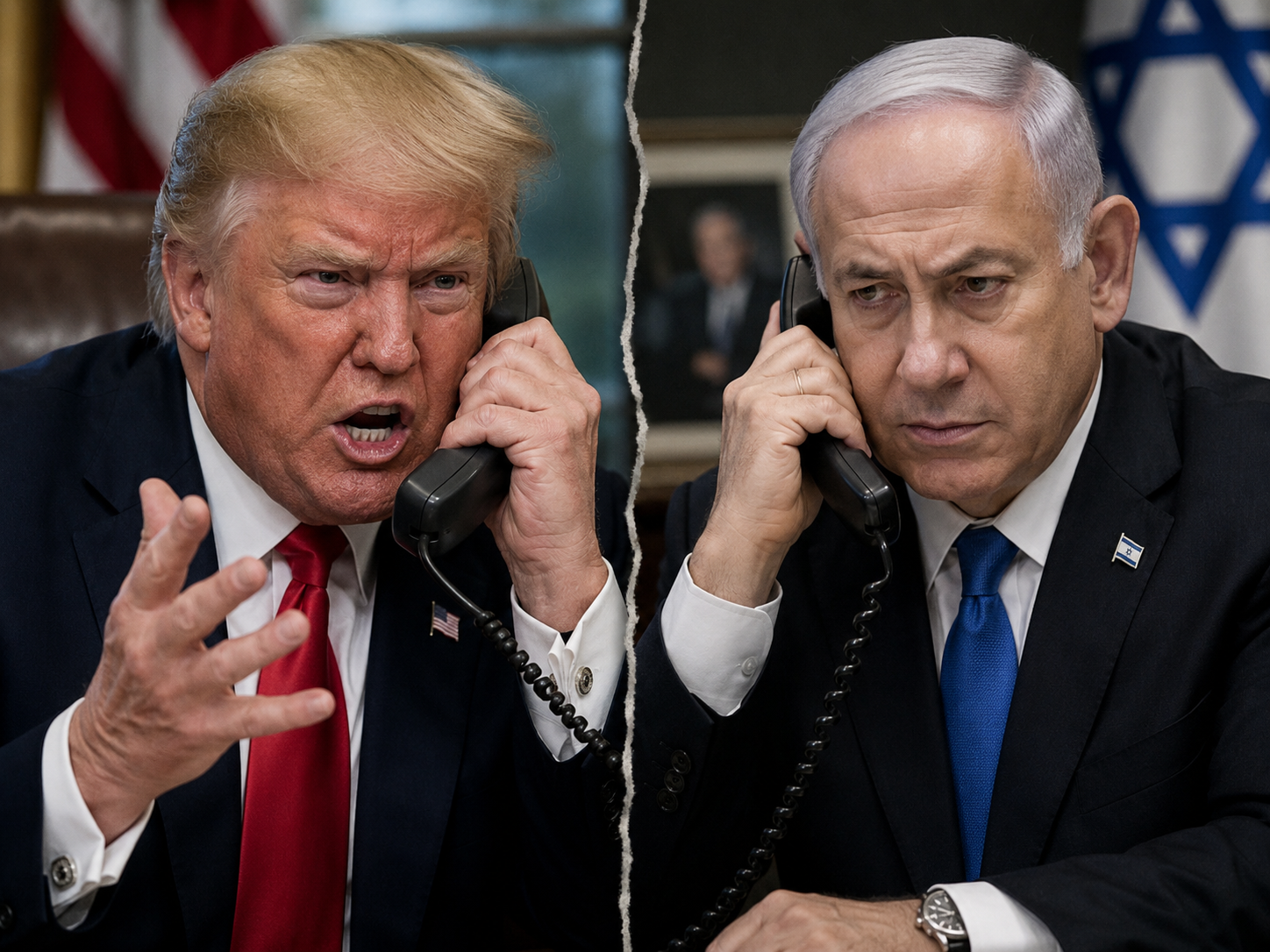
Illustrative: AI image created by the author.
Monday’s reported phone call between President Donald Trump and Prime Minister Benjamin Netanyahu may be remembered less for its profanity than for the power imbalance it exposed.
According to reporting cited by The Times of Israel, Trump allegedly raged at Netanyahu over Israel’s planned strikes against Hezbollah targets in Beirut, demanded that Israel agree to a ceasefire, and reportedly told the prime minister, “Everybody hates you now. Everybody hates Israel because of this.” Netanyahu’s office denied the harshest details while acknowledging that the call was “tense.”
Whether every word was said exactly as reported is almost beside the point.
The deeper issue is not Trump’s language. It is whether Israel’s national security decisions are being made in Jerusalem — or managed from Mar-a-Lago.
Israelis have every reason to value the American alliance. No serious person should minimize the importance of US military aid, diplomatic backing, intelligence cooperation, and strategic coordination. The United States is Israel’s most important ally. That alliance has saved lives.
But alliance is not obedience.
And friendship is not ownership.
Hezbollah Is Not a Public Relations Problem
The report says Trump was aware that Hezbollah had repeatedly fired at Israel and recognized Israel’s right to respond. It also notes that 14 IDF soldiers had been killed by Hezbollah since the April ceasefire, and that Hezbollah had stepped up rocket and drone attacks on northern Israel.
That is not a diplomatic abstraction.
That is not a messaging challenge.
That is the daily reality of Israeli soldiers and families in the north.
Metula is not a talking point. Kiryat Shmona is not a backdrop. Empty northern communities are not unfortunate optics in someone else’s regional strategy. They are Israeli lives, Israeli homes, Israeli children, Israeli parents, and Israeli trauma.
Any American president has the right to consider American interests. That is his job. If Washington believes a major Israeli strike in Beirut could derail negotiations with Iran or widen a war the United States is trying to contain, that concern deserves to be heard. The article reports that US officials feared Israeli action in Beirut could threaten Washington’s effort to secure a ceasefire extension with Iran, which was conditioning a deal on a truce in Lebanon.
But Israel also has a job.
Its first obligation is to protect its citizens.
Not to protect an American diplomatic calendar.
Not to protect a president’s social media narrative.
And not to protect the illusion that Hezbollah can fire, kill, regroup, and then be rewarded with another ceasefire that restrains Israel more than it restrains the terror army on its border.
The Humiliation Is Strategic
Much of the public attention will focus on Trump’s reported vulgarity. That is understandable. There is something grotesque about the leader of Israel’s closest ally allegedly speaking to Israel’s elected prime minister as if he were an unruly subordinate.
But the greater danger is not personal insult. It is strategic humiliation.
The article reports that Trump posted on Truth Social that Israel would not send troops to Beirut, that “any troops that are on their way” had been turned back, and that he thanked Netanyahu for turning his troops around. Israeli military sources said no troops had been en route to Beirut.
That matters.
In the Middle East, perception is not decoration. It is deterrence.
When Hezbollah sees the American president publicly claim he stopped Israel, Hezbollah learns something. When Iran sees Israel restrained under American pressure, Iran learns something. When Israelis in the north see their government appear to bend while rockets continue, they learn something too.
None of those lessons strengthens Israeli security.
Trump’s Popularity Is Real. So Is the Warning.
None of this erases why Trump remains extraordinarily popular among many Israelis.
He moved the US Embassy to Jerusalem, recognized Israeli sovereignty over the Golan Heights, helped broker the Abraham Accords, and often spoke about Israel’s enemies with a clarity Israelis rarely hear from world leaders. Many Israelis do not merely appreciate those decisions. They feel seen by them.
But gratitude is not a strategy.
Israelis also have reason to worry. Trump has shown, more than once, that allies can become expendable when he believes a short-term political interest is at stake. Kurdish partners who fought alongside the United States against ISIS felt abandoned after Trump’s 2019 Syria withdrawal opened the way for a Turkish assault — a move widely described as a betrayal of America’s Kurdish allies. Ukraine learned a similar lesson after a public Oval Office confrontation with President Volodymyr Zelenskyy was followed by a temporary suspension of U.S. military aid and intelligence sharing. Denmark, a NATO ally, faced extraordinary pressure over Greenland, with Danish and Greenlandic leaders publicly insisting that one country cannot annex another.
Israel should not assume it is immune from the same transactional logic.
That is why Trump’s reported humiliation of Netanyahu is more than another episode in the long-running theater of Trumpian bluntness. It is a wake-up call. Millions of Israelis, and millions of Americans who deeply value the US-Israel relationship, are now being forced to reconsider not their gratitude for what Trump has done, but their affection for a president who may treat even Israel as a negotiable instrument when his immediate interests require it.
Friends can disagree. Allies can pressure one another. Presidents can say no.
But when support begins to sound like ownership, and protection begins to sound like leverage, the relationship has entered dangerous territory.
Saying “No” Is Part of Sovereignty
Gadi Eisenkot, no lightweight on matters of war and security, blasted Netanyahu for what he called capitulation to Trump’s demand. “There has never been a prime minister in Israel who capitulated to such a demand,” he reportedly wrote, arguing that Netanyahu and his government were harming Israel’s national interests “from a place of weakness.”
Itamar Ben Gvir, from a very different political universe, also called on Netanyahu to say “no” to Trump, arguing that this was the moment to strike Hezbollah and restore security to the north.
When Eisenkot and Ben Gvir, of all people, are using the same verb — “no” — the issue deserves attention.
A strong prime minister does not say no to America for sport. He does not confuse independence with recklessness. He does not endanger Israel merely to prove he cannot be pushed around.
But a strong prime minister also does not outsource the security of Israelis to a foreign leader, even a friendly one. Especially not when that foreign leader has his own political needs, his own regional ambitions, his own negotiations with Iran, and his own habit of turning private pressure into public theater.
There is a difference between coordination and surrender.
There is a difference between listening and obeying.
There is a difference between strategic restraint and learned helplessness.
Israel Must Not Become a Client State
The Trump-Netanyahu relationship has long been presented as one of Netanyahu’s greatest diplomatic assets. Perhaps it has been.
But this episode shows the other side of personalized diplomacy.
When a nation’s most important alliance is filtered through one leader’s relationship with one president, the relationship becomes fragile. It becomes emotional. It becomes transactional. It becomes vulnerable to ego, insult, flattery, grievance, and public embarrassment.
Israel cannot build its national security on one man’s mood.
Not Trump’s.
Not Netanyahu’s.
The US-Israel relationship has to be larger than personalities. It has to rest on shared interests, democratic values, mutual respect, military cooperation, and a clear-eyed understanding that Israel is not an American protectorate.
A model ally is still an ally.
Not a vassal.
Restraint Must Have a Purpose
None of this means Israel should strike Beirut blindly. Civilian casualties matter. Regional escalation matters. American concerns matter. The lives of Lebanese civilians matter, too. A Jewish state cannot defend itself by forgetting the humanity of others.
Restraint can be wise.
But restraint must have a purpose.
If restraint buys time for a durable arrangement that removes Hezbollah from Israel’s border, protects northern communities, returns displaced families home, and prevents Iran from using Lebanon as a forward missile base, then restraint may be painful but strategic.
If restraint merely gives Hezbollah time to reload, gives Iran leverage in negotiations, gives Washington a headline, and gives Israelis in the north more sirens, then restraint is not strategy.
It is delay dressed up as diplomacy.
The report says that after Trump’s announcement of a truce, Hezbollah continued targeting northern Israeli communities, sirens sounded in Metula, rockets were intercepted across the north, and a Hezbollah drone struck near the border.
That is the test.
Not the announcement.
Not the post.
Not the phone call.
The test is whether Israelis can live safely in their homes.
Israel’s North Cannot Be Sacrificed to Optics
Since the latest round of fighting began, the article reports, 26 IDF soldiers and one Defense Ministry civilian contractor have been killed in southern Lebanon, along with two Israeli civilians killed by Hezbollah rockets. Hezbollah has fired thousands of rockets at IDF troops and Israeli communities, and launched hundreds of drones.
Those numbers should silence the easy slogans.
This is not about Netanyahu’s pride.
It is not about Trump’s anger.
It is not about whether Israel should always say yes or always say no to Washington.
It is about whether the State of Israel can fulfill the most basic promise of sovereignty: that Jewish families will not again be left defenseless while armed enemies decide when they may live in peace.
Israel should coordinate with America whenever possible.
It should listen carefully.
It should avoid unnecessary escalation.
It should explain itself better, act with moral discipline, and never mistake force for strategy.
But Israel must also be able to say, clearly and calmly: our citizens are under attack; our communities are empty; our soldiers are dying; our duty is not negotiable.
That is not ingratitude.
That is sovereignty.
The Relationship Needs Repair
The most troubling sentence in the report may not be the vulgar one. It may be the claim that “everybody hates Israel.”
Because whether Trump said those exact words or not, Israel has a serious problem when its closest ally sees its position becoming harder to defend.
That does not mean Israel should abandon its security needs to win applause.
It does mean Israel must understand that military power alone cannot sustain the US-Israel relationship. Israel must tell and live a fuller story: strength and restraint, security and democracy, Jewish self-determination and human dignity, courage and accountability.
But moral repair cannot come at the price of strategic paralysis.
Israel should not become reckless to prove independence.
Nor should it become obedient to preserve friendship.
A mature alliance can survive disagreement. What it cannot survive indefinitely is contempt, humiliation, and confusion over who is responsible for whose survival.
The United States can advise Israel.
It can pressure Israel.
It can even warn Israel.
But it cannot live for Israel.
And it cannot die for Israel.
That burden remains with the people of Israel, their soldiers, their families, and the leaders they elect.
A prime minister’s job is not to be loved by an American president.
It is to protect the State of Israel.
Even when the phone call gets ugly.
Related Topics
Related Posts