
When American politicians have nothing to say, they often say Israel.
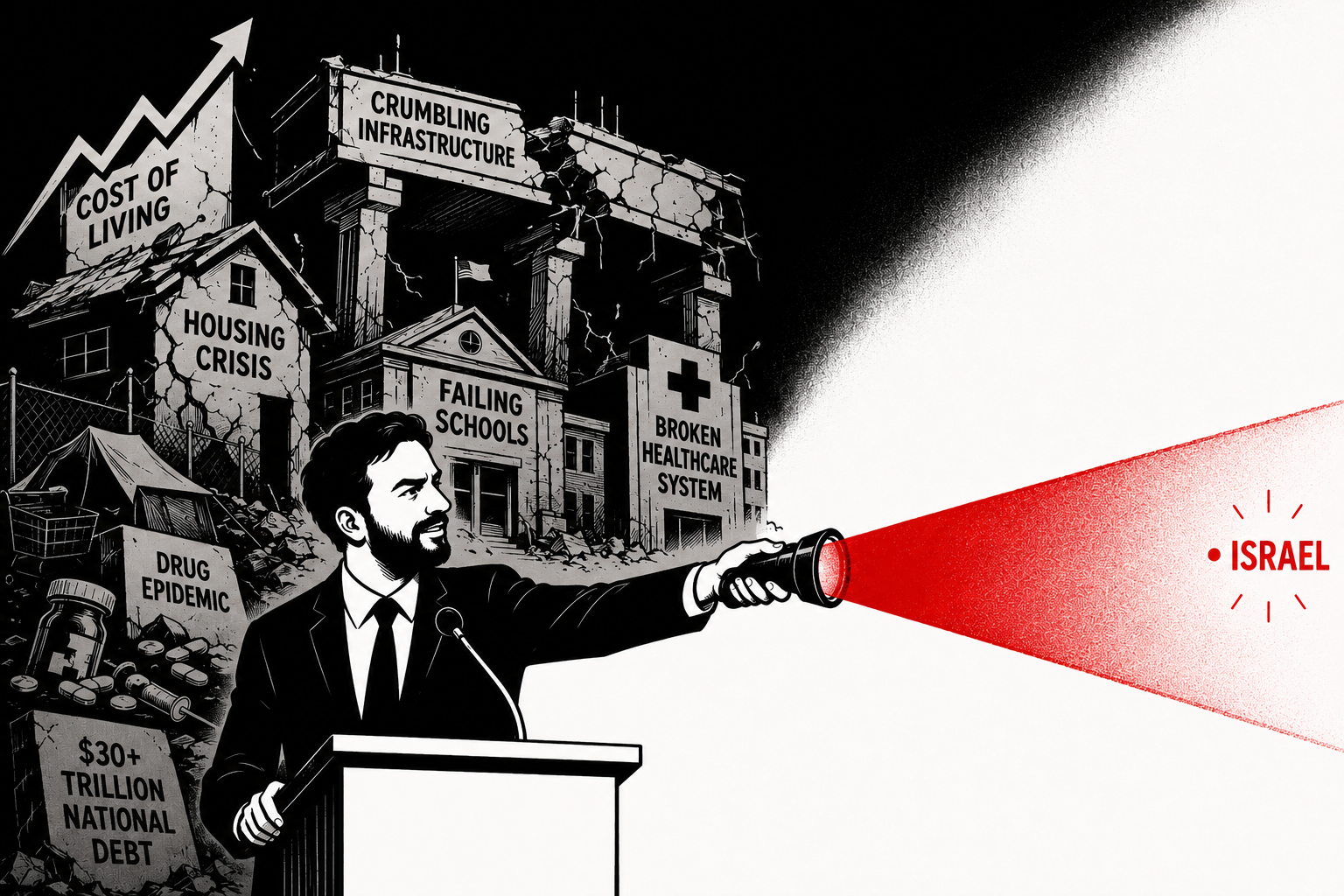
Americans are worried about the cost of living.
They are worried about gun violence and drug addiction. They are worried about homelessness and failing schools. About taxes, crumbling infrastructure, and whether artificial intelligence will take away their jobs. They are worried about a national debt exceeding $30 trillion, a healthcare system that often forces people to choose between treatment and affordability, and a housing market that has pushed homeownership out of reach for millions.
Yet, listening to some politicians, one would think the greatest threat facing Americans is the Jews.
Throughout history, populist politicians have relied on a simple political formula: when voters are frustrated, anxious, and angry about problems that are difficult to solve, give them someone else to blame. Historically, few targets have been more useful than the Jews. Today, Jews, Zionists, and the Jewish state serve a similar function.
America struggles with the legacy of racism and its treatment of Native Americans? Blame Israel for being a “settler-colonial, apartheid, genocidal state.”
America faces growing economic hardship? Blame “Zionists” for supporting a “capitalist, imperialist oppressor.”
Americans are frustrated with political corruption, corporate influence, and too much money in politics? Blame AIPAC and its American Jewish donors.
No matter the problem, Jews, Zionists, and Israel become the answer.
Such blame is not an accident. It is the product of what I call American Intellectual Antisemitism, the subject of my forthcoming book.
Over the past several decades, increasingly large swaths of Americans emerging from elite institutions have embraced an ideological framework that portrays Jews as uniquely powerful, Jewish self-determination as uniquely illegitimate, and opposition to both as a form of moral virtue. Through this lens, complex social problems are reduced to a simplistic morality play in which Jews are cast as the villain.
American Intellectual Antisemitism offers populists on both the far left and the far right an invaluable political tool: it transforms public frustration into political power. Rather than wrestle with difficult questions about economics, crime, education, healthcare, housing, or social cohesion, it offers politicians a ready-made explanation for why the world feels broken and a ready-made target at which to aim public anger.
Faced with seemingly impossible problems, American Intellectual Antisemitism offers an alarmingly simple answer: the problem is Jewish collective existence. Jewish peoplehood. Jewish power. Jewish self-determination. Ultimately, the existence of a Jewish state.
That is precisely why Israel, as the world’s only Jewish state, is such a useful target. Most Americans experience Israel through headlines, social media clips, activist slogans, and political rhetoric rather than through personal experience. Unlike inflation, crime, housing, or healthcare, Israel is distant enough that many voters must rely almost entirely on activists, politicians, and social media to tell them what to think about it.
American Intellectual Antisemitism turns that distance into a symbolic battlefield onto which Americans can project their frustrations, fears, grievances, and political ambitions. In doing so, it allows politicians to stage political theater disguised as moral conviction.
In a healthy democracy, citizens begin with facts, analyze evidence, form beliefs, and then support leaders whose views align with those conclusions. American Intellectual Antisemitism reverses that process.
Beginning with identity rather than evidence, it divides the world into “us” and “them,” casting Jews, Zionists, Israel, and anyone associated with them as the enemy. Once identity becomes primary, reality no longer matters. Evidence is selected to justify beliefs that have already been chosen. Facts become optional. Emotion becomes king. Disagreement becomes betrayal. Most importantly, loyalty replaces truth as the movement’s highest value.
Such political theater may win elections, but it never solves real problems. Worse still, its damage does not end with political distraction.
Although American Intellectual Antisemitism frequently presents itself as anti-Israel activism, its underlying logic is deeply anti-American. The same movements that demonize Israel routinely excuse, romanticize, or minimize organizations and regimes that are openly hostile to the United States, Western liberal values, and democratic institutions. The same activists who condemn Israel often reserve similar contempt for America itself, describing both countries as illegitimate colonial projects requiring liberation.
The only time you see an American flag at anti-Israel protests is when it is being burned, trampled on, or torn apart. The movement that presents itself as fighting oppression often reserves its deepest contempt not for Israel, but for America itself.
That alone should serve as a warning. Hatred directed at Jews rarely remains confined to Jews. Again and again, antisemitism has served as an early indicator of broader attacks on pluralism, free inquiry, dissent, and democratic norms. Like a canary in a coal mine, hostility toward Jews often signals deeper pathologies within a society.
That warning is particularly relevant as Americans head into yet another election season.
The question facing voters this election season is not whether Americans should care about what happens in Israel. They should, just as they should care about what happens in any democracy confronting terrorism and war. The question is why so many politicians seem more interested in talking about Jews, Zionists, and Israel than about the problems they were elected to solve.
A mayor cannot broker peace in the Middle East. A state legislator cannot determine the future of the Jewish state. A city council debating symbolic resolutions about Israel does little more than consume taxpayer resources while leaving local problems unsolved. But elected officials can help make housing more affordable. They can improve schools. They can strengthen public safety. They can address addiction, homelessness, and economic insecurity. They can tackle the problems Americans actually elected them to solve. Or at least they can try.
When politicians spend more time talking about Jews, Zionists, and Israel than about the lives of the people they represent, voters should ask themselves three simple questions: What are they trying to distract us from? What are they trying to hide? And why are they talking about Jews instead?
When politicians have nothing to say, they often say Israel.
*
American Intellectual Antisemitism: The Anti-Jewish Movement Tearing Through Our Universities (Wicked Son/Post Hill Press) is now available for pre-order.