Documenting Hidden Jewish Histories and Legacies
When Australia Made Jewish Belonging Public
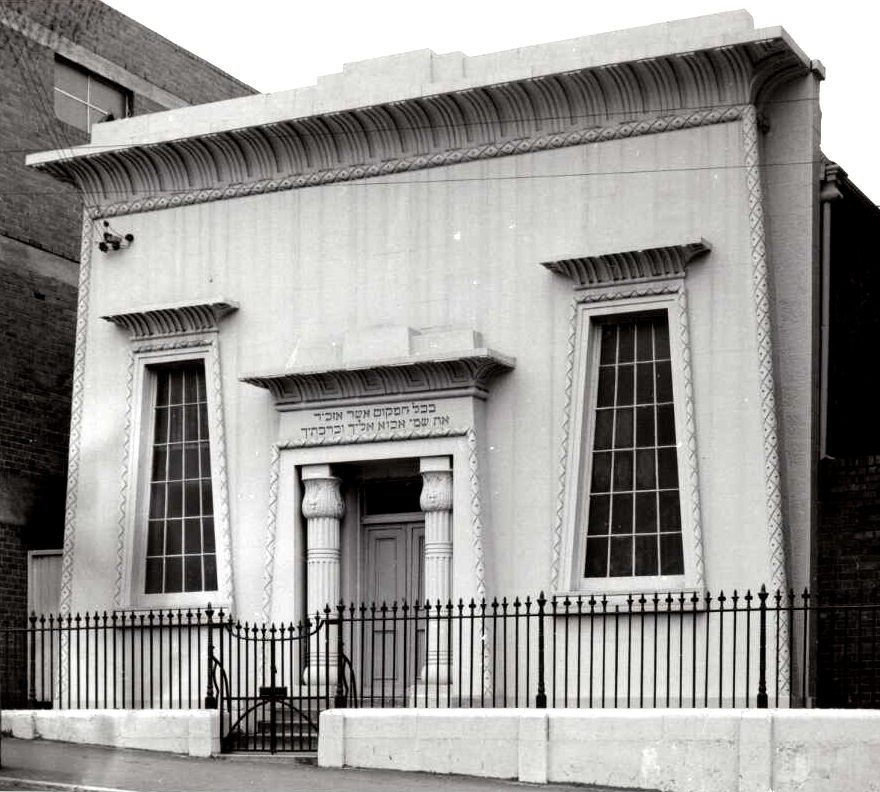
Hobart Synagogue, opened in 1845, designed by James Alexander Thomson; photo 1961, Australian News and Information Bureau; National Library of Australia.
In October 1845, the Hebrew Congregation of Sydney did something both profoundly ordinary and quietly radical at the time. It petitioned the colonial government.
The request was measured. The language was civic. For fourteen years, the congregation explained, Sydney’s Jews had maintained public worship without government aid. When an offered land grant proved unsuitable, they purchased ground themselves and erected a synagogue at great expense—£5,000—only to find themselves £1,000 in debt. They now asked whether the colony might recognize this work by relieving the burden and by providing a stipend for a Jewish minister, as it did for Christian clergy.
This was not a challenge to other congregations, nor a demand for special treatment. The synagogue already stood. The community already worshipped.
The government’s reply was polite—and negative. Officials expressed regret, not opposition. Under existing law, they explained, funds allocated for “public worship” could not be applied to a Jewish synagogue or the support of a Jewish minister. The refusal rested on an understanding of who the “public” were and what kinds of worship were meant to be engaged by the public. The law, as written, did not yet know how to name a synagogue—treating Judaism as a faith imagined as private, rather than one lived in public.
Read alone, the exchange might suggest a familiar story: Judaism left to stand for itself. Unrecognized by law, and therefore easy to mistake for unseen, and therefore vulnerable. But read alongside reporting from another Australian city at almost exactly the same moment, a fuller picture emerges.
In June 1844, the Launceston press reported on a meeting of the town’s Jewish residents to arrange the purchase of land and the erection of a synagogue “for their worship of the living God.” The article praised the “liberal spirit” of the Jewish community, noting their past contributions to Christian places of worship, and expressed confidence that non-Jewish residents would now reciprocate. Subscription lists were made public. Banks agreed to hold them. The synagogue’s site—facing Church Square—was described without novelty or suspicion. The building, readers were told, would be creditable to the town as a whole.
Here was no petition to Parliament. No reference to statute. Instead, there was lived memory, neighborliness, and respect. The Jews had shown up for Christians. Christians, it was implied, would show up for the Jews.
Together, these sources reveal something essential about early Australian pluralism. Support for Jewish life was uneven, imperfect, and real. Government bodies failed to keep pace with lived reality. Yet at the local level—through newspapers, subscription drives, and shared civic memory—Jewish belonging was already being practiced.
This pattern is also seen elsewhere at the same time. When a synagogue was dedicated in Hobart Town in 1845, newspapers treated it not as a private religious milestone, but as a public event. Visitors were invited. Pamphlets explaining the prayers were distributed in Hebrew and English. Hebrew verses were translated for readers who had not been present. Civic leaders attended. The service concluded with prayers for the Queen. Today, the building remains the oldest synagogue structure still in use in Australia.
Again and again, Jewish life was made visible, legible, and shared. Language was translated. Ritual was explained. Attendance was public. Pluralism was not proclaimed in the abstract; it was practiced.
That history matters now.
In the days following the antisemitic attack at Bondi Beach, Australians have again been faced with a familiar question: whether Jewish communities will be embraced as part of the larger civic body, or left to grieve and fear alone. Many have asked how to show up, how to offer support, how to make clear that Jews do not stand apart.
Australia has lived this choice before. Its own archive records moments that both inspire and caution. This history reminds us that pluralism does not begin with slogans or policy. It begins when people choose to show up for one another in public.
Australia has made that choice before. Its history suggests it knows how to do so again, if it chooses to remember.
Related Topics