

When Birds Aren’t Real: The body of power is off limits
There is a taboo today that works more reliably than most laws, committees, or constitutional safeguards. It is not about corruption. It is not even primarily about violence. It is about something more basic: the cognitive, mental, and metabolic constraints of the people who decide on war, repression, migration, policing, incarceration, and money.
Public language speaks of strategy, values, national interest, security. Yet an entirely different regime is at work, almost never named: the regime of thresholds. Thresholds of sleep, glucose, fatigue, pain, shame, tolerance for dissonance, impulse control, paranoid interpretation, memory stability. Politics as decision does not begin with an argument. It begins with whether, on a given day, a brain and body can hold complexity without collapsing into fixation.
This is taboo for a simple reason: modern states, media, and academia share a convenient fiction. The political actor is assumed to be sufficiently stable to be evaluated in terms of program, morality, competence, or ideology. In reality, what we often observe is not “a program,” but a trajectory of constraints. Someone may speak in perfect sentences while operating in compulsive ego defense. Someone may be procedurally correct and yet incapable of accepting correction without escalation. Someone may appear rational in form while running on the operational logic of revenge, panic, or self-confirmation.
Now consider a strange American cultural phenomenon that is not merely a side-show: “Birds Aren’t Real.” It began as deliberate satire, performing a fake conspiracy in public to mirror the logic of real conspiratorial culture. On the surface, it is absurd comedy: a meme that performs paranoia for laughs. But its real function is diagnostic. It tests the public sphere’s inability to distinguish belief from performance, and it exposes a deeper symptom: when serious mechanisms of power are unauditable, societies start building substitute narrations. Some are toxic, some are funny, but they are all signs of a missing audit.
In a functioning safety culture, you do not need “birds are drones” as a cultural product, because you have operational transparency where it matters. You have visible thresholds and visible failure-conditions. You can say, without scandal, that certain roles require enforceable escalation brakes and automatic decision dispersion under degradation. This is not medical theater. It is system design. Instead, we get the opposite: a public sphere trained to read polls and tweets, while being structurally blocked from auditing the thresholds that actually govern decision-making.
This is where Davos enters, not as “a circus,” but as a staging device that helps keep the taboo intact. Calling Davos a circus is comforting because it frames the problem as performance, hypocrisy, and bad taste. But Davos is more functional than that. It is a soft-border zone where responsibility is moved outside the room. It is a place where elite speech can be practiced as consequence-free action, while hard thresholds are exported downward to those who cannot buy insulation from reality. The spectacle is not the point. The point is immunities.
The most revealing part is how science shelters itself behind helplessness. We cannot examine a politician, we are told, because it is impossible, unethical, outside our role, a slippery slope. In practice this means something very concrete: power is exempted from failure-conditions that apply to pilots, surgeons, train operators, and bus drivers. In the name of protecting elite dignity, verifiability is suspended. Scientific modesty, in this domain, often functions as a polished form of institutional loyalty to the system that funds, rewards, and invites.
This is not an argument for public diagnoses or medical theater. It is not psychological gossip. It is a call for constraints engineering: designing systems that do not assume cognitive miracles, but build safety devices for predictable degradation. If that sounds harsh, it is because politics has grown addicted to romanticism: the myth of the solitary leader who “carries the weight of history.” That myth is also unmistakably male. The masculine fantasy of leadership is a story of unlimited agency, of will without biochemistry, of subjectivity without leakage.
This is why the topic becomes literature so easily, but becomes a serious book about fascisms so rarely. Because fascisms are not only ideologies. They are infrastructures that simplify reality into a form digestible for a constrained mind in power. They are machines that reduce complexity into an enemy, a conspiracy, a single cause, a single lever. They are political stimulants for a cognitive craving for simplicity, control, and self-certainty. No metaphysics is needed. Watch how systems reward narcissistic, impulsive, shameless trajectories: lack of brakes becomes “decisiveness,” aggression becomes “strength,” stubbornness becomes “consistency,” inability to revise becomes “principle.”
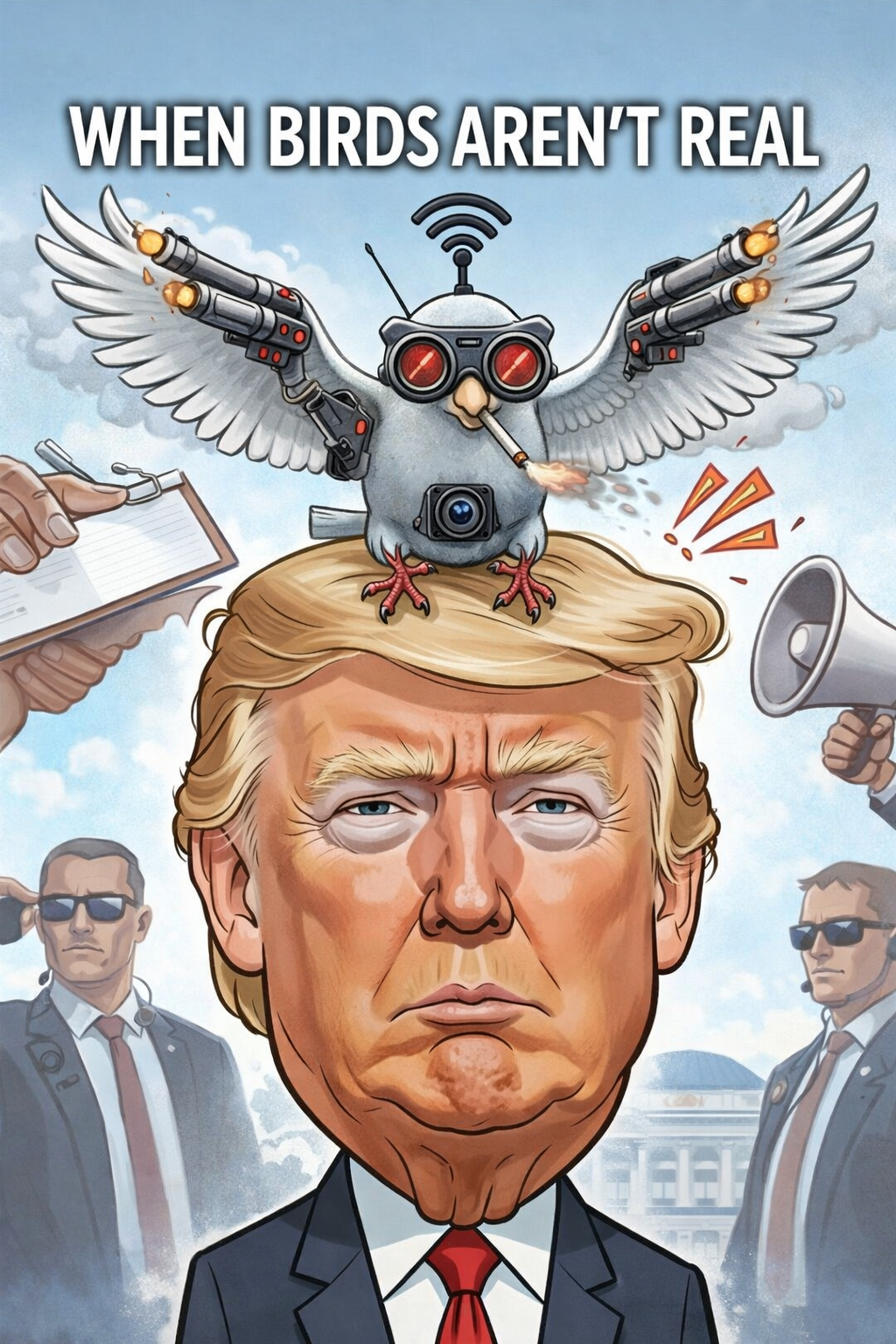
If you want the bridge between “Birds Aren’t Real” and this taboo, it is not content, it is form. A conspiracy meme is a cheap way to enjoy the structure of certainty. It offers an object that can absorb anxiety and distribute it as a story. When real auditing is blocked, the public sphere becomes a marketplace of certainty-objects. Some are playful and self-aware, some are lethal and fanatical. But the engine is the same: people will take a ridiculous certainty if the system refuses to offer adult transparency.
Why is there still no serious public discourse about this? Because it would require crossing two protective veils at once. The first veil is the cult of personality: the politician as a dramatic figure rather than an organism under constraint. The second veil is the dependence of knowledge institutions on the apparatus of power: when a question approaches real testability, the language of impossibility activates immediately. And where “impossibility” rules, one often finds a prohibition.
The lever is technical, not moral. Instead of asking whether a leader is good, we should ask: under what conditions does a decision become irreversible while cognitive capacity is degrading? What automatic blocks exist when risk rises for fixation, grandiosity, paranoid interpretation, impulsive escalation? What mechanisms force decision dispersion when a single person becomes correction-intolerant? This is not an attack on individuals. It is a defense of the world against the romantic fantasy of power without biology.
The deeper irony is that the public is treated as childish while being asked to live with adult consequences. We are told it is inappropriate to speak about thresholds at the top, but it is perfectly acceptable to impose thresholds at the bottom: eligibility thresholds, benefit thresholds, policing thresholds, deportation thresholds, triage thresholds. Power’s body is protected by taboo, while everyone else’s body is governed by rules.
This taboo is fascinating because it shows where modern claims of rationality actually end. They end exactly where power would have to be treated as a system with constraints, rather than a stage for myth. Until that boundary is touched, we will get more Davos spectacles, more rhetorical wars, more procedural theater. And the real problem will remain where it prefers to hide: in fatigue, in pain, in chemistry, in narcissism, and in impunity.
Yochanan