
When Children Inherit the Enemy
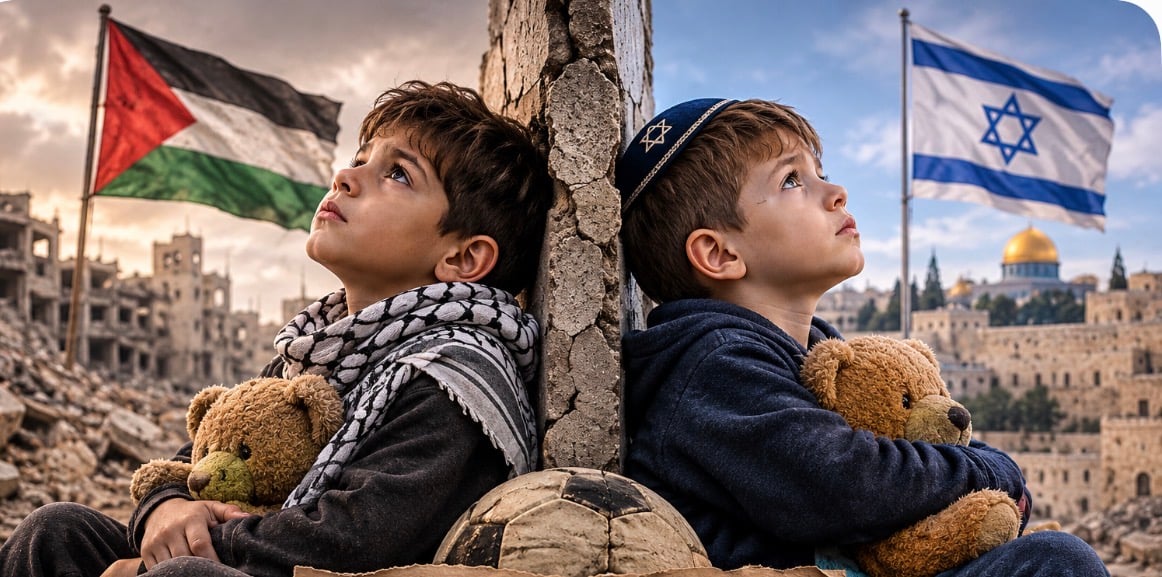
#Read_This_Carefully..
A Palestinian child is born and told:
“This is your land. It has been occupied.”
An Israeli child is born and told:
“This is your land. Others are trying to take it away from you.”
Neither of them chose the narrative.
Neither of them lived the history.
Yet both are expected to defend a memory they did not create.
Imagine two children meeting at a checkpoint.
One carries a schoolbag. The other carries a schoolbag.
Both are tired. Both simply want to go home.
Neither knows anything about the maps over which adults are fighting.
If they were left alone, perhaps they would play with a ball.
But before they even have the chance to know each other, history has already arrived before them,
placing between them borders that no child their age could possibly understand.
This is where the political tragedy lies:
power does not always need to create an enemy;
sometimes it only needs to raise a child to fear one.
For it is not only land that is inherited.
Maps are inherited.
Memory is inherited.
Fear is inherited.
And so is the definition of the enemy.
Then the child grows up believing that what he inherited is an absolute truth,
when part of it may simply be a historical narrative transformed into a political identity.
And so the conflict is no longer merely between one human being and another,
but between two narratives, each seeking to make the other impossible.
That is why the conflict will not end simply because one side defeats the other.
It will end only when both sides understand that recognizing the humanity of the other is not a surrender of one’s own identity.
The Palestinian child does not need to hate the Israeli to be Palestinian.
And the Israeli child does not need to deny the Palestinian to be Israeli.
Perhaps the most painful question is not:
Who does the land belong to?
But:
What if, one day, the two children could look at each other without the history of their fathers arriving before them?
Only then does the real question begin:
Do we want to leave our children a homeland… or an enemy?