

When did I decide I wanted to become a Rabbi?
In 1980, two Dartmouth psychologists, Robert Kleck and Angelo Strenta, set out to answer a question. If you believe there’s something wrong with you, will you see signs of that judgment in an ordinary conversation?
They used theatrical makeup to give college women a large scar on the right cheek. Each woman saw it in a handheld mirror. As she put the mirror down, the researcher said he needed to quickly dab on some moisturizer to keep the makeup from cracking.
They then sat down with another woman and spent six minutes talking about how people make friends. Afterward, the women in the scar group thought their conversation partners seemed more tense. When they watched the recording, they were especially likely to interpret the other woman’s behavior as a reaction to the scar they thought they had
Here’s what they didn’t know. When the researcher said he was putting on moisturizer, he had actually quickly wiped the scar away. Each of these women looked perfectly normal. They just didn’t think they did.
What fascinates me about this experiment is how much the story we tell ourselves about who we are can shape how we see reality. Even how we think someone else sees us.
I read about this experiment in the political context of a people who have been raised since childhood hearing that the defining fact of their lives is that they are an oppressed, robbed people who have been wronged by an “occupying enemy”. When this becomes the narrative of their lives, it’s only natural that victimhood becomes central to the identity by which they see themselves. It becomes the prism through which they see every interaction with those living near them.
But as I read this, I was thinking about the exact opposite reality. What happens when a child grows up hearing a story of purpose and of value? What happens when a child is told that what he does with his life matters?
People often ask me, “When did you decide you wanted to become a Rabbi?”
The honest answer is, never.
There was no moment when I made a conscious decision that this is what I wanted to do with my life. I never had a life-changing epiphany or a miraculous experience that suddenly made me want to devote my life to serving G-d.
As far back as I can remember, serving G-d and helping other Jews discover that same G-d, was how I understood who I was. I saw that sense of purpose in the way my parents lived.
So by the time I was old enough to think about my own future, their sense of purpose had already become my own. My parents measured a meaningful life by how much you cared for others and helped them find G-d. By the time I was old enough to think about my own future, I was already measuring my life by the same barometer.
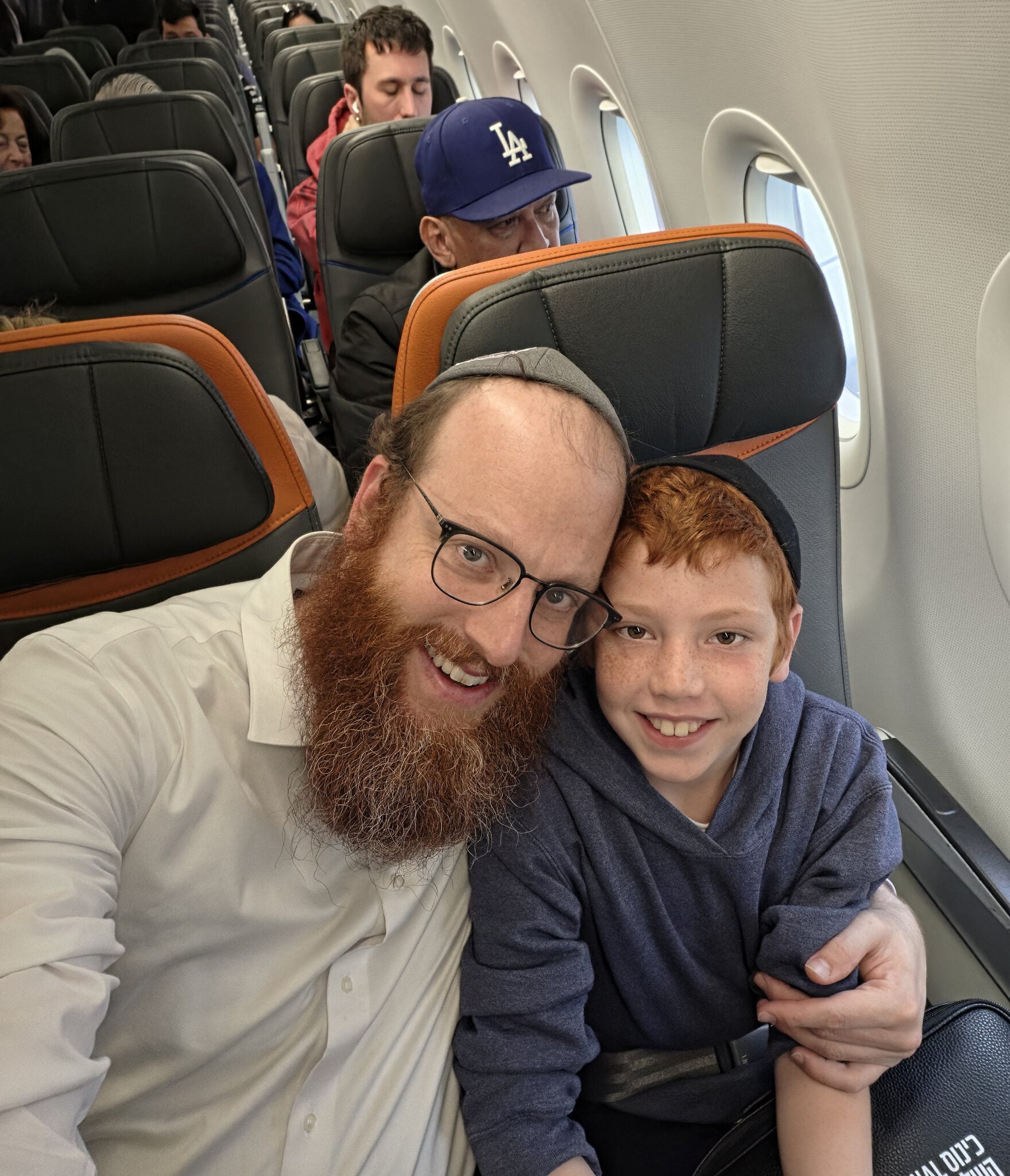
That’s why I brought my son Shaya to the Kinus Hashluchim, the international gathering of Chabad Rabbis this past weekend. While I was attending the adult program, he was at the Tzeirei Hashluchim program for young boys. Personally, it was an added hassle to bring him along, but it was important to me that he internalize the same message I had come to hear.
I wanted him to know that he is a shliach, an emissary of G-d and an Ambassador of Light, with a purpose of his own.
I wanted him to know that even though he’s young, he’s already old enough to make a difference in someone else’s life.
I was thinking about this at one of the most powerful moments of the banquet, when Nosson Schlanger took the stage. Less than a year ago, his father, Rabbi Eli Schlanger, was murdered in the terrorist attack at a Chanukah celebration at Bondi Beach in Sydney. We watched a powerful film about Nosson and his father, and we all cried when we saw his grandfather, Rabbi Yehoram Ulman, come up onstage and embrace him.
It was absolutely breathtaking to watch this 14-year-old boy speaking in front of thousands of people with such remarkable confidence and clarity. But what struck me most was not his bravery in speaking to such a large crowd, but the conviction in his voice when he spoke about his future. He knew he would keep digging the wells his father had dug.
Nosson recalled going with his father to deliver matzah before Passover and noticing how many Jewish homes didn’t have a mezuzah on the door. He decided to put up 120 mezuzahs in honor of the Rebbe’s 120th birthday. He raised the money, and his father went with him from door to door until they reached their goal of 120 Mezuzahs.
Afterward, Nosson heard his father say about him, “He isn’t just the son of a shliach. He is a shliach himself.”
Nosson told us that he hadn’t fully understood what his father meant back then. “Tatty” he said, “I think I understand now.”
This is how a father should educate his child. To make him a part of the “Shlichus” and bring him along to give out Matzah. He inspired in his son a desire to help others, and he empowered his child by supporting him as he pursued that desire.
This is exactly the message I heard growing up, and that’s exactly what I wanted my son Shaya to gain from this weekend trip to NY.
I wanted him to know G-d put him here for a reason. That he has the power to inspire others, and that there are people whose lives could be improved because of what he chooses to do.
I think of Sarah and the home in which she raised Isaac. Before Sarah ever held him in her arms, G-d had promised that His covenant would continue through him.
And so, from the day he was born, he was raised with an understanding that he was the future of the monotheistic beliefs his parents had introduced to humanity. He was raised to understand his own holiness, to appreciate the purity with which he must live, and to recognize the importance of his actions.
The great Isaac became the great Isaac because of the story his mother Sarah told him in the way she raised him. He internalized it in the home she made for him and in what she chose to keep out of that home.
He grew up seeing, in the choices his mother made how seriously she took the responsibility G-d had entrusted to her. From her actions Isaac understood how holy his own life should be, and how important his role in shaping history could be. How much his one life could matter.
My son is growing up in a world changing so fast, none of us can even imagine what our universe will look like by the time he is an adult. One day, Shaya will walk into rooms I’ll never see and face choices I’ll know nothing about.
I can’t prepare him for a world we don’t know.
But what I can give him now is a sense of who he is when he walks into those rooms. Not only can I influence the glasses he will use to see that world, but I can also influence the way he will see his own role and purpose in that world.
I can educate him the way my parents taught me, by how he hears me talk about my own life when something goes wrong, or what he sees me do when helping someone costs me more time than I had planned to give.
Our children learn their story from the one they watch us live.
I hope that one day, my son will see someone who needs help and think, “I can be the one to help.” Maybe that’s when he’ll understand what I wanted him to hear at the Kinus.
That G-d put him here for a reason, and the reason might be the Mitzvah right in front of him.
Good Shabbos!
Rabbi Yankie & Chana Denburg